Editor
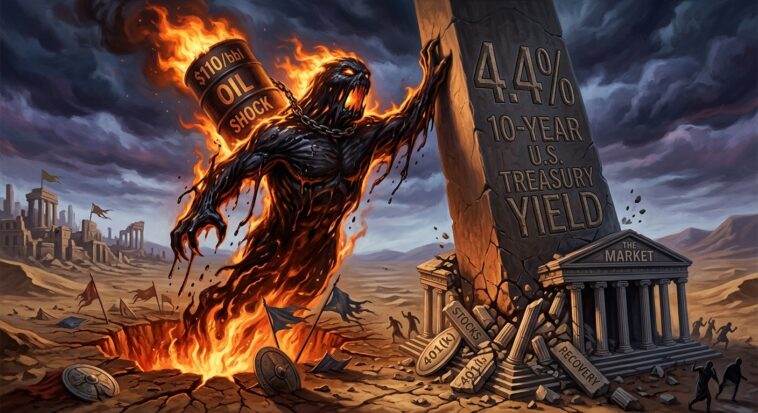
NEW YORK — The 10-year Treasury yield clawed its way back toward a punishing 4.4% on Monday morning, signaling that the weekend’s desperate diplomatic maneuvers have failed to soothe a bleeding bond market. This isn’t just a number on a terminal. It is a siren. A warning that the “geopolitical risk premium” has officially moved from a footnote to the front page. As the conflict in the Middle East enters its fifth week, the logic of the “soft landing” is being set on fire by $110-a-barrel crude oil.
Monday’s trading opened with a familiar, sickly rhythm. The Dow is already down 400 points. The Nasdaq? Sliding further into the red. For five straight weeks, the tape has been a disaster. The culprit is clear. When the benchmark yield hit its Friday peak of 4.48%, it broke something in the psyche of the American investor. We are no longer debating if inflation will stay high. We are debating how much damage it will do on its way up.
The Iran Deadlock and the 10-year Treasury yield
The catalyst for this latest surge isn’t hidden in a spreadsheet. It’s visible at every gas station in the country. With the April 6 “red line” for Iranian energy facilities looming, the market is pricing in a reality that Washington remains too timid to name: stagflation. The University of Michigan’s Consumer Sentiment Index just cratered to 53.3. People are scared. They should be.
“The bond market has stopped believing in the Fed’s 2% fairy tale,” says Marcus Thorne, Head of Macro Strategy at a New York boutique firm. “What we’re seeing is a brutal bear steepening. Investors are demanding a massive premium to hold long-term debt because they see oil staying north of $100 for the foreseeable future. The Fed is effectively boxed in. They can’t cut rates into a supply-side oil shock without incinerating the dollar.”
Thorne isn’t alone. The selling pressure on the long end of the curve has been relentless. When yields rise, tech valuations—built on the promise of future earnings—wither. The “AI revolution” feels like a distant memory when the cost of capital is at a 15-year high.
The Dissent: A Generational Buying Opportunity?
Not everyone on the floor is reaching for the panic button. In the quiet corners of the fixed-income pits, a few contrarians are beginning to sniff around the wreckage. They argue that the current spike is a “head fake” driven by headlines rather than the hard math of labor markets.
“We are reaching a point of maximum exhaustion,” argues Dr. Elena Vance, Senior Fixed-Income Analyst at Sterling Global. “The US consumer is already snapping. If the economy cools as fast as the latest sentiment data suggests, these 4.4% yields will look like a gift by Christmas. We are buying the long end here. This is a classic blow-off top.”
Vance’s view is the lonely one today. Most traders aren’t looking for gifts. They are looking for the nearest exit.
The Investment Tip: Shortening the Leash
For the retail investor, the current move in the 10-year Treasury yield requires a cold-blooded reassessment of what “safety” actually looks like. The traditional 60/40 portfolio is currently a 100/0 catastrophe because both halves are falling in tandem.
The Strategy: Kill the duration. In a market where yields are spiking, long-term bond funds (like the TLT) are radioactive. You lose principal for every tick upward in the interest rate.
The Play: Move into “Cash-Plus” vehicles. Three-month Treasury bills and high-yield money market accounts are the only safe harbor right now. They offer a front-row seat to 4%+ yields without the “price risk” of a long-term bond.
The Equity Hedge: If you must hold stocks, look for “Self-Funded” companies. If a firm needs to tap the bond market to survive, their interest expense is about to explode. Stick with firms that have fortress balance sheets and positive free cash flow.
The Bottom Line
Wall Street stumbles into the final days of March with its eyes fixed on the Persian Gulf. Today’s market action proves that the “wait and see” approach is over. As long as the 10-year Treasury yield hovers near these levels, the gravity well on stocks will only get stronger.
The bond market is the smartest person in the room. Right now, it’s screaming.