Editor
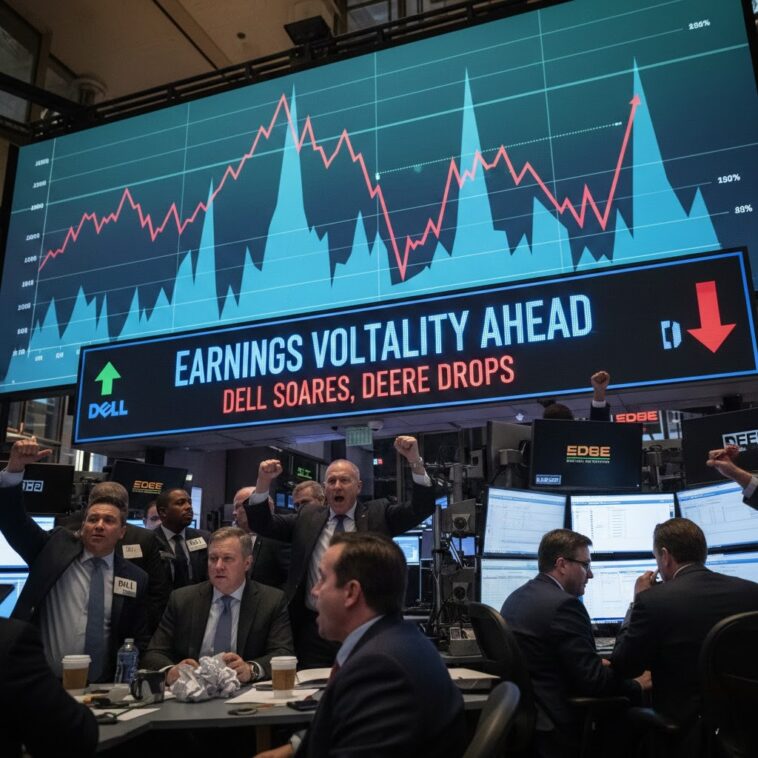
Wall Street is proving to be a particularly unforgiving judge this earnings season, delivering a mixed verdict on the latest round of corporate earnings. Forget just beating the street—it’s now a game of crushing expectations and offering a future guidance so robust it practically guarantees smooth sailing. Otherwise, you’re just dead in the water.
Take Dell Technologies, for instance. Shares surged a blistering 4.5% after the computing giant laid out a fourth-quarter sales forecast of $31.5 billion, utterly blowing past the consensus of $27.59 billion. Why the sudden rush? Simple: The company leaned hard into the hype surrounding generative AI, forecasting a massive jump in sales tied to those next-generation capabilities. That’s the kind of forward-looking narrative the market craves right now.
When Beating Estimates Isn’t Enough
The most peculiar trend, however, is the number of companies whose stocks tumbled despite delivering genuinely good news. It’s a puzzling phenomenon that speaks volumes about investor nervousness and perhaps, a touch of over-optimism already baked into valuations.
Consider farm equipment titan Deere. The company posted solid fiscal fourth-quarter results, with earnings of $3.93 per share on $10.58 billion in revenue, both comfortably exceeding analyst calls. Yet, the stock promptly slid 5%. A similar fate befell data infrastructure stalwart NetApp, which dropped 3% after initially popping, even though its quarterly results and future guidance bested expectations.
“This behavior is indicative of a market that has already priced in perfection, and sometimes more,” explains Sarah Chen, Chief Market Strategist at Vanguardia Capital. “When a company like Deere reports a beat, but the commentary on future agriculture cycles is anything less than euphoric, traders immediately sell the rumor—or, in this case, the slightest deceleration—of future growth. It’s an exercise in ruthlessness.”
Retail and Pharma Find Their Footing
Not every story was one of baffling pessimism. The retail sector, perpetually under siege, managed a surprisingly strong showing. Department store chain Kohl’s, having already soared 43% earlier in the week on an impressive turnaround in same-store sales and a profit beat, climbed nearly another 7%. Urban Outfitters also jumped roughly 12% after its third-quarter profit of $1.28 per share easily topped analyst estimates of $1.20. Apparently, consumers are still spending on apparel, even if the general economic mood feels shaky.
The biopharma space also saw a headline winner. Arrowhead Pharmaceuticals popped 19% after its fiscal year revenue, at $829.4 million, beat the FactSet consensus. Crucially, the company had just announced an FDA approval for a key familial chylomicronemia syndrome medicine. This is a classic case where a tangible, regulatory win—an actual product—carries more weight than a mere revenue adjustment.
The Cloud’s Cracks and Cautionary Tales
On the flip side, the cloud computing sector had a decidedly tough session. Nutanix tumbled a steep 15% after missing revenue expectations and, more critically, slashing its full-year outlook. Even cloud security firm Zscaler, which beat on both top and bottom lines, lost 12% following a surprising operating loss. And spare a thought for PagerDuty, the cloud incident response platform, which shed 23% despite beating on profit; its revenue of $124.5 million just missed the $125 million consensus.
The message is clear: the high-growth, high-multiple world of cloud software is no longer being given a pass on profitability or slowing growth. “The era of funding growth at any cost is over. Investors are now running a much tighter calculus,” says Dr. Ethan Cross, a technology analyst at Meridian Securities. “If your model suggests even a mild revenue hiccup, or if you can’t articulate a clear path to material operating profit, they are going to crush you. Workday and Ambarella both learned that lesson the hard way this week.”
Looking ahead, this extreme volatility suggests that simply reviewing corporate earnings statements is insufficient. Investors must now scrutinize the nuances of the balance sheet, the explicit language of executive guidance, and the macro-economic narrative surrounding each company. The market has shifted from buying potential to buying provable execution, and that trend is likely to intensify through the new year.