Editor
Treasury Yields Explode to One-Year High as New Fed Chair Faces Rate Hike Nightmare
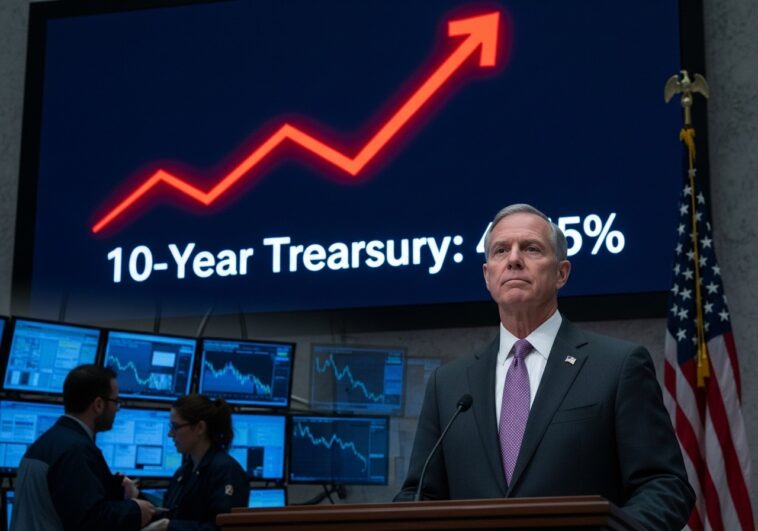
Treasury yields spiked Friday morning, with the 10-year note jumping nine basis points to 4.55%—the highest level in a year—just as Kevin Warsh prepares to take control of the Federal Reserve from outgoing Chairman Jerome Powell. Talk about inheriting a mess. CNBC
Markets stumbled. Hard. The S&P 500 shed 1%, while the Nasdaq Composite lost 1.4%, erasing Thursday’s record-setting rally in a single session. The tech sector—which has powered this market to absurd heights—suddenly looks fragile. Nvidia dropped 4%, Intel retreated 6%, while Advanced Micro Devices and Micron Technology lost around 5% each. 24/7 Wall St.24/7 Wall St.
Rate hike odds for 2026 have surged to 45%, according to the CME FedWatch Tool. Just one month ago? Those same odds sat at 1%. That’s not a shift. That’s a tectonic rupture in market expectations. CNBC
“The welcome wagon hasn’t rolled up yet for Kevin Warsh,” says Derek Harrison, Chief Strategist at Blackstone River Advisors in Boston. “He’s walking into a Federal Reserve facing twin nightmares: inflation that won’t die and a market addicted to easy money. The honeymoon phase? Cancelled before it started.”
Why Treasury Yields Matter More Than You Think
When bond yields spike like this, it’s not academic theory—it’s your wallet screaming. Higher yields mean higher borrowing costs for mortgages, car loans, and corporate debt. They mean growth stocks—the tech darlings that have dominated your 401(k) gains—become less attractive because future profits are worth less when discounted at higher rates.
President Trump’s China summit wrapped up with the president touting “fantastic” trade deals, though no major agreements or breakthroughs were announced. The market’s reaction? Disappointment. Investors wanted concrete progress on ending the Iran conflict, reopening the Strait of Hormuz, and bringing oil prices down from triple digits. They got photo ops instead. TheStreet
Oil prices rose Friday after Trump said China has agreed to purchase oil from America, with West Texas Intermediate advancing 1.55% to $102.74 per barrel. That’s great for Texas energy producers. Terrible for inflation hawks. 24/7 Wall St.
The Semiconductor Bubble Nobody Wants to Admit
Here’s the uncomfortable truth Wall Street won’t say out loud: The PHLX Semiconductor Index has surged 143% over the past year, while the S&P 500 Equal Weight Index is up just 15%. Even more alarming? The SOX now trades 32% above its 50-day moving average—one of the widest premiums in history. CNBCCNBC
“The group has witnessed an extremely unsustainable move in recent weeks and remains vulnerable to profit taking regardless of the headlines,” wrote Adam Crisafulli of Vital Knowledge. Translation: this rally has gone parabolic, and gravity still exists.
Cerebras Systems, which surged 68% Thursday in its Nasdaq debut, shed 4% Friday. The AI chipmaker commanded a near-$100 billion valuation on roughly $500 million in annual revenue. That’s a 130x sales multiple—the kind of number that makes even dot-com veterans wince. 24/7 Wall St.
The Contrarian View: Why One Analyst Says Buy the Dip
Not everyone’s running for shelter. Patricia Montgomery, Senior Portfolio Manager at Summit Peak Capital in Denver, sees Friday’s selloff as a gift. “These yield spikes are temporary panic,” she argues. “Manufacturing data crushed expectations—the Empire State Manufacturing index leaped to 19.6, the highest level since April 2022. That’s economic strength, not weakness.” 24/7 Wall St.
Montgomery’s prescription? Stick with quality tech names that have pricing power and genuine earnings growth. “Nvidia’s up 15% this month because it’s printing money, not because of momentum games,” she says. “When yields stabilize in two weeks and everyone realizes Warsh isn’t hiking in June, those same sellers will scramble back in at higher prices.”
Maybe she’s right. Or maybe we’re watching the exact moment when concentration risk becomes catastrophic and the everything-AI trade implodes.
What You Should Do Right Now
First, understand that a new Fed Chair changes nothing about underlying fundamentals. Warsh inherits inflation above 3.5%, oil above $100, and geopolitical chaos that shows no signs of resolution. His toolkit is identical to Powell’s: raise rates or hold steady. That’s it.
Second, reassess tech exposure. When seven stocks explain the entire year’s market gains and those seven stocks trade at nosebleed valuations while yields spike to one-year highs, concentration becomes catastrophe waiting to happen.
Third, consider rotating into sectors that benefit from higher yields. Financials enjoy wider net interest margins. Value stocks with strong cash flows become relatively more attractive. Dividend aristocrats that have compounded for decades suddenly look less boring.
The bond market just fired a warning shot. Yields don’t spike like this unless something fundamental changed. Kevin Warsh’s first day running the Federal Reserve might be remembered as the day the music stopped.