Editor
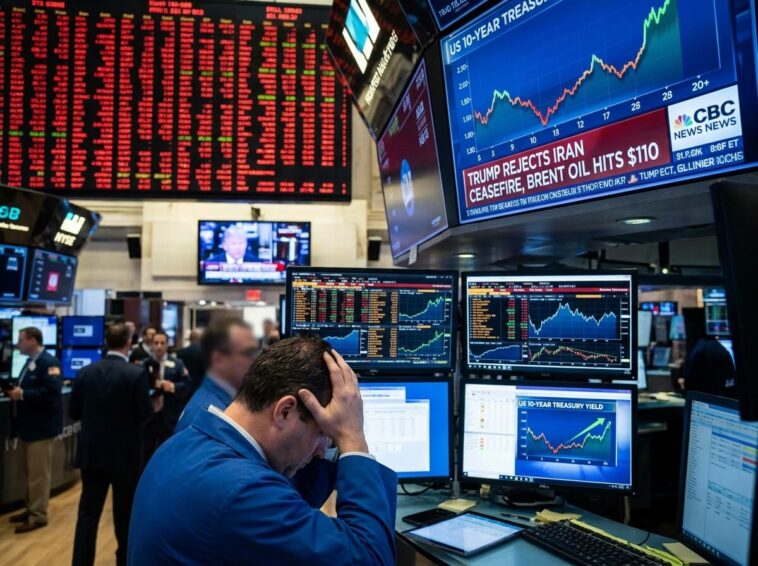
Trump Rejected Iran’s Ceasefire Offer. Oil Is Back Near $110, and Stocks Just Gave Back Friday’s Gains.
The Iran ceasefire rejected late Friday is now the dominant story on Wall Street, and Monday’s open made the cost plain. President Trump turned down Tehran’s seven-day ceasefire proposal. The Wall Street Journal reported he has told aides he expects to resume bombing Iran after the November midterms.
Brent crude jumped back toward $110 a barrel. It touched roughly $109 at the high. Treasury yields climbed again. The S&P 500 was down about 0.8% by midday, the Dow off roughly 0.7%, the Nasdaq off nearly 0.9%.
Friday’s rally? Gone. Erased in a single morning.
Why the Iran Ceasefire Rejection Hits Markets Through Oil and Yields
Last week’s whole story was oil cooling, yields easing, and Wall Street sitting within touching distance of record highs on tech strength. The Dow closed Friday up 478.64 points at 51,828.62. The S&P 500 finished at 7,743.41. The Nasdaq climbed 2% on the week, and the tech sector gained 3.6%.
That relief rested on one assumption: the supply shock was fading. Monday knocked it out.
“Friday’s rally was built on the idea that a deal was close enough to lean on,” said Marcus Thorne, Head of Macro Strategy at a New York boutique advisory firm. “Rejecting the ceasefire in public, and reportedly planning to hold off any resumption of strikes until after the midterms, tells markets this stays unresolved for weeks, maybe months. That’s the wrong kind of uncertainty. It keeps a war premium in crude and keeps bond traders demanding more yield, and both of those hit the stocks that had just rebounded.”
The yield backdrop is what makes this worse than an ordinary oil scare. The Fed hiked earlier this month and signaled more could follow. Wednesday’s 10-year touch of 5.12% set a 2007 high. Monday’s jump in yields lands on top of all that, at the start of a week packed with economic data.
Even so, the picture isn’t uniform. Kyle Rodda of Capital.com noted last week that Friday’s gains leaned on energy-sensitive, cyclical sectors, and one market note pointed out that some crude has been trickling out of the Persian Gulf as Iran struggles to maintain control of the strait. That suggests the physical supply shock may be less acute than it was at the war’s start, even as prices spike on headlines.
Corporate news pulled in different directions. Nvidia rose roughly 2% to 3% after announcing a $150 billion increase to its share buyback authorization, lifting total remaining capacity to $235 billion, along with a new AI agent safety platform. MongoDB dropped about 20% after Meta hired its CEO to lead an enterprise AI platform. Zscaler fell about 10%. Bank stocks slid on worries that AI could raise deposit costs. SpaceX’s Starship reached orbit on its first attempt, and the shares ticked up.
The Skeptic Who Says the Selloff Is Overdone
Not every strategist thinks Monday’s drop signals something lasting.
“We’ve seen this movie all year. Oil spikes on a ceasefire headline, stocks drop for a session or two, and then the physical data undercuts the panic,” said Elena Voss, senior equity strategist at a Chicago research shop. “If crude is trickling out of the Gulf and the market is already pricing a less acute shock than in the spring, a knee-jerk run toward $110 looks like positioning, not supply destruction. Nvidia is up on a record buyback while the indexes sag. That’s not a market in panic. That’s a market repricing risk and still willing to pay for AI.”
Voss’s argument has a data point behind it. The S&P 500 sits only a couple of percent below its August record of 7,816.70, and the VIX closed Friday near 14.87, a calm reading that hasn’t yet spiked on Monday’s news.
What This Means for Your Portfolio
Here’s the practical takeaway from a Monday that reversed a full week’s progress in a few hours.
A rejected ceasefire keeps two pressure points alive at once: oil-driven inflation and rate-hike risk. That combination punishes the same corners of the market every time, long-duration growth stocks, small caps, and anything sensitive to borrowing costs. It also rewards energy and defensive names, which is why last week’s rotation looked the way it did.
For retail investors, the discipline is to avoid trading the headline itself. Look at what you own and ask how much of it depends on cheaper money. If the answer is most of it, this week’s data deserves close attention. Watch Brent’s behavior through Tuesday. If crude holds near $110 as the week’s data lands, the case for another rate hike strengthens. If it retreats the way earlier spikes did, Voss’s read wins out. Keep position sizes modest until one of those two stories is confirmed, because this year has shown again and again that a single geopolitical headline can undo a week of gains before lunch.