Editor
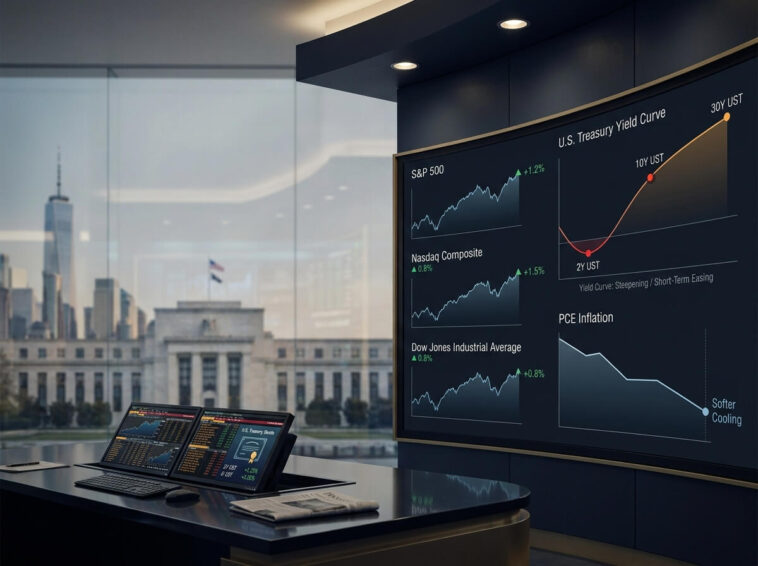
The U.S. stock market rallied Wednesday after softer-than-expected August PCE inflation gave investors a fresh reason to believe the Federal Reserve may not raise interest rates at its October meeting.
The move was immediate. Tech led.
By midday, the Nasdaq Composite was up about 1.1%, while the S&P 500 gained roughly 0.6%. The Dow was nearly flat. The catalyst was not another blockbuster earnings report. It was a number buried in the Commerce Department’s inflation release: headline PCE prices rose 3.4% from a year earlier in August, below the 3.7% forecast in a Reuters poll. Monthly PCE increased 0.3%, versus 0.4% expected. Core PCE rose 0.2% for the month and 3.0% from a year earlier.
That was enough to jolt rate expectations.
CME-linked market pricing showed the perceived chance of a 25-basis-point Fed hike at the Oct. 27-28 meeting falling to roughly 35% after the report, from 51.5% before the data. A day earlier, it had been around 70%.
But Wall Street is not suddenly declaring victory over inflation.
Why the U.S. Stock Market Cares About PCE Inflation
PCE matters because it is the Federal Reserve’s preferred inflation measure. The Fed’s target is 2%, so today’s 3.4% headline and 3.0% core readings remain well above policymakers’ goal.
There is also a wrinkle in the latest report. The Bureau of Economic Analysis changed the methodology for several PCE components and revised historical inflation data. Reuters reported that those changes helped pull earlier inflation readings lower. The improvement is real, but it is another reason not to treat one release as the end of the inflation story.
Steve Wyett, chief investment strategist at BOK Financial, said the PCE report was “under a microscope” as markets tried to judge how aggressive the Fed would need to be with future rate increases.
The bigger story is the collision between cooler inflation and stubborn economic strength.
Second-quarter U.S. GDP was revised sharply higher to a 2.2% annualized rate, from 1.5% previously. Consumer spending was revised to a 3.8% growth rate for the quarter. For August alone, personal consumption expenditures surged 0.9%.
That matters for the Fed.
A central bank can tolerate some inflation if demand is breaking. It has less room to relax when households are still spending and businesses are investing heavily. Reuters reported that equipment investment maintained double-digit growth, with AI-related infrastructure spending a notable driver.
In other words: inflation cooled. The economy did not.
That is the tension running through U.S. markets.
Treasury Yields Are Sending a Different Signal
There is a second market investors need to watch: Treasurys.
On Tuesday, the benchmark 10-year Treasury yield climbed to about 5.28%, near its highest level since 2007. The 30-year yield reached its highest level since 2002. The two-year yield, which is more sensitive to expected Fed policy, was around 4.89%.
The result is a pronounced positive spread between short- and long-term yields. The curve is steepening as investors demand more compensation for holding long-duration debt.
That signal matters. Long-term yields reflect more than the Fed’s next meeting. They also absorb expectations for future inflation, economic growth, government borrowing and the premium investors demand for duration.
Right now, the bond market is demanding plenty of that compensation.
Tuesday’s trading made the split clear. Two-year yields eased after New York Fed President John Williams said there was “no need for urgency” to raise rates again, while longer maturities stayed elevated.
That helps explain why Wednesday’s stock rally needs context.
Growth stocks tend to benefit when traders expect the Fed to be less aggressive. But those same shares remain sensitive to long-term yields because their valuations depend heavily on profits expected years into the future. If the 10-year yield remains around 5% or higher, the valuation math becomes less forgiving.
The Counter-Narrative: Inflation Could Still Force the Fed’s Hand
There is a credible argument against the bullish reading of today’s numbers.
Sal Guatieri, senior economist at BMO Capital Markets, said the softer report may give the Fed time to wait, but “still-elevated inflation and a resilient consumer” could point to another rate hike later this year.
That is the market’s other voice.
Core inflation at 3.0% is still far from the Fed’s 2% target. Energy prices remain a risk. And if consumer spending stays strong while businesses keep pouring money into AI infrastructure, demand could keep price pressures sticky.
Then there is the bond market itself. A 30-year yield at a multi-decade high is hardly the signal of a market convinced inflation has been defeated.
The stock market is leaning toward patience. The bond market is asking tougher questions.
What Retail Investors Can Take From the Yield Curve
The practical lesson is simple: watch rates, not just headlines.
When the short end of the Treasury curve falls because traders expect fewer Fed hikes, high-growth stocks can catch a bid. But if long-term yields refuse to fall, the benefit can be limited.
For retail investors, that means paying attention to interest-rate sensitivity inside a portfolio. High-duration growth shares, long-maturity bonds and heavily leveraged companies can all feel pressure when long-term borrowing costs stay high.
A practical way to reduce that exposure is to avoid making the entire portfolio a bet on falling rates. Shorter-duration Treasury securities and cash-like instruments provide a different return profile with less sensitivity to large moves in long-term bond prices. On the equity side, investors can examine cash generation and debt levels rather than buying solely because a cooler inflation number pushed the Nasdaq higher.
No heroics required.
Wednesday’s rally is a reminder that markets move on expectations. The PCE report changed the expected path of the Fed. It did not settle the inflation debate.
For now, the U.S. economy is giving policymakers a difficult combination: inflation is easing, demand remains alive, the Fed has room to wait, and long-term yields are still painfully high.
That is not a clean risk-on signal.
It is a market on watch.