Editor
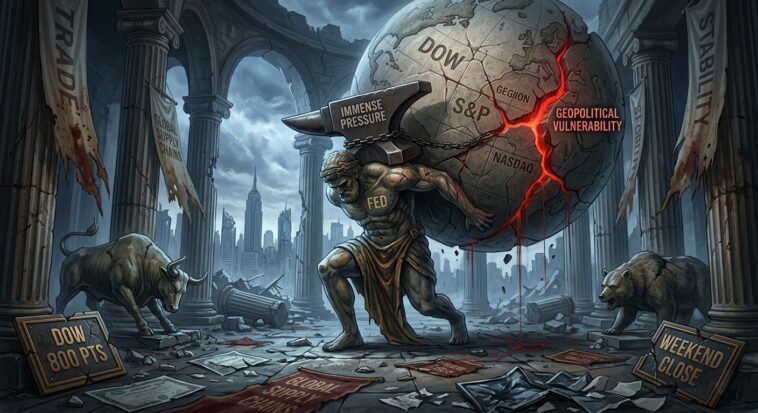
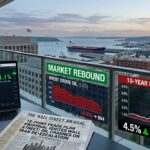
NEW YORK — The trap door finally swung open on Friday. Wall Street’s resilience, already frayed by a month of geopolitical posturing, snapped as the Dow Jones Industrial Average plunged 793 points. It was a bloodbath. With that drop, the blue-chip index officially entered a market correction, closing more than 10% below its February record. This wasn’t a “dip.” It was a reckoning.
For five straight weeks, investors have watched their portfolios bleed. It is the longest losing streak in nearly four years. While early-week trading saw a few “hope trades” based on President Trump’s extended April 6 deadline for Iran, those hopes died a quiet death on the vine yesterday. The tape tells a story of fear. Pure, unadulterated fear.
The S&P 500 fell 1.7%, and the Nasdaq composite—already in its own correction—sank another 2.1%. Big Tech is no longer a sanctuary. When Brent crude oil is screaming past $110 a barrel, the “AI revolution” takes a backseat to the price of a gallon of gas.
The Sentiment Shock and the Market Correction
The morning’s catalyst wasn’t just the headlines from the Persian Gulf. It was the American consumer. The University of Michigan’s Consumer Sentiment Index for March dropped to 53.3, a 6% plunge that caught analysts off guard. People are feeling the pinch. Inflation expectations for the year ahead surged from 3.4% to 3.8%—the largest one-month jump in nearly a year.
When the consumer retreats, the “soft landing” narrative goes into the shredder.
“The market is finally realizing that the Fed doesn’t have a ‘pause’ button; they have a ‘stuck’ button,” says Marcus Thorne, Head of Macro Strategy at a New York boutique firm. “You cannot have a sustained recovery when energy costs are up 40% and consumer sentiment is at a three-month low. Today’s market correction is the first time the equity market is pricing in a real-deal energy shock. The Fed is effectively boxed in. If they cut rates now, they pour gasoline on the inflation fire.”
The Dissent: A Panic-Driven Overreaction?
Not everyone in the pits is waving the white flag. On the floor of the NYSE, some veterans see this as a classic “capitulation” moment—the kind of extreme fear that often precedes a bottom.
“We are seeing a total liquidation of ‘weak hands’ right now,” argues Dr. Elena Vance, Senior Fixed-Income Analyst at Sterling Global. “Yes, oil is a problem. Yes, the Iran deadline is a massive wildcard. But the US economy is still adding jobs. This isn’t 2008 or 2020. This is a valuation reset. If you have a three-year horizon, you should be salivating at these levels. The herd is running, and that’s usually when the smart money starts shopping.”
Vance’s perspective is the minority view. Most traders spent Friday afternoon just trying to keep their heads above water.
The Investment Tip: Watch the Yield Curve
For the retail investor, the most dangerous move right now is trying to “catch the falling knife” in tech stocks. The math is simple but brutal: as long as the 10-year Treasury yield hovers near 4.5%, growth valuations will stay compressed.
The Strategy: Focus on the “Yield Curve Steepener.” Historically, when the curve begins to “un-invert” under stress, it’s a signal to move into defensive, high-quality assets.
The Play: Prioritize short-duration Treasuries. You can get nearly 5% on a 6-month T-bill with zero price risk. That is your “anchor” while the market correction plays out.
The Equity Hedge: If you must stay in stocks, pivot to “low-beta” consumer staples. Think companies that sell what people need, not what they want. When gas hits $5.00, people stop buying lattes, but they don’t stop buying toothpaste.
The April 6 Countdown
The clock is ticking. We are now nine days away from the President’s deadline. If the Strait of Hormuz remains a chokepoint and the drone strikes resume, Friday’s 800-point drop might look like a warm-up act.
The weekend will be a long one for anyone with a 401(k). The bond market is screaming, the oil market is surging, and the Dow is officially in a hole. Wall Street is no longer betting on a miracle. It’s betting on a storm.