Editor
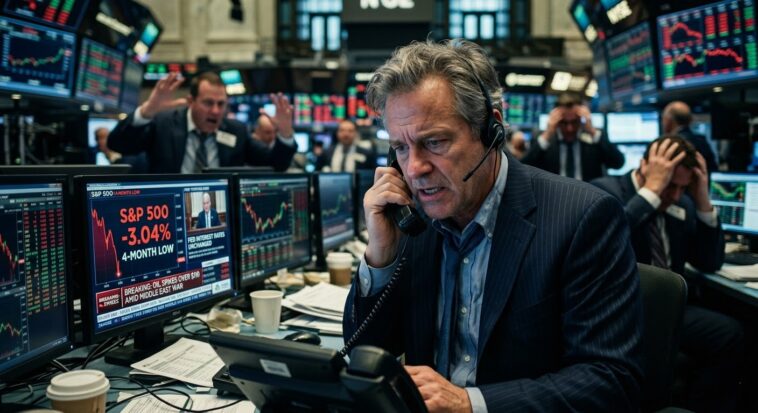
The decision on Fed interest rates Wednesday did more than just pause a hiking cycle; it sucked the oxygen out of the room for equity bulls. By Friday morning, the fallout was absolute. Wall Street is now staring down its lowest levels in four months, with the S&P 500 slipping to 6,606 and the Dow Jones Industrial Average shedding over 200 points in a single, gut-wrenching session. The culprit isn’t just a stubborn central bank. It’s a perfect storm of soaring energy costs and a Treasury market that has finally stopped believing in a soft landing.
The Fed’s move? Predictable, yet jarring.
While Chair Jerome Powell kept the benchmark rate at a 3.5% to 3.75% range, the fine print in the Summary of Economic Projections was a “kick in the teeth” for those expecting relief. The central bank hiked its 2026 inflation forecast to 2.7%, up from a previous 2.4% estimate. Why? Crude oil. With Brent futures flirting with $119 a barrel following intensified strikes on Iranian energy infrastructure, the “transitory” narrative has been buried in the backyard.
Fed Interest Rates and the End of the “Easy Money” Dream
The market’s reaction highlights a massive shift in psychology. For months, traders bet on a sequence of cuts to grease the wheels of growth. Those bets are being cashed in for pennies on the dollar. “The Fed is trapped in a pincer movement,” says Marcus Thorne, Head of Macro Strategy at a New York boutique firm. “They have a mandate to keep prices stable, but they can’t shoot down missiles in the Strait of Hormuz. If energy stays this high, the next move for rates might actually be up, not down. That’s the ghost currently haunting the trading floor.”
Yields on the 10-year U.S. Treasury note spiked to 4.32%, a level not seen since the conflict began. When yields climb, tech valuations shrivel. It’s a math problem that Silicon Valley can’t disrupt. The Nasdaq Composite took the brunt of it, sliding 0.3% as Micron Technology tumbled nearly 4% on guidance that suggested the AI-led hardware boom might finally be hitting a cost-of-capital ceiling.
The Tech Drag and Smuggling Scandals
It wasn’t just macro pressure weighing on the tape. Internal rot in the tech sector added weight. Super Micro Computer saw its stock price crater by 25% after federal authorities leveled charges against executives involving the smuggling of high-end Nvidia chips to sanctioned regions. In a jittery market, scandal acts like an accelerant.
However, there is a loud, if lonely, counter-narrative emerging from the debris. While most of the street is pricing in a stagflationary slog, some veterans believe the panic is overcooked. They argue that the U.S. consumer, supported by a still-tight labor market—initial jobless claims actually fell to 205,000 this week—can absorb the energy shock.
Elena Rodriguez, Chief Equity Strategist at WestPier Capital, is one of the few voices calling for calm. “We’ve seen this movie before,” Rodriguez notes. “Markets overreact to energy spikes because they’re visible at every gas station. But the Philadelphia Fed Index just hit a 2026 high. Industrial activity is actually accelerating. If the war de-escalates by summer, the Fed will have a massive amount of dry powder to cut rates into a strengthening economy.”
The Retail Investor’s Playbook
For the average retail investor, the current volatility is a reminder that the “TINA” (There Is No Alternative) era for stocks is officially dead. With Fed interest rates staying high, “cash” is no longer trash—it’s a high-yield competitor to risky equities.
The practical tip? Look at the yield curve. With the 10-year yield surging, the spread between short-term “safe” money and long-term equity risk is narrowing. If you are sitting on a portfolio heavy in high-multiple tech, the move isn’t necessarily to sell everything, but to rebalance into short-duration Treasury bills or “defensive” energy producers that profit from the very volatility killing the rest of the market.
The Fed has made its bed. Now, investors have to sleep in it. The era of cheap money is in the rearview mirror, and the road ahead is paved with expensive oil and a central bank that has run out of easy answers.
Bracing for the PCE Print: A Litmus Test for Fed Interest Rates
The next big reveal comes April 9. That’s when the Bureau of Economic Analysis drops the February Personal Consumption Expenditures (PCE) report. For those tracking Fed interest rates, this isn’t just another data point. It’s the final verdict on whether January’s “sticky” inflation was a fluke or a trend. Markets are currently pricing in a headline PCE jump toward 3.5%. If that number hits, the “higher for longer” mantra won’t just be a warning; it’ll be a mandate.
The January report showed a deceptive calm. Core inflation sat at 3.06%, but that was before the missiles flew. Now, the lag is catching up. Fuel surcharges are bleeding into shipping costs. Groceries are getting pricier. The Fed’s preferred gauge is about to feel the heat of $119 oil.
“We are looking at a delayed-action fuse,” says Silas Vane, Chief Economist at a Chicago-based trading desk. “The January PCE didn’t reflect the Iran shock. February will show the first cracks, and March will be a crater. If the Fed sees core services accelerating alongside energy, any talk of a June cut is dead on arrival. You don’t put out a fire by lowering the water pressure.”
The “Silent” Service Sector Inflation
While oil grabs the headlines, the real danger is under the hood. Service sector inflation—everything from haircuts to hospital stays—hit 3.5% in the last reading. This is the “sticky” stuff. It doesn’t fluctuate with the price of a barrel. It moves with wages. And with unemployment holding at 4.3%, workers still have the leverage to demand more.
This creates a “double-whammy” for the Fed. They can’t control the war-driven energy spike. They can try to crush service demand. But doing so requires keeping Fed interest rates high enough to trigger real pain in the labor market. It’s a brutal trade-off.
The counter-narrative? Some, like Rodriguez, argue the Fed is actually looking for an excuse to ignore the energy spike. They point to the “base effect”—the idea that since inflation was so high last year, the year-over-year comparisons will naturally look better by summer. It’s a gamble. If they wait too long and inflation expectations “unanchor,” they’ll have to hike again.
The trading floor is already voting. The shift into short-duration bonds suggests the pros are bunkering down. They expect a “hot” PCE print to force the Fed’s hand. For the retail crowd, the message is clear: the volatility isn’t a glitch. It’s the new operating system.