Editor
NEW YORK — The “April Fool’s” joke on Wall Street this morning wasn’t funny. It was expensive.
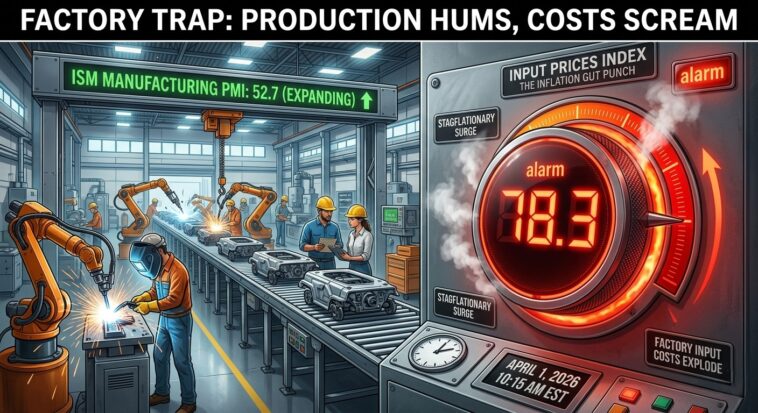
Just as traders were beginning to buy into the “de-escalation” headlines regarding President Trump’s Iran deadline, the Institute for Supply Management (ISM) dropped a reality check that felt more like a lead pipe. The March Manufacturing PMI registered at 52.7%. On the surface? Good news. It marks the third consecutive month of expansion for the American industrial core. But look under the hood. The engine is smoking.
The prices index—the metric that tracks what factories pay for raw materials—exploded to 78.3. That is the highest reading since the dark days of mid-2022. It is a staggering leap that confirms what every driver at a gas station already knows: the “energy tax” from the Middle East conflict is now hard-coded into the U.S. economy.
The tape didn’t lie. Even with a pre-market “hope trade” pushing futures higher on rumors of a naval ceasefire, the S&P 500 gave up its gains within minutes of the 10:00 AM release. You can’t ignore a 78.3 price print. Not when the Fed is already looking for reasons to keep rates at 15-year highs.
The Stagflationary Squeeze and the Manufacturing PMI
This is the classic stagflationary setup. Activity is expanding, sure, but the cost of that activity is rising faster than the output. New orders are at 53.5, but supplier deliveries are slowing to a crawl. The Strait of Hormuz remains a chokepoint. Container delays are no longer a risk; they are a daily operational reality for every plant manager from Ohio to Arizona.
“The headline number is a trap,” says Marcus Thorne, Head of Macro Strategy at a New York boutique firm. “If you only look at the 52.7, you think the ‘soft landing’ is back on. You’re wrong. The internal price surge is a gut punch to the Fed’s 2% target. Powell can’t pivot into a price spike like this. The 10-year yield is staying glued to 4.4% because the bond market knows this isn’t transitory. It’s a supply-side war shock.”
Thorne’s grit reflects a growing consensus in the pits. When manufacturing costs spike this sharply, they don’t stay at the factory gate. They move to the retail shelf. Fast.
The Counter-Narrative: An Inventory Rebound?
Not everyone is ready to call for a recessionary winter. On the floor of the CME, some believe the price spike is a “one-off” inventory squeeze rather than a permanent trend shift.
“We are seeing a massive restocking cycle meet a temporary geopolitical bottleneck,” argues Silas Vane, Chief Credit Officer at a Chicago-based distressed debt fund. “Companies are panic-buying raw materials because of the April 6 deadline. Once that risk clears—and the President’s latest comments suggest it will—those price indices will crater. I’m not selling tech here. I’m buying the industrial players who have the pricing power to pass these costs through.”
Vane’s optimism is a lonely island. Most traders spent the morning repositioning for a “higher-for-longer” reality that just got a second wind.
The Investment Tip: Yield is the Only Shield
For the retail investor, the March Manufacturing PMI data suggests that the “easy money” from the 2025 tech rally is over. The volatility isn’t going away.
The Strategy: Defensive Duration. As long as the Prices Index is at 78.3, long-term bonds are a losing hand. You are fighting a losing battle against inflation.
The Play: Move into “Hard Asset” equities. Look for mid-stream energy companies and domestic materials providers. These firms benefit from the price surge rather than being crushed by it. If they own the copper or the oil, they set the price.
The Cash Hedge: With the 2-year Treasury yield screaming back toward 4.7%, the risk-free rate is your best friend. Why chase 2% dividends in a volatile market when you can get 4.5% in a money market fund while the world figures out its energy problems?
The April 6 Countdown
We are five days away from the deadline. The Tuesday “hope rally” was built on a tweet and a prayer. Today’s ISM data was built on actual invoices and factory orders. The invoices won.
The bond market is the smartest person in the room. Right now, it’s not listening to the politicians. It’s listening to the supply chain. And the supply chain is saying that the cost of doing business just went through the roof.