Editor
Wall Street saw a flurry of activity Tuesday as several market movers dictated the pace of trade, led by a staggering trillion-dollar projection from Silicon Valley and a renewed appetite for air travel. While the broader indices showed resilience, the day was not without its casualties, as heavyweight names in the pharmaceutical and industrial sectors grappled with downgrades and Middle Eastern instability.
Nvidia’s Trillion-Dollar Ambition
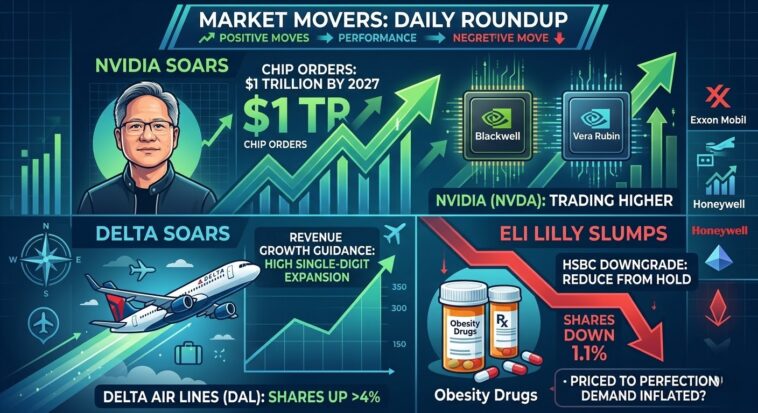
The narrative of the day belonged, once again, to Nvidia. Shares of the chipmaking titan edged higher following comments from CEO Jensen Huang that effectively recalibrated the scale of the AI revolution. Huang signaled that orders for the company’s next-generation Blackwell and Vera Rubin chips are expected to hit a cumulative $14 trillion through 2027.
“We aren’t just looking at a cycle; we’re looking at the complete rebuilding of the global computing stack,” said Marcus Thorne, lead technology analyst at Arcus Research. “When Jensen talks about a trillion dollars in orders, he’s no longer just selling hardware—he’s selling the infrastructure of the next century. The market is still trying to figure out how to price that kind of dominance.”
Delta Takes Flight on Revenue Revamp
Airlines were a bright spot in early trading, with Delta Air Lines leading the charge. Shares climbed more than 4% after the carrier aggressively hiked its first-quarter revenue guidance. Delta now anticipates high single-digit expansion, a notable jump from its previous, more conservative forecast of 5% to 7%.
The upgrade suggests that despite lingering inflation concerns, the American consumer’s “revenge travel” phase hasn’t yet hit its expiration date.
Energy Tensions and the Strait of Hormuz
In the commodities space, energy stocks followed crude prices on a steady march upward. The movement comes as skepticism grows among traders regarding a U.S.-backed plan to escort tankers through the volatile Strait of Hormuz.
Exxon Mobil and Occidental Petroleum both posted gains of over 1%, while the Energy Select Sector SPDR ETF (XLE) shadowed that rise. The market appears to be pricing in a “risk premium” that refuses to dissipate, as the logistics of protecting global oil arteries remain murky at best.
A Reality Check for Eli Lilly
It wasn’t all green on the screens. Eli Lilly felt the sting of a rare downgrade, sliding 1.1% after HSBC moved the stock from “hold” to “reduce.” Analysts at the bank didn’t mince words, suggesting the frenzy surrounding obesity drugs may have finally reached a ceiling.
“We think Lilly shares are priced to perfection,” the HSBC note read, citing discomfort with working capital trends and suggesting that medium-term earnings expectations have become perhaps too “optimistic.” It is a sobering reminder that even the darlings of the pharmaceutical world aren’t immune to the gravity of valuation.
Middle East Disruptions Hit Honeywell
Honeywell International faced a tougher session, dropping 1.5%. CEO Vimal Kapur warned that ongoing conflict in the Middle East could shave “high-single digits” off first-quarter revenue, primarily due to shipping bottlenecks.
However, Kapur was quick to characterize the hit as “transitory,” maintaining that the company’s 2026 outlook remains intact. It’s a classic corporate tightrope walk: acknowledging the immediate pain of geopolitics while trying to keep long-term investors from hitting the exit.
Uber’s Robotic Pivot
Finally, Uber shares jumped 3% on news that the company is doubling down on its autonomous future. By 2027, San Francisco and Los Angeles residents may find themselves hailed by robotaxis powered by Nvidia’s self-driving software.
“Uber is trying to solve the labor cost equation once and for all,” noted Sarah Jenkins, a senior transportation strategist. “By tethering themselves to Nvidia’s stack, they are betting that the software is finally ready for the chaos of city streets. If they can scale to 28 cities by 2028 as planned, the business model shifts from a platform of humans to a platform of pure infrastructure.”