Editor
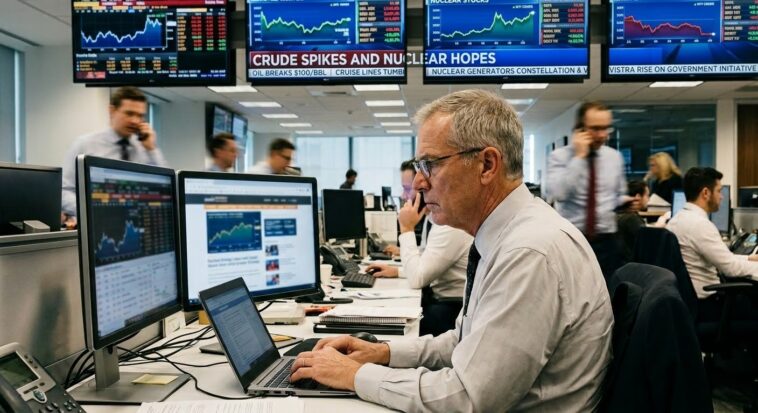
Market volatility gripped Wall Street on Thursday as a toxic mix of surging energy costs and cautious corporate outlooks sent traders scrambling to recalibrate their portfolios. From the cruise docks of Miami to the high-tech corridors of Silicon Valley, the day’s price action served as a stark reminder that the post-pandemic “easy money” era has been replaced by a much grittier reality.
While the broader indices struggled to find a footing, the narrative under the surface was one of stark contrasts: a “flight to quality” in energy, a brutal reckoning for growth-at-any-cost tech, and a surprising tailwind for the pet industry.
Energy Crossroads: Nuclear Gains as Oil Hits Triple Digits
The most immediate shock to the system came from the energy sector. With crude oil breaching the $100-per-barrel mark, the ripple effects were felt instantly at sea. Cruise giants Royal Caribbean and Carnival saw their valuations sink by 5% and 6%, respectively.
“When oil hits triple digits, the math for leisure travel gets ugly fast,” says Marcus Thorne, a senior energy analyst at Global Capital Insight. “Fuel isn’t just a line item for these guys; it’s the anchor dragging down their recovery.”
Conversely, the Department of Energy’s latest push to leverage existing nuclear infrastructure provided a localized “green rush.” Constellation Energy and Vistra, both heavy hitters in the nuclear space, bucked the downward trend, gaining 2% as investors bet on a future where the atom—not the oil barrel—dictates the grid’s stability.
E-Commerce and Tech: The Margin Squeeze
The darling of Latin American e-commerce, Mercado Libre, found itself in the crosshairs of a JPMorgan downgrade. The bank moved the stock to ‘neutral,’ slashing its price target to $2,100. The rationale? A “lower for longer” margin environment that suggests the company’s period of hyper-growth may be hitting a ceiling of stiff competition.
In the software space, the story was even bleaker. Netskope cratered 22% after issuing guidance that missed the mark, proving that in a high-interest-rate environment, “almost meeting expectations” isn’t enough to satisfy a jumpy market. UiPath followed suit, dropping 7% after its outlook failed to ignite any optimism among the belt-tightening crowd.
Winners in the Chaos: Pets, Rockets, and Dating
It wasn’t all red on the screens, however. Petco Health and Wellness provided the day’s biggest surprise, surging nearly 30%. The company hinted at a return to sales growth, defying a consensus that had expected a decline.
“Americans might be skipping their own vacations, but they aren’t skipping the premium kibble,” observed Elena Rodriguez, a retail strategist. “Pet care remains one of the few truly ‘recess-proof’ corners of the consumer discretionary world.”
Other notable outliers included:
Bumble: Popped 36% on a massive earnings beat, proving the “loneliness economy” remains a powerhouse.
Firefly Aerospace: Shot up 20% following the successful launch of its Alpha Flight 7 rocket.
Fertilizer Stocks: CF Industries and Intrepid Potash surged over 13% as geopolitical tensions in the Strait of Hormuz threatened global food supply chains.
The Private Credit Cracks
Perhaps the most concerning signal for the long-term health of the financial system came from the private credit sector. Blue Owl, Blackstone, and Apollo all saw significant retreats after Morgan Stanley and Cliffwater moved to cap withdrawals from their multibillion-dollar funds.
This “gating” of funds suggests a liquidity crunch is brewing. When investors can’t get their money out, they tend to sell what they can—often leading to the very market volatility we witnessed today.
Looking Ahead
As we head into the final trading sessions of the week, all eyes remain on the Strait of Hormuz and the Federal Reserve. If oil remains above $100, the pressure on consumer-facing stocks like Dollar General (which slid 5% on weak guidance) will only intensify. The market is currently in a “show me” phase; investors are no longer buying on potential—they are buying on proven resilience.