Editor
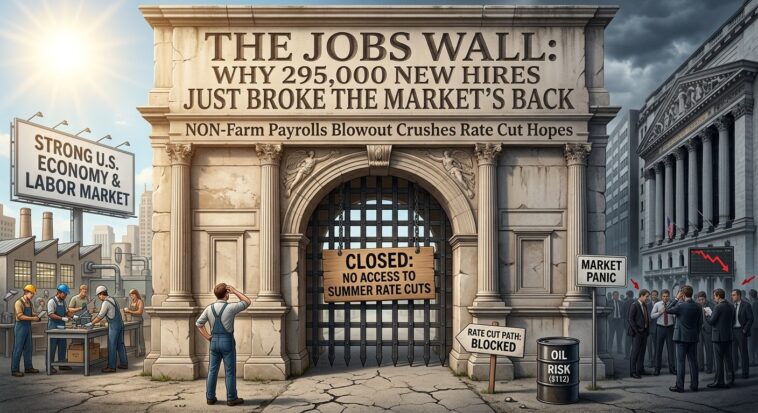
The Jobs Wall: Why 295,000 New Hires Just Broke the Market’s Back
NEW YORK — The March non-farm payrolls report just landed like a hand grenade on the floor of the New York Stock Exchange, vaporizing any lingering hope for a summer rate cut.
The numbers were staggering. According to the Bureau of Labor Statistics, the U.S. economy added 295,000 jobs last month. Wall Street expected 210,000. It wasn’t even close. A blowout. Too big for the Fed to ignore. The unemployment rate ticked down to 3.7%, while average hourly earnings rose 0.4%—a hot print that suggests the wage-price spiral is far from over.
The market reaction was swift and violent. S&P 500 futures plummeted 1.2% in the minutes following the 8:30 AM release. The 10-year Treasury yield, which has been flirting with disaster all week, shot up to 4.58%. It is a bloodbath in the bond pits. Investors are finally accepting a grim reality: the “soft landing” is being replaced by a “no landing” scenario where interest rates stay high enough to choke off growth.
The Fed’s Dilemma and the Non-Farm Payrolls Shadow
Jerome Powell is officially pinned. For months, the Federal Reserve has looked for an excuse to pivot. They wanted to see the labor market cool. They wanted a sign that the 5.25%–5.50% range was actually biting. Today, they got the opposite.
The strength in the non-farm payrolls proves that the American consumer is still bulletproof. But in this inverted economy, a strong consumer is a liability for the stock market. With the April 6 Iran deadline just 72 hours away and oil prices screaming past $112, the Fed cannot afford to let the economy run this hot. If they cut rates now, they invite a 1970s-style inflation second wave.
“The labor market is a runaway freight train,” says Marcus Thorne, Head of Macro Strategy at a New York boutique firm. “You can’t talk down inflation when you’re adding nearly 300,000 jobs a month and wages are accelerating. The Fed’s move? Predictable, yet jarring. They are going to have to hold rates at these levels through the end of the year, if not higher. The market was priced for a fantasy. Today, reality checked in.”
Thorne’s sentiment is echoed across the bulge-bracket banks. The “higher for longer” mantra isn’t just a threat anymore; it’s the base case.
The Dissent: A Mirage of Part-Time Growth?
Not everyone is convinced that the jobs report is a sign of a healthy expansion. On the floor of the CME, a few veteran traders are pointing to the “household survey” as a counter-narrative.
“If you look past the headline 295,000, the quality of these jobs is suspect,” argues Dr. Elena Vance, Senior Fixed-Income Analyst at Sterling Global. “We are seeing a massive shift toward part-time work and government-subsidized sectors. Full-time employment actually stalled. The Fed is reacting to a lagging indicator that is being propped up by people taking second jobs to pay for $5.00 gas. This isn’t an ‘explosive’ economy; it’s a desperate one. Powell risks breaking the back of the middle class if he stays this hawkish based on noisy data.”
Vance is in the minority, but her point stands: the divergence between the headline “Establishment Survey” and the “Household Survey” is wider than it’s been in years.
The Investment Tip: The Yield Curve ‘Barbell’
For the retail investor, the spike in yields following the jobs data is a signal to stop chasing “growth at any price.” As the 10-year Treasury yield climbs, the “discount rate” on future earnings goes up. That’s poison for high-multiple tech stocks like Nvidia or Tesla.
The Strategy: The Barbell Play The yield curve remains deeply inverted, but it is starting to “bear steepen.” This is a dangerous phase for stocks.
The Front End: Keep 40% of your dry powder in 3-month T-bills. They are yielding nearly 5.4% with zero price risk. You are being paid to wait for the geopolitical smoke to clear.
The Defensive End: Put 60% into “Fortress Balance Sheets.” Look for companies that generate massive free cash flow and don’t need to borrow. If a company has to roll over debt at these new 4.6% yields, their margins will evaporate.
The Hedge: Stay long on energy. As long as the labor market stays this tight and the Middle East remains a powder keg, $100 oil is the floor, not the ceiling.
The Long Weekend
Monday is the deadline. The Iran-Israel tension is the elephant in the room that no jobs report can overshadow. If we get a military escalation over the weekend, Friday’s job beat will be a distant memory.
The tape is telling you to be cautious. The bond market is telling you to be afraid. Wall Street is no longer betting on a miracle. It’s betting on a storm.