Editor
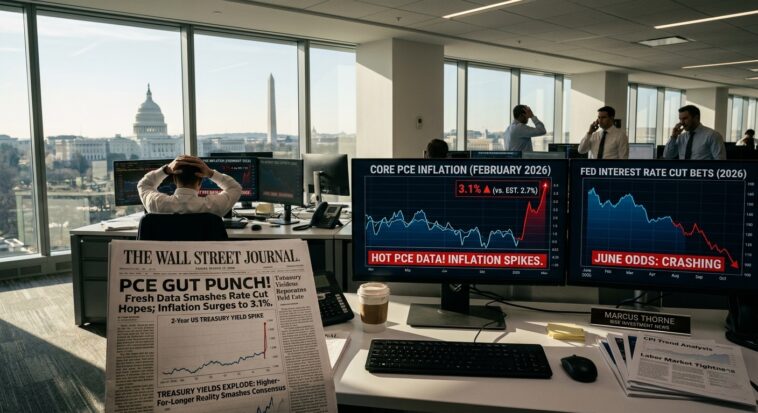
NEW YORK — Wall Street’s long-standing bets on imminent Fed interest rate cuts just collided with a wall of sticky reality.
For months, the narrative driving the U.S. stock market rally was simple, almost elegant: inflation was conquered, and the Federal Reserve would spend 2026 normalizing rates. It was a comfortable lie. Friday morning’s Personal Consumption Expenditures (PCE) data—the Fed’s absolute favorite inflation gauge—just exposed it.
The numbers were, in a word, hot. Core PCE, which strips out the volatile food and energy components, stripped out market illusions too. It rose 0.4% in February, pushing the annual rate back up to 3.1%. The consensus estimate was 2.7%.
The market reaction was swift. Violent, even.
Bond Market Carnage: Higher for Real
The immediate fallout was visible in the U.S. Treasury market. The policy-sensitive 2-year yield, which trades on near-term Fed expectations, screamed higher, kissing 4.6% after starting the week near 4.2%. The benchmark 10-year yield wasn’t far behind, surging past 4.4%.
This isn’t just noise. It’s capital capitulating. It’s the sound of traders realizing they were wrong. The premise that inflation would effortlessly glide down to the Fed’s 2% target has been incinerated.
“The immaculate disinflation narrative just checked into rehab,” said Marcus Thorne, Head of Macro Strategy at a New York boutique firm. “Powell missed his window to declare victory. Now, the Fed is boxed in. They can’t cut into a re-accelerating inflation print without destroying whatever credibility they have left. The soft landing just got a lot harder.”
The equity market, which had been priced for perfection, naturally stumbled. The Nasdaq, the poster child for duration risk, bore the brunt. When risk-free yields rise, long-dated growth stock valuations get squeezed. Gravity is back.
What Sticky Inflation Means for Fed Interest Rate Cuts
The implications for Fed interest rate cuts are profound. Going into today, the futures market was stubbornly pricing in three cuts for 2026, starting in June. Those odds are now in freefall. June is effectively off the table. July is a coin flip.
The “higher-for-longer” mantra isn’t just a threat anymore; it’s the base case. The Fed is now forced to prioritize inflation fighting over growth preservation, a dangerous game when the yield curve has been inverted for a record duration, signaling recessionary pressures.
Connecting this macro trend to practical strategy is where retail investors need to focus. The surge in bond yields means the “income” part of fixed income is finally real. You don’t need to chase dividend yield in the volatile stock market when you can lock in 5%-plus on short-term U.S. Treasuries without the equity risk.
The retail tip? Stop expecting the Fed to bail out high-multiple growth stocks. Stop fighting the Fed. Instead, look at front-end yields. Six-month and one-year Treasury bills are now yielding substantially more than the S&P 500’s earnings yield. That’s a massive hurdle rate for equities. For a conservative portfolio, parking cash in T-bills is no longer a holding pattern; it’s a viable investment strategy.
The Lonely Bull in the Room
Not everyone is ready to tear up the playbook, though. There is always a counter-narrative, however lonely.
Sarah Jenkins, Chief Investment Officer at a mid-tier asset manager, argues that today’s PCE print is a “last gasp” of lag effects.
“You have to look at the shelter component,” Jenkins insisted. “It’s still artificially propping up the number due to the way it’s calculated. Real-time private data shows rents are flat-to-down nationwide. The Fed knows this. Today is a buying opportunity for quality tech, because the disinflationary trend is delayed, not denied.”
It’s a gutsy call. But right now, the broad market isn’t listening.
The Fed is trapped. They’re staring at a labor market that is too tight and an inflation rate that is too stubborn. Today’s PCE data was a moment of clarity for the market. It was a painful, expensive realization that the 2026 narrative didn’t just change; it was utterly wrong.