Editor
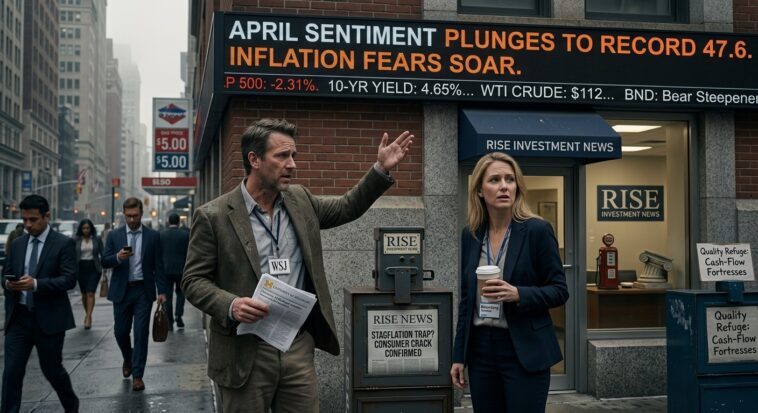
The Consumer Crack: Why Record-Low Sentiment Just Ended the ‘Soft Landing’
NEW YORK — Stagflation is the only word echoing through the canyons of lower Manhattan this Friday, as a brutal double-header of economic data effectively broke the back of the “soft landing” narrative.
The morning started with a wince and ended with a full-blown shudder. First, the March Consumer Price Index (CPI) confirmed that inflation has clawed its way back to 3.4%, fueled by the unrelenting energy tax at the Strait of Hormuz. But the real knockout blow landed at 10:00 AM. The University of Michigan’s preliminary consumer sentiment index for April plummeted to 47.6.
It is the lowest reading in the history of the survey. Lower than the 2008 financial crisis. Lower than the 1980 inflation peak. The American consumer, who has spent the last year defying gravity, has finally looked down. They don’t like what they see.
The Anatomy of a Stagflation Trap
The data tells a story of a pincer movement. On one side, 1-year inflation expectations have surged to 4.8%. On the other, the “Current Conditions” sub-index is cratering. Households are being squeezed by $5.00 gasoline and a 10-year Treasury yield that touched 4.65% earlier today.
This is the classic definition of a stagflation trap: rising prices meeting falling confidence. In this environment, the Federal Reserve’s playbook is useless. If Jerome Powell cuts rates to save the consumer, he risks hyper-inflating an energy-starved economy. If he holds steady, he watches the backbone of the U.S. GDP—consumer spending—snap in real-time.
“We have reached the limits of consumer resilience,” says Marcus Thorne, Head of Macro Strategy at a New York boutique firm. “You can’t keep telling people the economy is strong when it costs $100 to fill a SUV and 8% to finance it. The U-Mich print is a cry for help. The Fed’s move? Non-existent. They are boxed in by the geopolitical reality of $112 oil. The market is finally realized that ‘higher for longer’ isn’t just a policy—it’s a sentence.”
The bond market is already pricing in the pain. The yield curve remains deeply inverted, a jagged reminder that a recession is no longer a “risk”—it is the baseline.
The Dissent: A ‘Geopolitical Head-Fake’?
Not everyone on the floor is ready to start hoarding gold and canned goods. Amid the sea of red screens, a small contingent of “Growth Bulls” is arguing that the sentiment crash is a lagging indicator of a panic that has already peaked.
“Sentiment is a feeling, not a fact,” argues Silas Vane, Chief Credit Officer at a Chicago-based distressed debt fund. “The headlines are terrifying because of the Hormuz deadline, but look at the payrolls. We added 295,000 jobs last month. People are miserable because the news is bad, but they are still employed. This isn’t 1979. We have a digital economy that can pivot. Once the 45-day ceasefire in the Gulf is signed—and it will be—oil will drop $20 in a week. This sentiment print is the ‘bottom’ of the fear cycle. It’s a buy signal, not a funeral.”
Vane’s take is bold. It is also, currently, very lonely. Most traders spent Friday afternoon liquidating consumer discretionary stocks and moving into “Quality” shelters.
The Investment Tip: The ‘Quality’ Lifeboat
For the retail investor, the Friday data dump is a signal to stop playing “catch-up” with speculative tech and start building a fortress. In a stagflation environment, cash flow is the only currency that matters.
The Strategy: The “Cash-Flow Fortress.”
The Play: Pivot to “Quality” equities. These are companies with high profit margins, low debt, and “inelastic” demand. Think healthcare, staples, and regulated utilities. If the consumer is cutting back, they’ll cancel Netflix before they cancel their heart medication.
The Debt Hedge: Keep your bond duration short. As long as inflation expectations are rising (now at 4.8% for the 1-year), long-term bonds are a value trap. Stay in 3-to-6 month T-bills. They are yielding nearly 5.5% and offer a safe harbor while the geopolitical storm rages.
The ‘Hormuz’ Insurance: Hold a 5% position in domestic energy or gold. If the ceasefire Vane is betting on doesn’t materialize by Monday, $130 oil becomes the new reality.
The Weekend Watch
The tape is closed, but the risk remains open. All eyes now shift back to the Persian Gulf. The U-Mich report has shown us the consumer is at the breaking point. A single spark in the Strait of Hormuz this weekend could turn this “crack” into a canyon.
The bond market is the smartest person in the room. Right now, it’s not just whispering. It’s screaming.