Editor
Trump’s Hormuz Blockade Sends Oil Past $104 — And Every Retail Investor Should Be Paying Attention
The Strait of Hormuz oil price surge that slammed global markets Monday morning wasn’t a slow burn. It was a detonation.
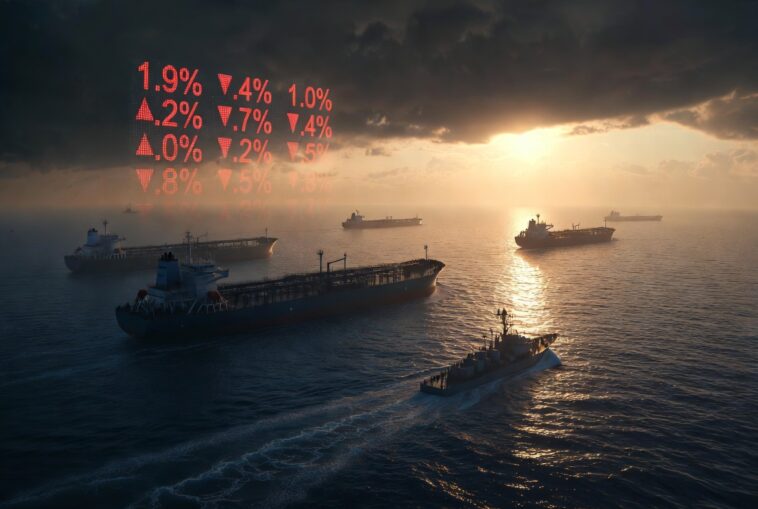
After weekend peace talks collapsed, President Donald Trump announced that the U.S. Navy would begin blockading ships entering or leaving the Strait of Hormuz. The geopolitical shockwave was immediate. West Texas Intermediate crude exploded 8.14% to $104.40 per barrel. Brent crude wasn’t far behind, climbing 7.43% to $102.30. Oil above $100 again. Just like that.
Vice President JD Vance departed Islamabad without a deal, with Iranian officials refusing to halt their nuclear ambitions while Tehran reportedly demanded control of the strait, war reparations, and access to frozen assets. Diplomacy, in short, is dead — at least for now.
The Strait of Hormuz Oil Price Surge and What’s Underneath It
Here’s what the headline numbers won’t tell you.
The effective closure of this critical shipping route has driven energy prices sharply higher and heightened inflation risks, reinforcing market expectations that central banks may delay rate cuts — or even tighten policy further. Read that again. Rate cuts? Off the table. That’s the part that should chill every investor sitting on rate-sensitive assets right now.
“This isn’t just an energy story,” said Marcus Thorne, Head of Macro Strategy at Meridian Capital Advisors in New York. “When Hormuz sneezes, the Fed catches a cold. You’ve got supply-chain inflation baked back into the equation at exactly the moment policymakers were hoping to exhale. The bond market is repricing in real time.”
Thorne has a point. Energy-driven inflation — the kind that comes from choked supply routes rather than overheated demand — is the Fed’s worst nightmare. It’s stagflationary. It raises prices without growing the economy. Jerome Powell has no clean lever to pull here.
The S&P 500 traded up about 0.4% and the Nasdaq gained 0.7% by midday Monday, as investors held onto thin hopes that a deal could eventually be reached. Thin hope. That’s the operative phrase.
Technology offered the market its scaffolding on Monday — Oracle and Palantir Technologies rose 10% and 4% respectively — while Goldman Sachs was a notable drag, slipping roughly 2% despite a strong earnings beat. The Goldman story is worth noting. Record equities revenue. Missed FICC targets. A market that punishes anything with a whiff of macro sensitivity. Even a blowout quarter couldn’t save it.
The Counter-Narrative: Don’t Panic Yet
Not everyone is reaching for the exits.
Diana Voss, Chief Investment Strategist at Lakeshore Global Partners in Chicago, argues the market’s relative resilience today signals something important. “Investors have been living with Hormuz risk since January,” she told Rise Investment News. “The blockade announcement is dramatic, but the market had already priced in a significant risk premium on oil. The real danger is if this drags into Q3 — that’s when you see genuine earnings revisions.”
Voss makes a fair point. The S&P 500 managed back-to-back weekly gains above 3% last week, the first time that’s happened since October 2022. This market has been punched before. It keeps getting up.
Still. $104 oil has a way of wearing people down slowly.
What This Means for Your Money — Right Now
Let’s be direct. Here’s a practical framework for retail investors watching this unfold:
Energy stocks just became a short-term hedge, not a long-term bet. With WTI pushing toward $105 and Brent above $103, U.S. energy producers with domestic-heavy operations are the clearest beneficiaries. Names like ExxonMobil, ConocoPhillips, and Devon Energy are worth a look — but treat them as a geopolitical hedge, not a value play. Blockades end. Negotiations restart. Oil prices snap back.
Watch the 10-year Treasury yield. If inflation expectations ratchet higher on the back of $100+ oil, the 10-year will push toward 4.7–4.9%. That hammers growth stocks and long-duration bonds simultaneously. If you’re overweight tech or holding long-dated bond funds, today is a day to reassess your exposure.
Avoid panic-selling broad index funds. The S&P 500’s mild green close today tells you the market isn’t collapsing. It’s recalibrating. Volatility isn’t the same as catastrophe.
Bank Earnings Week Adds Another Layer
This isn’t happening in a vacuum. The first-quarter earnings season kicks off this week, with results due from Goldman Sachs, JPMorgan Chase, Citigroup, Wells Fargo, Morgan Stanley, and Bank of America. Every one of those reports will be filtered through the lens of $104 oil and whatever happens in the next 48 hours in the Strait.
Goldman’s already reported. Net revenue jumped 14% to $17.23 billion and EPS of $17.55 beat expectations — but a sluggish fixed income desk missed analyst targets by nearly $850 million. The market’s lukewarm reaction says everything about where sentiment sits today.
The rest of the banks report Tuesday through Thursday. Watch the loan loss provision language closely. If executives start talking about “geopolitical uncertainty” in their forward guidance — and they will — that’s the tell. Not the earnings headline. The guidance.
One thing is certain this Monday: the Strait of Hormuz just became the most important body of water on Wall Street’s radar. What the Navy does next matters as much as what Jerome Powell says next.
Maybe more.
Disclaimer: This article is for informational purposes only and does not constitute financial advice. Always conduct your own due diligence before making investment decisions.