Editor
The Tuesday Ultimatum: Wall Street Paralyzed by the Hormuz Clock
NEW YORK — The Strait of Hormuz is currently the only ticker that matters on Wall Street, and it is flashing red.
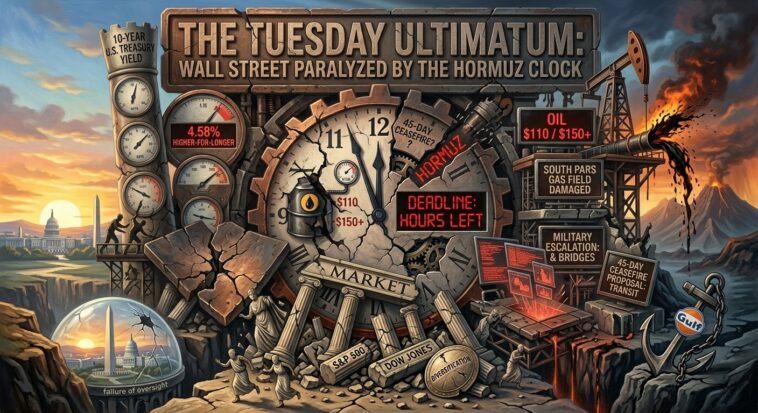
The clock is officially the enemy. President Trump’s deadline for Tehran to reopen the world’s most vital energy artery expires tonight. Washington time. The threat? Blunt. “Tuesday will be Power Plant Day and Bridge Day,” the President posted yesterday. It wasn’t a metaphor. It was a target list. As the final hours of the “10-day extension” bleed away, the S&P 500 is stuck in a 10-point range, held hostage by a binary outcome that could either ignite a regional war or yield a miraculous 45-day ceasefire.
Oil is the ghost in the machine. WTI crude hovered at $110.14 per barrel this morning, down slightly on whispers of a Pakistani-mediated deal, but still up 60% since the February 28 opening shots. The market is exhausted. Traders are no longer betting on earnings or innovation; they are betting on whether a protocol to “monitor transit” in the Gulf actually exists or if it’s just diplomatic smoke.
The Fed’s Trap and the Strait of Hormuz While the headlines focus on fighter jets, the real casualty is the American bond market. The 10-year Treasury yield is currently pinned at 4.58%. It is a grim reflection of a “no-landing” scenario. Last Friday’s blowout jobs report—295,000 new hires—was supposed to be the week’s biggest story. The Strait of Hormuz effectively buried it.
The Federal Reserve is now in a box with no exits. If Trump pulls the trigger on Iranian infrastructure tonight, oil doesn’t just stay at $110. It gaps to $150. That is an inflation bomb that no amount of rate hikes can defuse. Powell is watching a decade of “price stability” evaporate in real-time, fueled by a supply-side shock that the central bank is powerless to fight.
“We are looking at a classic geopolitical squeeze,” says Marcus Thorne, Head of Macro Strategy at a New York boutique firm. “The bond market is telling you that the ‘inflation genie’ is out of the bottle. Even if a ceasefire is signed tomorrow, the damage to the infrastructure in the South Pars gas field is done. You can’t just flip a switch and bring that capacity back. The yield curve is inverted because it knows a crash is coming, but the labor market is so tight that the Fed has to keep hiking into the storm. It’s a mess.”
The Counter-Narrative: The ‘Head-Fake’ Ceasefire
Not everyone is buying the “doom and gloom” Tuesday scenario. In the quiet corners of the currency desks, some see the current tension as the ultimate “buy the rumor” opportunity.
“This is the art of the deal playing out at a trillion-dollar scale,” argues Sarah Jenkins, a senior geopolitical strategist at a Tier-1 London bank. “The 45-day ceasefire proposal isn’t a long shot; it’s the only way both sides save face. Iran’s economy is buckling under the Mahshahr strikes. They need to sell oil. Trump needs gas prices under $4 before the summer driving season. I’m not selling my energy holdings, but I am buying the ‘recovery’ names in transport and tech. If the Strait opens tomorrow, you’re going to see a 4% relief rally in a single session. The downside is already priced in; the upside is a coiled spring.”
Jenkins represents a slim margin of optimism. Most of the floor spent Monday afternoon moving to cash or defensive “hard asset” positions.
The Investment Tip: The ‘Ceasefire Call’ vs. The ‘War Hedge’
For the retail investor, the “Tuesday Ultimatum” is a reminder that diversification is dead in a war zone. When the Strait of Hormuz closes, all correlations go to one.
The Strategy: The Geopolitical Straddle.
The Play: If you are heavy on tech, you are essentially shorting the Middle East. If war escalates, your “growth” stocks will buckle under the weight of a 5% 10-year yield.
The Hedge: Tactical Energy. Look at domestic U.S. shale producers that are unaffected by the Persian Gulf. They are your only real shield. If the Tuesday strikes happen, these stocks are your lifeboat.
The Exit: If a 45-day ceasefire is announced, sell your oil hedges immediately. The “war premium” will evaporate $15 off a barrel of crude in forty-eight hours.
The Final Hour
Tonight is the night. The diplomats are in Oman. The carriers are in the Arabian Sea. And the algorithms are waiting for a single tweet or a Reuters flash to determine the next 500 points of the Dow.
The market hates uncertainty. Tonight, it gets an answer. Whether it’s the sound of a ceasefire pen or the roar of a Tomahawk missile, the period of “tentative moves” is over.
Keep your eyes on the yields. They never lie, even when the politicians do.