Editor
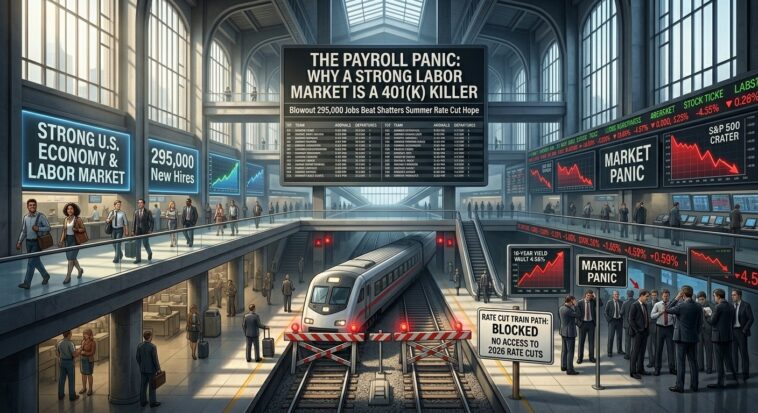
The Payroll Panic: Why a Strong Labor Market is a 401(k) Killer
NEW YORK — The wage-price spiral is no longer a ghost story told by central bankers; it is the lead story on every trading desk in Manhattan this Saturday morning.
Yesterday’s March non-farm payrolls report was a gut punch. The Bureau of Labor Statistics reported 295,000 new hires. Wall Street expected 210,000. It wasn’t just a beat; it was a blowout. In a vacuum, more people working is a triumph. In the high-stakes poker game of 2026 macroeconomics, it is a disaster. It tells Federal Reserve Chairman Jerome Powell that his interest rate hikes haven’t finished the job. The economy is still running too hot.
The tape told the story immediately. S&P 500 futures cratered, while the 10-year Treasury yield—the benchmark for global credit—vaulted to 4.58%. If you’re looking for a summer rate cut, keep looking. That dream died on the vine Friday at 8:30 AM.
The Anatomy of the Wage-Price Spiral
The danger isn’t just the hiring. It’s the paychecks. Average hourly earnings jumped 0.4% last month. When you combine $112-a-barrel crude oil with rising wages, you get a feedback loop that is nearly impossible to break without a recession.
“The Fed is staring at a two-front war,” says Marcus Thorne, Head of Macro Strategy at a New York boutique firm. “On one side, you have a geopolitical oil shock that is driving up the cost of every physical good. On the other, you have a labor market so tight that employers are forced to hike wages to keep the lights on. It’s a classic wage-price spiral. The market was priced for a pivot. Today, reality checked in. Powell can’t cut rates into this kind of heat without incinerating the dollar.”
Thorne isn’t being dramatic. The yield curve has been screaming recession for months, yet the labor data refuses to cooperate. This disconnect is the “no landing” scenario that keeps fund managers awake at night. If the economy doesn’t slow down, rates don’t come down. And if rates don’t come down, the valuations for tech giants like Nvidia and Apple start to look like a house of cards.
The Dissent: A Laggard’s Mirage?
Not everyone is ready to wave the white flag on the 2026 recovery. In the quiet research labs of the fixed-income pits, a few contrarians are beginning to question the quality of the data.
“We are seeing a massive divergence between the headline ‘Establishment Survey’ and the ‘Household Survey’ that people choose to ignore,” argues Dr. Elena Vance, Senior Fixed-Income Analyst at Sterling Global. “While the headlines show 295,000 jobs, full-time employment is actually stagnant. Most of these new positions are part-time or second jobs taken by people trying to survive $5.00 gas prices. This isn’t an ‘explosive’ economy; it’s a desperate one. If the Fed stays this hawkish based on noisy data, they risk breaking the back of the consumer by the fourth quarter.”
Vance’s perspective is the minority view. Most traders spent their Friday evening repositioning for a “higher-for-longer” reality that just got a massive second wind.
The Investment Tip: The ‘Barbell’ Defense
For the retail investor, the Friday jobs beat is a signal to stop chasing “growth at any price.” As the 10-year Treasury yield climbs toward 4.6%, the gravity well on stocks gets stronger.
The Strategy: Use a Barbell approach.
The Front End: Keep 40% of your portfolio in 3-month T-bills. They are currently yielding nearly 5.4%. It is the only “risk-free” way to outpace inflation while the geopolitical smoke clears.
The Growth End: Put 60% into “Fortress Balance Sheets.” Avoid companies that need to borrow to survive. If a firm has to roll over debt at these new yields, their margins will evaporate. Look for companies with high free cash flow that can fund their own dividends.
The Hedge: Stay long on energy and materials. As long as the wage-price spiral is in effect, the price of “things” will stay high.
The Monday Deadline
The clock is ticking. We are now roughly 48 hours away from the April 6 deadline regarding the Iran energy corridor. The bond market is already on edge. The labor market is on fire.
The bond market is the smartest person in the room. Right now, it’s not cheering for the new hires. It’s bracing for the bill. It’s a long weekend for anyone with a 401(k), and the tape is telling you one thing: protect your capital. The storm hasn’t passed; it just got a new source of fuel.