Editor
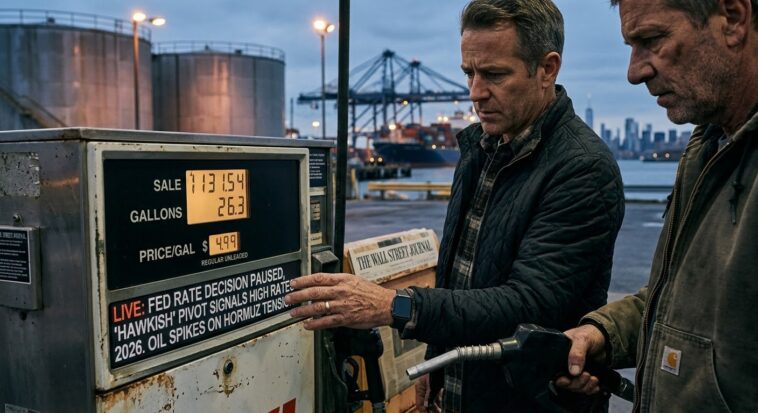
WASHINGTON, D.C. — The Federal Reserve is holding the line, but the ground beneath Jerome Powell’s feet is shifting. As the March Fed interest rate decision landed on Wednesday afternoon, the central bank opted to keep the federal funds rate in its current range of 3.5% to 3.75%. On the surface, it’s a pause. In reality, it’s a defensive crouch against a geopolitical storm that refuses to blow over.
Wall Street had largely priced in this move, yet the air in the briefing room was thick with a new kind of tension. With the conflict in Iran continuing to choke global energy supply chains, the “higher for longer” mantra has evolved into something more permanent. The Fed’s updated Summary of Economic Projections—the infamous “dot plot”—now suggests that the widely anticipated rate cuts for 2026 might be off the table entirely.
The Oil Shadow and the 3% Ceiling
The elephant in the room isn’t just sticky inflation; it’s the $3.84 average at the American gas pump. Energy prices have spiked nearly 30% since the start of the year, a direct result of the volatility in the Strait of Hormuz. For a Fed that was hoping to glide into a 2% inflation target, these numbers are a gut punch.
“We are seeing a classic supply-side shock,” says Dr. Aris Thorne, Chief Macro Strategist at Atlantic Capital. “Powell is trapped. He can’t cut rates while gas prices are fueling a secondary inflation wave, but he can’t hike without risking a hard landing for a consumer already stretched thin.”
While the S&P 500 and Nasdaq showed some resilience in early trading—shrugging off the “Extreme Fear” sentiment that has dominated the month—the underlying metrics tell a different story. The cost of living is creeping up, and the Fed is signaling that it won’t be the hero investors were looking for this spring.
A Value Play in the Tech Rubble?
Interestingly, the Fed interest rate decision has created a strange divergence in equity valuations. While traditional “safe” sectors like consumer staples are trading at a premium, tech giants like Nvidia and Amazon are starting to look like value stocks. It’s an upside-down world where Big Tech—often the first casualty of high rates—is showing better earnings-to-price ratios than your local grocery conglomerate.
“The market is finally realizing that these aren’t just growth plays anymore,” notes Marcus Vane, an analyst with New York-based Vane & Associates. “They are cash-flow machines. If the Fed stays at 3.75% for the rest of the year, investors are going to prioritize balance sheet strength over speculative ‘rebound’ stories.”
The Rise Investment Strategy: What Now?
For the everyday investor, this “hawkish pause” is a signal to stop waiting for a bailout from the central bank. The era of cheap money is firmly in the rearview mirror.
Fixed Income: With yields on the 10-year Treasury hovering near 4.2%, the window for locking in long-term income remains wide.
Energy Hedges: As long as the geopolitical situation remains unresolved, energy remains a necessary, if volatile, hedge.
Quality Over Growth: Focus on companies with low debt-to-equity ratios. When the Fed stops cutting, the “debt-heavy” zombies start to stumble.
Looking Ahead
As Jerome Powell prepares to wrap up his term this May, the narrative is no longer about “if” he can stick the landing, but how much damage the runway can take. The market’s focus now shifts to the upcoming Producer Price Index (PPI) data. If that comes in hot, the “pause” we saw today might be the last bit of breathing room we get before the Fed is forced back into the trenches.
The Fed isn’t blinking. Not yet. But with oil near $100 and a “dot plot” that looks more like a plateau than a descent, investors need to buckle up for a long, dry summer.