Editor
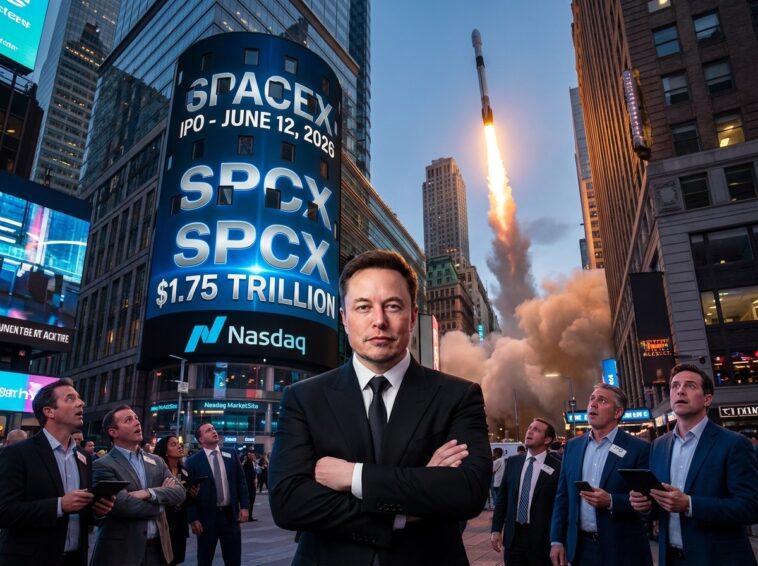
SpaceX IPO Targets $1.75 Trillion Valuation in Largest Market Debut Ever
The SpaceX IPO is targeting June 12, 2026 as its Nasdaq debut date, aiming to raise up to $75 billion at a staggering $1.75 trillion valuation—a figure that would make Elon Musk’s aerospace conglomerate the eighth-largest public company instantly, slotting in just ahead of Tesla. Wall Street hasn’t seen anything like this. Ever. TheStreetYahoo Finance
SpaceX shareholders approved a 5-for-1 stock split over the weekend, adjusting the per-share fair market value to approximately $105.32 from $526.59, a tactical move designed to make shares feel accessible to retail investors when trading begins under the ticker “SPCX.” The split is expected to be officially completed by May 22nd. CNBC + 2
But accessibility is marketing. The real story? The valuation marks a major jump from SpaceX’s prior $1.25 trillion combined valuation after its merger with Musk’s AI venture xAI in February. That’s a 40% markup in three months. Yahoo Finance
“This isn’t just a listing—it’s a referendum on whether Musk can keep defying gravity,” says Marcus Chen, Senior IPO Strategist at Whitestone Capital in New York. “You’re asking public markets to value rockets, satellites, and artificial intelligence at nearly two trillion dollars. That’s not an investment thesis. That’s a leap of faith.”
BlackRock Betting Big as Skeptics Circle
Reports over the weekend indicated BlackRock is discussing a $5 billion to $10 billion investment in the offering, signaling institutional appetite despite the eye-watering valuation. SpaceX is expected to file its S-1 prospectus in mid-May, kick off its roadshow around June 4, and price shares on June 11. CNBCYahoo Finance
The math is brutal. Starlink, SpaceX’s satellite internet service with over 9 million users, is projected to generate $15-16 billion in 2025 revenue. That means the company trades at roughly 110x revenue—a multiple that makes even the frothiest tech IPOs look conservative by comparison. Yahoo Finance
“Cerebras just debuted at 130x sales and investors barely blinked,” counters Patricia Valdez, Managing Director at Riverside Equity Partners in Chicago. “The market’s telling us it’ll pay any price for genuine technological moats. SpaceX has reusable rockets that land themselves and a satellite constellation blanketing Earth. That’s not vaporware—that’s infrastructure.”
Maybe. But Scottish Mortgage Investment Trust, which holds SpaceX as 18% of its portfolio, valued the company at just $1.25 trillion as of March 31, basing that figure on real transactions rather than media speculation. That’s a $500 billion valuation gap between existing shareholders and IPO targets. CNBC
The Dual-Class Structure Nobody’s Talking About
Here’s what retail investors need to understand before they rush in on June 12: The dual-class share structure will grant Elon Musk voting control through Class B shares with superior voting power, while public investors receive Class A shares with standard voting rights. Sound familiar? It’s the same playbook Facebook, Google, and Snap used. Yahoo Finance
Translation: you’re buying economic exposure without governance rights. Musk maintains iron-fisted control even as he cashes out billions. Musk himself will not be selling a single share in the offering, which tells you everything about his confidence in the valuation—or his need to keep control concentrated. Yahoo Finance
Reports indicate Musk wants to reserve up to 30% of IPO shares for individual investors, a populist gesture that sounds democratic until you realize those retail buyers get zero say in company strategy while Musk drives vision from the CEO seat. TRADING ECONOMICS
What Could Go Wrong? Plenty.
Key risks include governance concentration, Starship execution challenges, reliance on government contracts, and competition in satellite broadband. Amazon’s Project Kuiper is launching. China’s state-backed constellations are operational. OneWeb exists. Yahoo Finance
Starship—the massive rocket system meant to revolutionize space transport and enable Mars colonization—remains unproven at commercial scale. Every launch delay, every regulatory snag, every competitor breakthrough chips away at that $1.75 trillion story.
And then there’s Musk himself. The man runs Tesla, xAI, Neuralink, The Boring Company, and X (formerly Twitter). How much bandwidth does a human have? When Tesla needed him most in 2018-2019, he was fighting the SEC and tweeting through production hell. What happens when three companies simultaneously need rescuing?
Should You Buy on Day One?
Short answer: probably not. A lower share price may make the stock feel accessible on June 12, but the real test is whether SpaceX can justify its valuation over the next two to three years. First-day pops are exciting. Three-year underperformance is expensive. TheStreet
For context: Cerebras popped 68% on its recent debut, then shed 4% the next session. Rivian IPO’d at $106 billion, then collapsed 80%. Uber opened at $75 billion and took five years to justify it.
If you believe Musk is building the infrastructure layer for humanity’s multiplanetary future, buy and hold for a decade. If you’re chasing momentum on Day One, remember that $1.75 trillion valuations leave very little room for error—and Elon Musk’s companies specialize in chaos before glory.
The roadshow starts June 4. Buckle up.