Editor
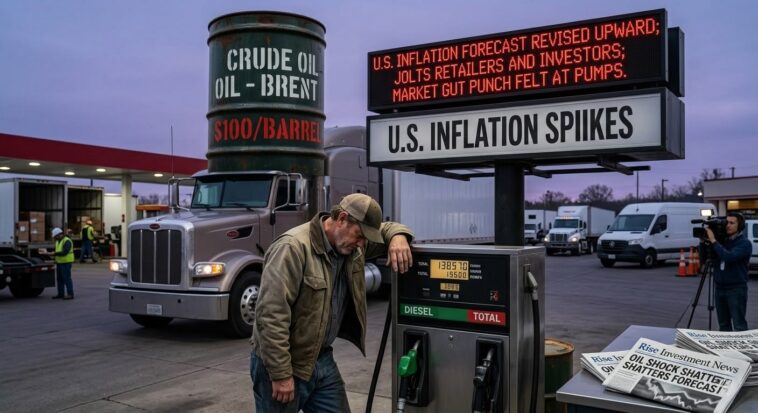
The U.S. inflation forecast just went through a windshield at 90 miles per hour.
Panic is a cold business on Wall Street, and today it smelled like crude oil. As Brent hit $100 a barrel this morning following the escalation of conflict in the Middle East, the comfortable narrative of a “soft landing” died a quiet death on the floor of the New York Stock Exchange. The Dow shed 700 points before lunch.
The math is simple and brutal. High energy costs act as a regressive tax on every American household. When the Producer Price Index (PPI) surged yesterday to its highest level in a year, it wasn’t just a statistical blip. It was a warning shot. The Fed’s move? Predictable, yet jarring. They are pinned in a corner, unable to cut rates while the cost of moving goods across the country is exploding.
“The Fed is effectively trapped in a burning building with no fire extinguisher,” says Marcus Thorne, Head of Macro Strategy at Thorne-Baylor, a New York boutique firm. “You can’t talk down inflation when the Strait of Hormuz is a parking lot. Every cent added to a gallon of gas is a nail in the coffin of a 2026 rate cut.”
The U.S. Inflation Forecast: A $100 Reality Check
For the retail investor, the secondary effects are where the real damage happens. Look at the Treasury yields. The 10-year note is screaming toward 5% again, a level that makes the average mortgage seeker want to give up and rent forever. Mortgage demand has already tumbled 12% in the last 48 hours.
The market’s reaction isn’t just about the war; it’s about the realization that “higher for longer” isn’t a threat anymore—it’s the new permanent residency. When energy costs spike, the cost of everything from cereal to silicon chips follows. This isn’t a “glitch in the system.” It is the system re-pricing itself for a world where cheap energy is a memory.
However, not everyone is buying the doomsday script.
“We’ve seen this movie before,” argues Sarah Jenkins, Lead Economist at Pacific Vista. Jenkins stands as a lone voice of dissent, suggesting the current spike is a “speculative blow-off top” fueled by algorithmic trading rather than a long-term shift in fundamentals. She believes that once shipping lanes stabilize, oil will retreat to $75 faster than the market can panic. It’s a bold bet, but in this environment, being a contrarian is a lonely, expensive hobby.
The Retail Play: Hedging the Heat
So, what do you do when your 401(k) starts bleeding red?
The practical tip here isn’t to run for the hills. It’s to follow the yield. When the yield curve flattens or inversions deepen during an energy shock, growth stocks—those tech darlings with high valuations and no current profits—get slaughtered. They rely on cheap future money. That money just got a lot more expensive.
The Investment Move: Pivot toward “cost-pass-through” entities. Think large-cap energy producers or consumer staples with massive brand loyalty. If a company can raise its prices without losing its customers, it survives an inflation spike. If it can’t, it’s a casualty.
“Retail investors need to stop chasing the ‘AI moonshot’ for a minute and look at the companies that actually own the pipes and the pumps,” notes Elena Vance, Chief Investment Officer at a Chicago-based fund. “In a $100-oil world, the guy selling the fuel is king. The guy building the app? He’s just another victim of the overhead.”
The U.S. inflation forecast will likely be revised upward again by the end of the week. This isn’t a time for “comprehensive” rebalancing or waiting for a “transformative” shift in policy. It’s a time for grit. Watch the crude prices. If they stay north of $95, the Fed’s hands are tied, and your cash is your best friend.