Editor
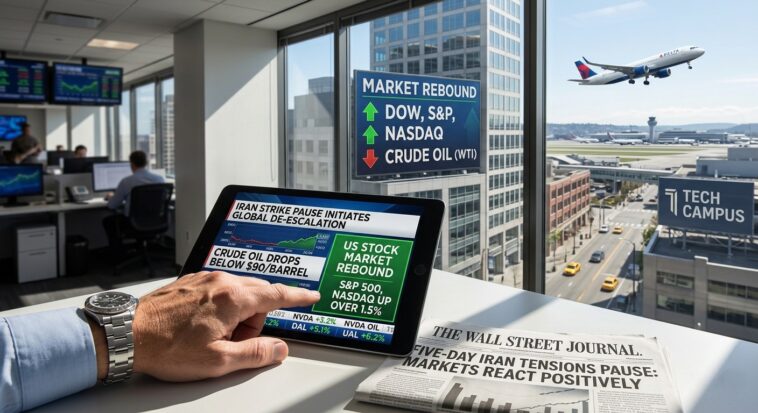
WASHINGTON, D.C. — A massive US stock market rebound electrified Wall Street on Monday morning as a sudden cooling of geopolitical tensions sent crude oil prices into a tailspin. The Dow Jones Industrial Average surged more than 900 points at the opening bell. The catalyst? A reported five-day suspension of planned strikes against Iranian energy infrastructure. It was the relief valve investors had been begging for after weeks of “Extreme Fear” sentiment.
By mid-day, the S&P 500 and the tech-heavy Nasdaq were both up nearly 1.5%. For a market that had been staring down the barrel of $120-per-barrel oil, the retreat toward $99 feels like a miracle. But don’t confuse a tactical pause with a permanent peace. The rally is broad, yet the foundations remain shaky.
The Flight Path: Airlines Catch a Tailwind
Nowhere is the relief more palpable than in the hangars of the major carriers. Fuel is the single largest variable cost for the airline industry, often accounting for 25% to 30% of total operating expenses. When crude cracks, airline margins expand almost instantly.
Delta Air Lines (DAL) and United Airlines (UAL) saw their shares jump 5% and 6% respectively in early trading. For these “legacy” carriers, $100 oil was the break-even nightmare; $90 oil is a profit engine.
“The math for the airlines is brutal and fast,” says Marcus Thorne, Head of Macro Strategy at a New York boutique firm. “Every $10 drop in a barrel of oil adds hundreds of millions to the bottom line of a carrier like Delta. If this pause holds, the Q2 earnings beat is already in the bag.”
Silicon Resilience: Why Tech Loves Lower Yields
While airlines benefit from the physical cost of fuel, the tech sector is feasting on the secondary effect: falling Treasury yields. High energy prices drive inflation, which drives interest rates. When oil dips, the “inflation tax” on future earnings disappears.
The “Magnificent Seven”—led today by NVIDIA (NVDA) and Microsoft (MSFT)—are leading the Nasdaq’s charge. For these growth-heavy giants, lower yields mean their future cash flows are worth more today. NVIDIA, in particular, has become the market’s primary barometer for risk-on sentiment. If the world isn’t ending in a regional war, investors want to own the chips that power the future.
“It’s a valuation reset,” notes Sarah Kessler, a geopolitical risk analyst. “Tech isn’t just about AI anymore; it’s a play on liquidity. When the threat of a $150 oil spike recedes, the ‘discount rate’ applied to tech stocks drops, and prices naturally move higher. It’s a textbook recovery.”
The Investment Trick: Sector Divergence
For the retail investor, the “trick” in today’s US stock market rebound isn’t just buying the dip on the S&P 500. It’s looking at the sectors that were most compressed by high fuel costs.
Beyond the obvious tech and travel plays, keep an eye on homebuilders. If the “Iran Pause” keeps Treasury yields from climbing further, the mortgage market gets a much-needed ceiling. The real alpha today isn’t in the broad indices; it’s in the companies that were being “choked” by the energy spike.
A Note of Caution
However, not everyone is buying the hype. While Washington talks of “productive” negotiations, Tehran has been less than clear about a long-term de-escalation. This contradiction is the classic fog of war. It suggests this rally might be built on sand.
“The market is celebrating a ceasefire that hasn’t even been signed,” warns Elias Vance, a senior equity strategist. “We are one headline away from oil being back at $110. Enjoy the green screens, but don’t sell your hedges just yet.”
Looking Ahead
The S&P 500 is still testing its 200-day moving average. Technical analysts call this a “pivotal support zone.” If the index can’t hold these gains through the Friday close, the “bull trap” narrative will take over.
Our take? The five-day clock is ticking. By the weekend, we’ll know if this was the start of a new bull run or just a temporary breather in a long, hot summer.