Editor
Trump Kills the Peace Trade. Now Everything Rides on Tuesday’s Inflation Print.
April CPI 2026 drops at 8:30 AM Tuesday morning — and after President Trump spent Sunday night torching Iran’s latest peace proposal on Truth Social, the number landing on that tape could be the most consequential inflation print of the year.
The weekend started with cautious optimism. It ended with a presidential post in all caps.
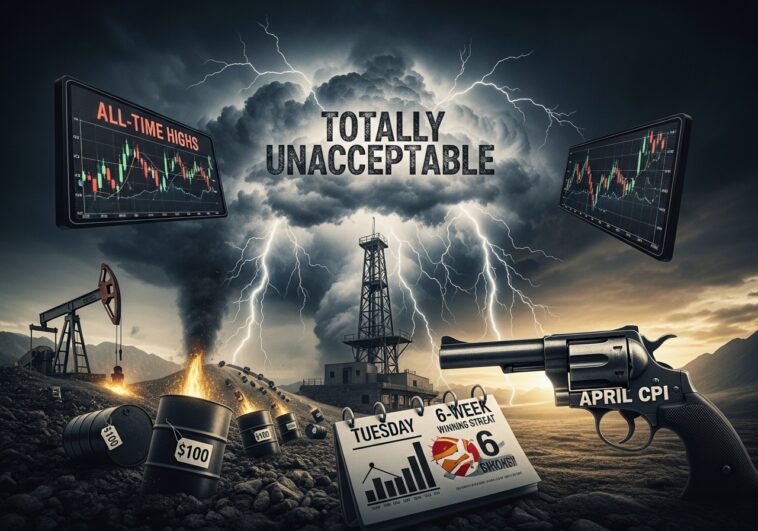
“I have just read the response from Iran’s so-called ‘Representatives.’ I don’t like it — TOTALLY UNACCEPTABLE!” That was Trump, Sunday evening, dismantling what remained of the peace trade in a single social media post. Oil futures climbed following Trump’s rejection, with Brent crude advancing as much as 3.5% to $104.80 a barrel, while West Texas Intermediate climbed to near $99. Yahoo FinanceAxios
Just like that, the weekend’s tentative calm evaporated. And now this market — sitting at record highs after its best six-week run since 2024, still digesting a blockbuster earnings season, watching a new Fed Chair take the helm — has to stare down an inflation report that most forecasters expect to be ugly.
Not panic-inducing ugly. But ugly enough to matter. A lot.
April CPI 2026: What the Consensus Is Expecting — and Why It May Not Be Enough
The Street’s base case heading into Tuesday is neither comfortable nor catastrophic.
Barclays U.S. economist Pooja Sriram forecasts headline inflation at 0.55% month-over-month and 3.7% year-over-year, while core inflation — which strips out food and energy — is expected at 0.34% month-over-month and 2.7% year-over-year. Other forecasters are slightly more aggressive. Some models show monthly CPI as high as 0.7% and annual CPI rising to 3.8%, with market prediction contracts on Polymarket pricing the highest probability outcomes at 3.7% and 3.8%. CNBCCharles Schwab
Here’s the problem with the base case: it was built before Trump rejected Iran’s counteroffer Sunday night. With WTI back near $99 and the Strait of Hormuz still effectively closed, the risks to Tuesday’s print are skewed upward — not downward.
Analysts at several major banks warn that risks to their forecasts are “to the upside for both headline and core inflation,” citing food price reversion, sticky non-housing services inflation, and energy pass-through that hasn’t yet fully shown up in the data. CNBC
“The April CPI report is the moment of truth for whether the ‘headline up, core contained’ story holds,” said Rachel Voss, Chief Inflation Strategist at Cornerstone Macro Research in New York. “If core breaks decisively above 0.3% month-over-month, the narrative shifts from ‘war-driven energy spike’ to ‘broad inflation re-acceleration.’ Those are very different markets. One the Fed can wait out. The other it cannot.”
Six Weeks of Records. One Number to Test Them All.
Step back and absorb what this market has done since the April lows.
The S&P 500 topped 7,300 for the first time ever and capped a six-week winning streak, as did the Nasdaq Composite, driven by strength in memory stocks. The Roundhill Memory ETF soared nearly 30% in the week just ended. The Nasdaq Composite finished Friday at 26,247.08 — its new record close — while the S&P 500 closed at 7,398.93, its own fresh record high. stlouisfedinsiderfinance
Six consecutive weeks of gains. Back-to-back record closes. An earnings season where the Magnificent Seven’s earnings growth outpaced the other 493 S&P 500 stocks by more than 40%, according to JPMorgan. stlouisfed
All of that sits on a ledge Tuesday morning. Because here’s the iron law of elevated-multiple markets: the higher you go on good news, the harder one bad number can hit you on the way down.
Sam Stovall of CFRA Research noted that the S&P 500’s relative strength index closed in overbought territory as of May 6, alongside overbought readings for communication services, information technology, and the Nasdaq 100. “Before a continuation of the current bull market run, the S&P 500 may need to take some time to catch its breath,” he wrote. Yahoo Finance
Overbought. Record highs. Oil re-accelerating. Inflation expectations already at multi-year highs. Tuesday’s CPI doesn’t have to be a catastrophe to cause real damage. It just has to disappoint.
The Warsh Inheritance: A New Chair Walks Into a Burning Kitchen
Timing, in markets, is everything. And the timing of this week could not be more loaded.
Jerome Powell’s term as Fed Chair ends Friday, May 15. The U.S. Senate is expected to confirm Kevin Warsh as Powell’s successor this week. Warsh inherits his new office with a strict 2% inflation mandate, a philosophical aversion to forward guidance, and — if Tuesday’s CPI runs hot — an immediate credibility test before he’s even sat in the chair. advisorperspectives
Bank of America has completely overturned its rate cut forecast, now pushing the timing of the Fed’s first rate cut to the second half of 2027. Previously, the bank had expected two cuts in 2026. With the Iran war, tariff pressures, and the AI-driven demand surge all simultaneously applying inflationary force, economists say the difficulty of forecasting interest rates has rarely been higher. Charles Schwab
JPMorgan’s analysis suggests that even in the most optimistic scenario — rapid diplomatic resolution, oil prices normalizing — U.S. year-over-year CPI will remain above 3.0% until February 2027, making rate cuts in 2026 “essentially hopeless.” Charles Schwab
No cuts. A new hawkish chair. And oil back above $97. That’s the environment Warsh inherits.
“Warsh is walking into one of the hardest monetary policy environments since 1980,” said Thomas Keane, Senior Macro Strategist at Meridian Capital in Washington D.C. “He can’t cut — inflation won’t let him. He shouldn’t hike — the labor market is softening and consumer confidence is at multi-year lows. His only tool is credibility. Tuesday’s CPI either gives him room to build it, or takes it away before he starts.”
What Else This Week Is Watching: Xi, Cisco, and the Sentiment Collapse
Tuesday’s CPI isn’t the week’s only pressure point. Not even close.
The Trump-Xi summit on May 14-15 has become a de facto market deadline for the Iran war. Investors are hoping Trump resolves the Hormuz situation — or at least reopens key shipping lanes — before meeting with China’s president. “The market’s been using this China summit as a bit of a deadline,” said Scott Ladner, investment chief at Horizon Investments. “If we get to the summit and the Strait is still closed, that has to extend the time period the market will need to take into account.” stlouisfed
AI discussions at the summit add another layer. The world’s two largest economies negotiating guardrails on artificial intelligence simultaneously inflames and confirms the AI investment thesis — two superpowers acknowledging the technology is consequential enough to require diplomatic management.
Consumer sentiment, meanwhile, is deteriorating again. The preliminary University of Michigan Consumer Sentiment Index for May came in at 48.2 — below the 49.7 consensus and below April’s already-record-low 49.8, marking the lowest reading since June 2022. CNBC
The consumer is scared. And getting scarier.
Average gas prices have risen over $1 per gallon since the conflict started, reaching $4.06 nationwide as of Friday. Bank of America data shows most spending growth is being driven by higher-income households, while lower-income consumers face acute pressure. The K-shape widens. Every week. TipRanks
The Counter-Narrative: This Market Has Earned the Benefit of the Doubt
Not every strategist is bracing for Tuesday’s CPI to break the rally. James Calloway, Chief Equity Strategist at Westfield Capital Partners in Boston, argues the bull case remains structurally intact regardless of the print.
“This market has absorbed oil above $100, record-low consumer sentiment, and a Fed transition — and hit six consecutive weeks of record highs,” Calloway told clients Monday morning. “That’s not complacency. That’s conviction in earnings quality. When AMD grows data center revenue 57%, when Apple prints $111 billion, when Visa processes $3.7 trillion in a single quarter — the fundamentals override the macro noise. A hot CPI print will cause a sharp two-day selloff. It won’t end the bull market.”
He may be right. Some analysts argue that while high energy prices may dampen growth, deep-seated structural strengths — led by AI investment and the strongest corporate earnings season in five years — should prevent economic derailment. umich
The counter-narrative is coherent. But it requires the CPI to behave. And after Sunday night’s Truth Social post, “behave” is no longer the base case.
Three Moves Before 8:30 AM Tuesday
This is one of those weeks where preparation beats reaction. Here’s the framework.
Know your inflation scenario before the print drops. Market prediction contracts are pricing 3.7% as the single most likely outcome — a 39% probability — followed by 3.8% at 30%. If headline comes in at 3.7% or below with core contained at 0.3% or less, this market likely digests it and moves higher. If headline breaks 3.9% or core exceeds 0.35%, expect an immediate, sharp repricing in rate-sensitive equities and growth stocks. Know which stocks in your portfolio are most exposed to that repricing before the number lands. The Motley Fool
Don’t abandon AI infrastructure on Iran noise. JPMorgan’s trading desk expects mega-caps to build on their recent momentum heading into Nvidia’s earnings results on May 20. The semiconductor cycle doesn’t reverse because Trump posted in caps lock. Nvidia, AMD, Micron, and Corning remain the most structurally sound positions in this market. Short-term geopolitical volatility is not a reason to exit long-term structural positions. stlouisfed
Watch the China summit as your geopolitical signal. Investors don’t expect oil prices to return to pre-war levels — it takes weeks for ships sailing out of the Strait of Hormuz to reach major destinations. But even partial progress — a humanitarian shipping lane, a framework agreement, a public handshake between Trump and Xi that signals Hormuz reopening — would send energy prices sharply lower and remove the biggest single risk factor from this market’s inflation outlook. That’s worth more than any earnings beat this week. stlouisfed
Tuesday’s CPI print is the gate. Everything else — the Warsh Fed, the Xi summit, the Nvidia earnings, the summer rally — sits behind it.
The market is ready. The question is whether the data cooperates.