Editor
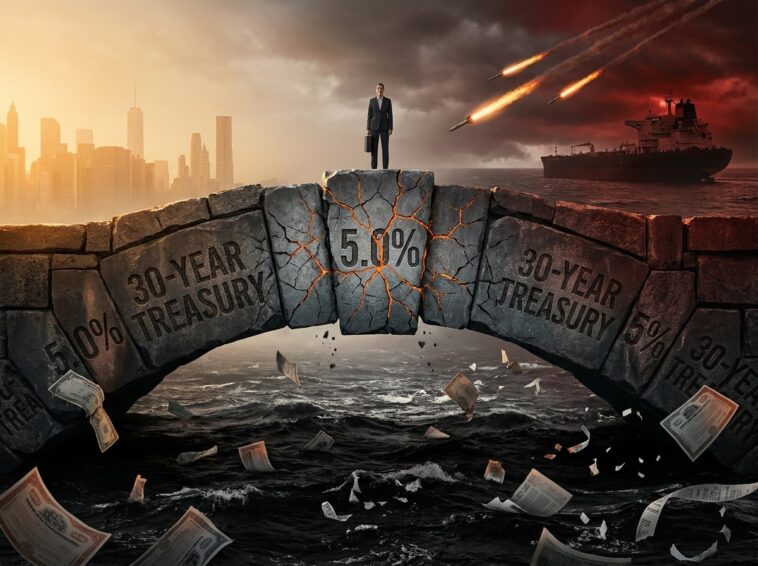
The Bond Market Just Sent Wall Street Its Loudest Warning of the Year
The 30-year Treasury yield crossing 5 percent on Monday morning isn’t just a bond market footnote — it’s a five-alarm fire that every retail investor holding equities needs to understand before this week gets worse.
Seventy-two hours ago, the S&P 500 was sitting at an all-time high. Apple had just printed $111 billion in quarterly revenue. Oil had dipped on Iran peace rumors. The mood was borderline euphoric.
Then Monday happened.
U.S. Treasury yields surged as investors weighed the implications of costlier energy prices on inflation. The 2-year yield jumped almost 9 basis points to 3.973%, the benchmark 10-year note rose more than 7 basis points to 4.48%, and the 30-year bond yield gained more than 6 basis points to 5.029%. That last number. That’s the one that matters. The 30-year hasn’t traded above 5% since last summer. Its return above that threshold isn’t a blip. It’s a structural signal about where this economy may be heading — and it arrived on the worst possible morning. TipRanks
The 30-Year Treasury Yield at 5 Percent: Why This Number Breaks Things
Most retail investors don’t watch the 30-year Treasury. That’s a mistake. Always has been.
Here’s the mechanics, plain and simple. When the 30-year yield rises, the cost of long-term money in America goes up. Mortgages get more expensive. Corporate borrowing costs climb. And the discount rate applied to future earnings — the foundational math underneath every growth stock’s valuation — rises sharply. A company priced at 40 times forward earnings when the 30-year was at 4.5%? It’s worth considerably less at 5%. The math is cold and indifferent.
Mortgage rates were averaging 6.52% on Monday, up 8 basis points from Friday’s levels, closely tracking the 10-year Treasury yield which jumped nearly 8 basis points to 4.45%. The 30-year Treasury yield also crossed 5% for the first time since last summer. Yahoo Finance
That mortgage rate matters beyond housing. It’s a proxy for the general availability of credit across the economy. When it rises, consumers pull back. When consumers pull back, corporate revenue estimates come down. And when estimates come down at the same moment the bond market is demanding a higher return — you get the kind of Monday the bulls don’t want to talk about.
“The 30-year yield at 5% isn’t the end of the bull market,” said James Alworth, Senior Fixed Income Strategist at Meridian Capital in New York. “But it absolutely resets the math on anything trading at a premium multiple. You can’t have tech stocks priced at 35 times earnings and a risk-free rate at 5% without someone, eventually, doing the arithmetic.”
What Pulled the Trigger: Iran’s Missiles Return
The bond market doesn’t move in a vacuum. Today’s catalyst was as dramatic as they come.
Oil prices surged after the United Arab Emirates said it intercepted Iranian missiles for the first time since the start of the ceasefire. WTI crude futures rose 3% to above $105 per barrel, while Brent climbed 5% to more than $113 per barrel. The UAE interception came alongside conflicting reports of an Iranian attack on a U.S. warship — Iranian state media claimed a ship was hit near Jask island, while U.S. Central Command denied the reports. TipRanksBloomberg
Denied or not, the market didn’t wait for verification. It never does.
U.S. stocks sank on Monday, with the Dow Jones Industrial Average dropping about 1%, while the S&P 500 and Nasdaq both slipped roughly 0.5%, as concerns about escalation in the Iran war eclipsed optimism from strong quarterly earnings. The Russell 2000 got hit hardest. Small caps — which had been quietly leading the rally — took ten consecutive five-minute red candles as the Iran headlines broke. That’s not a rotation. That’s a stampede. Yahoo Finance
The geopolitical picture is getting murkier, not clearer. President Trump said on Truth Social he would review Iran’s latest peace proposal but “can’t imagine it would be acceptable” given Iran had not “paid a big enough price.” That’s not the language of imminent resolution. CNBC
The Inflation-Bond Paradox That’s Quietly Suffocating This Market
Here’s the cruel dynamic at work — and it’s one that most mainstream financial coverage consistently undersells.
In a normal geopolitical crisis, investors flee to Treasury bonds. Yields fall. Stocks may drop, but bonds cushion the blow. That’s the textbook playbook. It’s not what’s happening. PCE inflation rose 0.7% in March, putting the annual rate at 3.5% — far above the Fed’s 2% target. Core PCE, excluding food and energy, rose 3.2% year over year. The Motley Fool
When inflation is already running hot and oil spikes, the bond market can’t play its safety role. Investors who buy Treasuries during an oil shock are locking in a real negative return if inflation accelerates further. So they don’t buy. Yields rise instead of fall. And suddenly equities lose both their earnings support and their bond market hedge simultaneously.
“Every major central bank that met last week held rates steady and leaned hawkish,” noted Anthony Saglimbene, chief market strategist at Ameriprise, in a client note Monday. “The consumer engine is still running, but it’s running without a full tank of gas. This isn’t just a domestic dynamic — it’s global.” TipRanks
The Counter-Narrative: One Strategist Sees Opportunity in the Wreckage
Not everyone is bracing for further pain. Sandra Reyes, Chief Investment Officer at Harborview Equity Partners in Chicago, is leaning into Monday’s selloff with deliberate calm.
“The market just handed disciplined investors a gift,” Reyes told clients in a note this morning. “The fundamentals of this earnings season are exceptional — the best beat rate in five years, AI capex confirmed and accelerating, Apple printing record margins. None of that changed this weekend. What changed is a geopolitical headline that may look very different by Thursday. I’m buying the dip in quality names while everyone else is selling the war.”
It’s a coherent argument. But it requires believing the Strait of Hormuz situation stabilizes quickly. That’s a faith-based investment thesis in a conflict where every ceasefire has so far lasted less than two weeks.
Your Playbook for a 5% Thirty-Year World
Three moves that make sense in this specific environment — not the one from last Friday.
Shorten your bond duration immediately. The 30-year yield crossing 5% means long-duration bond funds are getting crushed. T-bills and short-duration Treasuries yield competitive rates without the price destruction embedded in anything with a 20-30 year maturity. Don’t hold long bonds waiting for yields to fall — that call requires a peace deal nobody can guarantee. Yahoo Finance
Energy is still the war trade. With WTI above $105 and the Strait of Hormuz still effectively closed, domestic producers and refiners continue to print cash. Exxon and Chevron both beat Q1 earnings last week despite war-related accounting charges. Both stocks fell slightly Friday despite the beats — which means they’re cheap relative to their current operating environment. capitaleconomics
Watch Friday’s jobs number like your portfolio depends on it. It does. April nonfarm payrolls are set for release Friday, with economists expecting only modest gains. A weak jobs print alongside hot inflation formally activates the stagflation scenario. A strong print keeps the economy’s resilience narrative alive. There is no data point this week more important. None. TipRanks
The record high from last Friday feels like a different market. In a sense, it was. The 30-year just changed the rules. Time to play by the new ones.