Editor
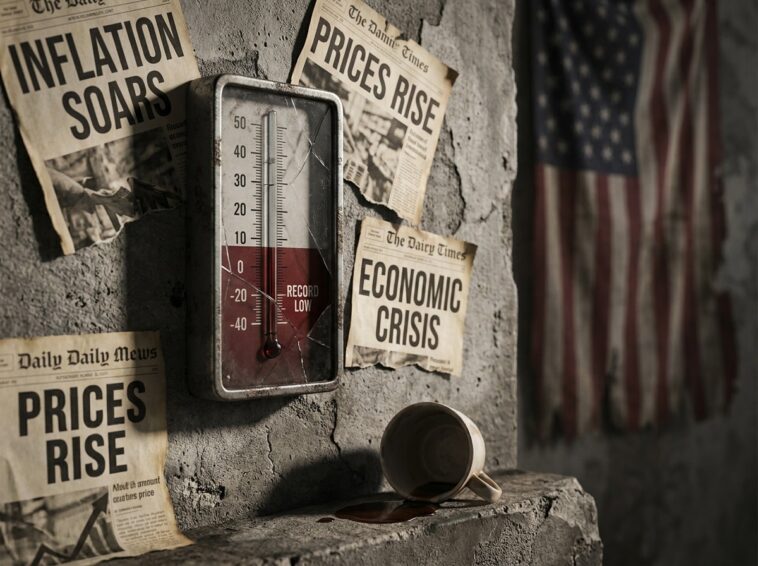
The American Consumer Is Scared. Wall Street Should Be Too.
Consumer sentiment record low 2026 is no longer just a headline — it’s a warning shot fired from every income bracket, every age group, and every corner of the country.
Friday morning handed investors a data point that doesn’t get buried in earnings noise or geopolitical spin: the final April reading of the University of Michigan Consumer Sentiment Index came in at 49.8. That’s the lowest reading in the survey’s 74-year history. Worse than the Great Recession. Worse than the pandemic. Worse than the inflation spiral of 2022.
Let that sink in.
Consumer sentiment ticked down 3.5 index points this month, now comparable to the trough seen in June 2022, with decreases seen across political party, income, age, and education. advisorperspectives This wasn’t a partisan panic or a demographic blip. It was a clean sweep. And when the whole country sours simultaneously, markets eventually follow.
Consumer Sentiment Record Low 2026: The Inflation Expectations Buried in the Fine Print
The headline number is bad. The inflation expectations buried inside it are worse.
Year-ahead inflation expectations surged from 3.8% in March to 4.7% in April — the largest one-month increase since April 2025. Long-run inflation expectations climbed to 3.5%, the highest reading since October 2025. advisorperspectives
That last number is the one the Fed is watching. Long-run expectations unhinging from the 2% anchor is precisely the scenario Jay Powell has spent two years trying to prevent. When consumers start believing inflation is permanent — when they build it into wage demands, into rent negotiations, into how they shop — it becomes a self-fulfilling prophecy. The psychology of inflation is almost as powerful as inflation itself.
The conflict’s primary impact on consumers stems from energy and broader price shocks, with the two-week ceasefire and a slight dip in gasoline prices only helping sentiment recover a fraction of its early-month losses. tradingeconomics
That’s damning. Even a ceasefire barely moved the needle.
“This isn’t just about gas prices at the pump,” said Rachel Solano, Chief Economist at Cornerstone Macro Advisors in Washington, D.C. “When households start revising their five-year inflation outlook upward, the Fed has a credibility problem — and a credibility problem at the Fed is a market problem. Full stop.”
Intel’s Surprise and the Semiconductor Silver Lining
Not everything Friday was grim. Markets needed a win, and Intel delivered one.
Nasdaq 100 futures advanced 0.5% on Friday, supported by a sharp rally in Intel shares — which surged more than 19% in extended trading after beating first-quarter earnings expectations and delivering a strong outlook for the current quarter. TRADING ECONOMICS Sentiment got an extra jolt when Tesla CEO Elon Musk suggested his company could spend roughly $3 billion with Intel, leveraging its chip fabrication capabilities.
Megacaps were back in the green by midday, led by semiconductor names such as Intel gaining over 23% and AMD climbing nearly 14%. TheStreet
The chip sector remains the market’s most reliable life raft. While software stocks got torched Thursday — IBM and ServiceNow tumbled 8% and 17% respectively, with Microsoft sliding 4%, Palantir down 7%, and Oracle falling 6% TRADING ECONOMICS — the hardware and fabrication layer of the AI economy keeps proving its durability.
The divergence matters. It’s not “sell tech.” It’s which tech you own.
The Counter-Narrative: Don’t Confuse Feelings With Spending
Here’s where not everyone agrees.
David Wrenshaw, Senior Portfolio Strategist at Bridgefield Capital in Boston, is notably unfazed by the sentiment collapse. “Michigan sentiment and actual consumer spending have had a notoriously loose relationship for years,” he told clients Friday morning. “Americans say they feel terrible and then go spend. We saw it in 2022, we saw it in 2023. I’m watching credit card data and payroll numbers — not survey responses.”
Capital Economics echoed this caution, noting that while the record low sentiment supports forecasts for weak consumption this quarter, the link between sentiment and spending has been very loose in recent years. capitaleconomics
Wrenshaw’s contrarian point is legitimate. But here’s the counterargument: eventually, feelings catch up to behavior. The longer oil stays above $100, the longer the blockade holds, the longer inflation expectations stay elevated — the greater the chance that consumer retrenchment becomes real, not just reported.
We’re not there yet. We could be soon.
What Retail Investors Must Do Before Next Week
The coming week is loaded. Investors face housing starts and building permits data, the government’s first look at first-quarter GDP, and — most critically — the Fed’s preferred inflation gauge: Personal Consumption Expenditures prices. Charles Schwab
If PCE comes in hot alongside a weak GDP print, stagflation stops being a theory and starts being the official story. That changes everything about how the second half of 2026 trades.
Three moves worth considering right now:
Rotate toward defensive consumer staples. Procter & Gamble beat earnings Friday and reiterated guidance. Companies that sell things people have to buy — soap, food, medicine — hold up when discretionary spending crumbles. P&G is the blueprint.
Don’t abandon semiconductors. Intel’s blowout confirms that AI-driven chip demand is structural, not cyclical. When sentiment craters and software gets sold, the hardware picks up the slack.
Watch the 10-year Treasury yield like a hawk. The 10-year yield is sensitive to war news and could rise sharply if tensions flare — and a rise in yields would likely bring pressure to the broader stock market. Charles Schwab If it pierces 4.8%, equity valuations across the board need to be repriced.
The American consumer has spoken. They’re worried. History says the market should listen.