Editor
Wall Street’s Record Run Hits a Wall: Oil Shock, Tesla’s Capex Bomb, and the Return of Stagflation Fears
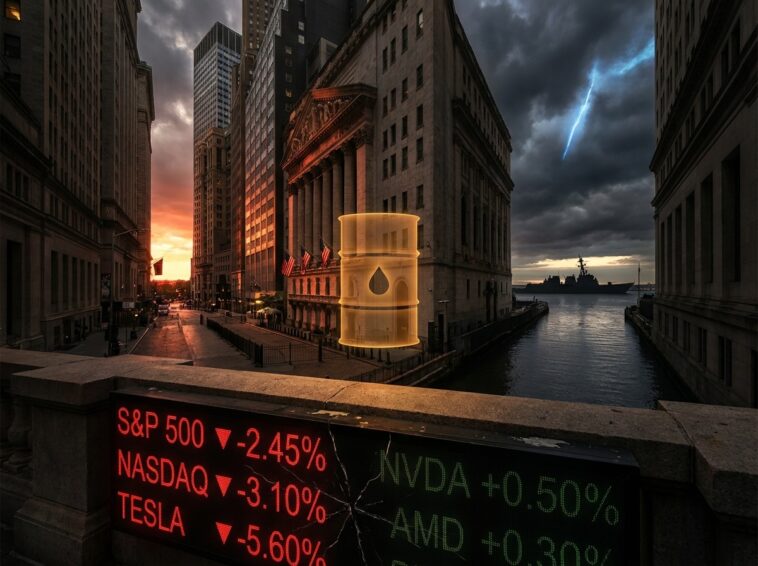
Markets wobbled Thursday as stagflation fears 2026 resurged, Brent crude punched past $103, and a string of tech earnings left investors questioning whether the rally had finally outrun reality.
It was supposed to be a clean continuation. Wednesday’s session had been the kind of day traders dream about — the S&P 500 pushed 1.05% higher to close at a fresh record, the Nasdaq surged 1.64%, and President Trump’s decision to extend the Iran ceasefire indefinitely handed bulls exactly the geopolitical cover they needed. Chipmakers had risen for a 16th straight session, with Broadcom, AMD, and Micron surging between 5% and 8%. TRADING ECONOMICS
Then Thursday happened.
Stock futures retreated as a breakdown in U.S.-Iran negotiations overshadowed Trump’s “indefinite” truce, and a complete naval blockade of the Strait of Hormuz pushed Brent crude back above $103 per barrel — fueling stagflation fears ahead of April’s manufacturing data. The Motley Fool By early afternoon, the mood had curdled completely. The Nasdaq fell more than 1%, while the Dow and S&P 500 weren’t far behind, with barely a third of U.S. issues advancing as selling accelerated into the afternoon. TheStreet
The Stagflation Trade: Why This Oil Spike Is Different
This isn’t your garden-variety crude rally. Energy traders aren’t just pricing in supply disruption — they’re pricing in duration. With Iran showing no appetite for near-term negotiations and the Strait of Hormuz choke point effectively shuttered, the math gets ugly fast for the U.S. economy.
Oil above $100 is a tax on everything. Airlines, trucking, manufacturing, plastics — the inflationary tentacles reach everywhere. And here’s the cruel irony: the Fed has no clean answer.
“The textbook response to an oil-driven price surge is to hold rates steady and let the shock pass,” said Marcus Thorne, Head of Macro Strategy at Meridian Capital Partners in New York. “But if this blockade persists past June, we could be looking at headline CPI re-accelerating past 4% — and suddenly ‘hold steady’ becomes a political liability for Powell’s team.”
Rate cuts? Off the table if inflation reignites. Rate hikes? A body blow to an economy that just spent two years clawing back consumer confidence. That’s the stagflation trap — slow growth, rising prices, and a central bank with its hands tied.
Tesla’s $25 Billion Bombshell
If the oil story was the macro gut punch, Tesla delivered the earnings-season gut punch. The company beat first-quarter estimates. Should have been cause for celebration. It wasn’t.
Despite the Q1 earnings beat, shares fell as CEO Elon Musk announced capital expenditure guidance of $25 billion for 2026 to fund a massive “Cybercab” and AI robotics push — with a dedicated “Optimus” humanoid robot facility in Austin set to begin large-scale output in August. The Motley Fool That’s a tripling of the prior capex run-rate. Investors who showed up expecting cash flow discipline got a moonshot instead.
Tesla closed down roughly 3%. Not catastrophic. But directionally significant.
The company is making a calculated bet: sacrifice near-term free cash flow for autonomous vehicles and robotics dominance. Maybe it pays off in 2028. Maybe it doesn’t. But in a market environment where the VIX has quietly crept back above 20 and oil is flirting with triple digits, investors don’t have the patience for “trust us.”
Software Gets Hammered
Tesla wasn’t alone. Enterprise software giants IBM and ServiceNow dragged on the indices, dropping 7% and 13% respectively, as investors questioned whether current profit growth can sustain premium valuations amid ongoing geopolitical uncertainty. The Motley Fool
IBM’s sin was unchanged guidance in a market demanding upside. ServiceNow’s was slower subscription growth — a four-alarm fire in a sector that has been priced for perpetual acceleration.
“The problem isn’t that these companies are bad businesses,” said Dana Weir, Portfolio Strategist at Ashford Lane Investment Group in Chicago. “The problem is they’ve been priced for perfection in an environment that’s becoming increasingly imperfect. When oil spikes, enterprise IT budgets get the first haircut.”
The Counter-Narrative You’re Not Hearing
Not everyone is spooked. Texas Instruments told a different story. TI’s solid outlook lifted chipmakers for a 17th straight session Bloomberg, a remarkable streak that suggests the semiconductor cycle has legs regardless of geopolitical noise.
And there’s a contrarian case worth hearing. James Kowalski, a rates strategist at Harbor Street Advisors, argues the stagflation narrative is being overplayed. “Brent at $103 is not Brent at $130,” he told clients Thursday morning. “The U.S. is a net energy exporter now. Domestic producers benefit. The reflex panic about oil and inflation ignores how structurally different the American energy picture is compared to 2022.” He’s sticking with energy equities and trimming duration on Treasuries — a bet that the fear is louder than the fundamentals.
What Retail Investors Should Do Right Now
Here’s the practical takeaway from a messy Thursday.
Energy is your hedge. If the Strait of Hormuz standoff persists even another 30 days, integrated oil majors and domestic refiners keep printing. Exxon, Chevron, and Valero have pricing power that almost nothing else in this market can match right now.
Be selective in tech. Not all tech is equal. TD Cowen reiterated a buy rating on Nvidia 24/7 Wall St., and chipmakers tied to AI infrastructure remain structurally different from the enterprise software names getting hammered. Nvidia is not ServiceNow. Don’t let Thursday’s broad tech sell-off trick you into selling the semiconductor story.
Watch the yield curve. If stagflation fears harden, the 2-year Treasury yield climbs while the 10-year stalls — a re-inversion nobody wants to see. That spread will tell you more about where this economy is actually headed than any earnings call.
One bad Thursday doesn’t break a bull market. But Wednesday’s record close looks a little more fragile today. And that’s worth taking seriously.