Editor
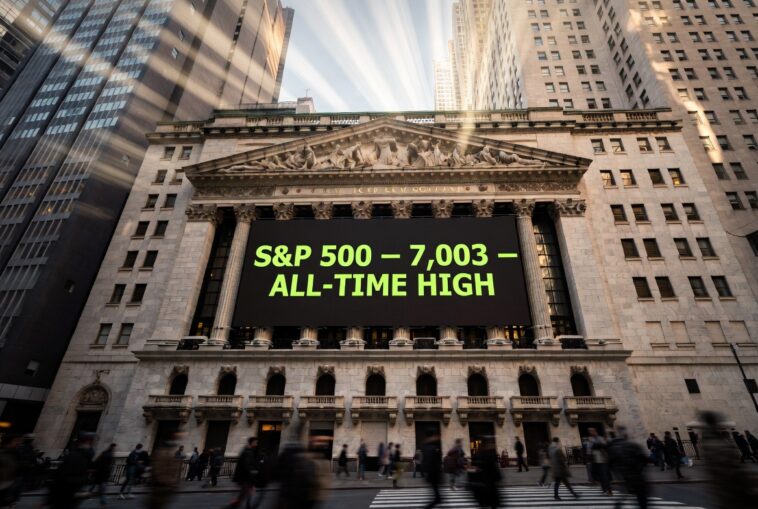
The S&P 500 Just Touched a New All-Time High. Don’t Celebrate Yet.
The S&P 500 all-time high arrived quietly on Wednesday — no fanfare, no confetti on the trading floor. Just a broad market index grinding past 7,003, reclaiming a level it hadn’t seen since January 28th, in the middle of an oil shock, an active Middle East conflict, and a banking sector still sorting through a mixed earnings week.
That’s the market for you. Stubborn. Illogical. Often right.
The catalyst this time was unmistakable. Morgan Stanley posted record quarterly revenue of $20.58 billion in Q1 2026 — a 16% jump from a year ago — while profit surged 29% to $5.57 billion, or $3.43 per diluted share. Both figures blew past Wall Street estimates. The number analysts were penciling in? $3 per share on $19.72 billion in revenue. Morgan Stanley didn’t just beat the bar. It raised it.
The stock? Shares rose more than 4% in pre-market trading following the announcement. By midday, it was leading the financial sector higher — and dragging the broader market with it.
S&P 500 All-Time High Fueled by One Exceptional Trading Desk
Here’s what made the Morgan Stanley number genuinely extraordinary.
Equities trading revenue surged to a record $5.15 billion — a 25% increase driven by hedge fund prime brokerage activity and derivatives, easily outpacing analyst estimates. That’s not a small beat. That’s a different league entirely.
But the real story — the one that separates this from a typical cyclical trading pop — is what happened in fixed income. Fixed income revenue jumped 29% to $3.36 billion, powered largely by commodities desks that capitalized on the wild swings in energy prices during the quarter. Morgan Stanley actually surpassed Goldman Sachs in that trading category for the period.
Let that sink in. Goldman — the firm that practically invented fixed income trading dominance — got outrun by Morgan Stanley on energy-driven commodities revenue. In a quarter defined by $100-plus oil and a naval blockade in the Strait of Hormuz, that’s a telling result.
Investment banking revenue also jumped 36% to $2.12 billion, driven by advisory fees on completed deals as well as equity and debt issuance. The dealmaking machine is back. AI-related infrastructure acquisitions and software mergers drove a significant chunk of that business, according to analysts tracking the sector.
“This isn’t just Morgan Stanley having a good quarter,” said Jonathan Hale, Senior Managing Director at Ridgecrest Capital Markets in New York. “This is a signal that institutional clients are still moving capital aggressively — hedging, repositioning, making bets — even amid everything happening in the Middle East. When your clients are scared, they trade. And Morgan Stanley gets paid when they trade.”
Wealth Management Tells a Different Story
Not everything in Wednesday’s report screamed euphoria.
Investment management was the only business line to disappoint, with revenue declining 4.2% to $1.54 billion. The firm attributed the drop to reduced carried interest on private funds. That’s a notable crack in an otherwise gleaming report. Private fund performance — the kind of returns that generate carry — has been uneven in a market rattled by geopolitical volatility since January.
Total non-interest expenses came in at $13.5 billion, up 12% year-over-year and slightly above forecasts. The earnings statement showed $178 million set aside for severance charges as the firm reduced headcount during the quarter. Layoffs and record revenue in the same quarter. Only on Wall Street.
Sandra Vance, Chief Investment Officer at Lakemont Wealth Advisors in Chicago, isn’t entirely sold on the rally’s durability. “The Morgan Stanley number is spectacular, and I’m not disputing the quality of the quarter,” she told Rise Investment News. “But you need to ask: how much of this was driven by volatility-induced trading that won’t repeat in Q2? If the Iran situation resolves and oil pulls back to $80, the commodity desks that saved fixed income this quarter go quiet. The market is pricing in a continuation that may not come.”
It’s a fair challenge. Markets have a way of rewarding traders who profit from crisis — and then punishing them when calm returns.
What the 7,000 Level Means for Retail Investors
The S&P 500 hit a new intraday all-time high of 7,003 Wednesday, with the broader index up 0.4% and the Nasdaq gaining 0.9%, led by gains in Broadcom, Meta, Nvidia, Apple, and Microsoft.
The all-time high is psychologically significant. It means the market has fully absorbed the shock of a Middle East war, $104-per-barrel oil, and a Strait of Hormuz blockade — and decided none of it was enough to derail the long-term bull case. That’s remarkable. It’s also worth scrutinizing.
President Trump has said the Iran conflict is “very close to over,” with reports suggesting a new round of direct U.S.-Iran peace talks could be imminent. If that materializes, oil falls. Inflation expectations cool. The Fed gets breathing room it desperately needs. That’s the scenario the market is trading right now.
Here’s the practical read for individual investors. Record highs aren’t signals to sell — history is clear on that. The S&P 500’s best years often produce their highest closes in the final stretch. But a market at all-time highs, running on peace-deal optimism and one spectacular bank earnings report, warrants discipline over euphoria.
Rebalance if your equity allocation has drifted meaningfully above your target. Financials — particularly investment banks exposed to trading revenue — look well-positioned if volatility persists. And watch Morgan Stanley CEO Ted Pick’s forward commentary carefully: he described the firm’s posture as one of “measured confidence,” citing higher asset prices, tight credit spreads, and interest rate path uncertainty as factors warranting vigilance.
Record quarter. Watchful CEO. That gap is worth noting.
The S&P 500 is at 7,003. It got there the hard way. Staying there is a different challenge entirely.