Editor
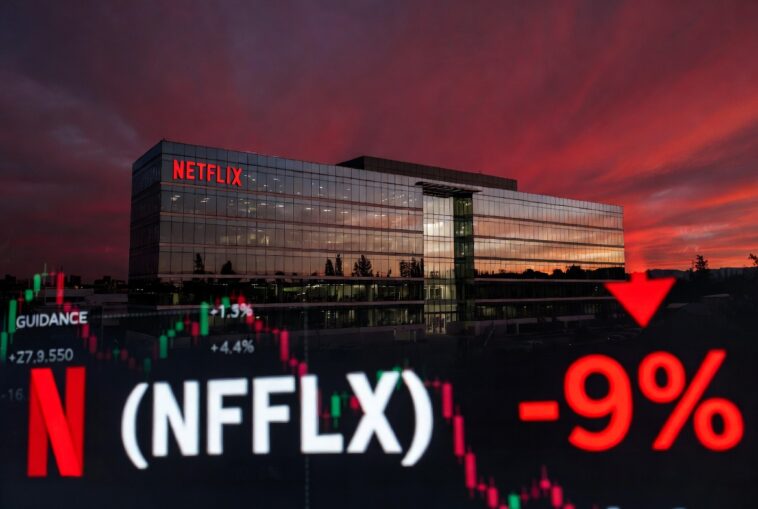
Netflix Beat the Numbers and Still Got Punished. Here’s the Real Story
Netflix stock’s 9% after-hours drop on Thursday wasn’t irrational. It was a market sending a precise, cold message: on Wall Street in 2026, what you did last quarter matters far less than what you say you’ll do next.
Netflix posted Q1 revenue of $12.25 billion — beating the $12.18 billion analyst consensus — while full-year revenue guidance held steady at $50.7 to $51.7 billion. Quartz Solid numbers. By any traditional measure, a good quarter. And yet, the stock crashed nearly 9% in after-hours trading. The Motley Fool
The market wasn’t confused. It was reading the fine print.
Netflix Stock Drop: When a Beat Isn’t Really a Beat
The earnings-per-share headline was eye-catching. Bottom-line profits reached $5.28 billion, or $1.23 per share — nearly twice the $2.89 billion the company posted in the same quarter last year. Quartz But that number needs an asterisk the size of a Hollywood billboard.
The inflated EPS was largely driven by a $2.8 billion breakup fee Netflix received after withdrawing from a contentious bidding war over Warner Bros. Discovery assets. The Motley Fool Paramount SkyDance ultimately won that bid. Netflix walked away with a windfall. That’s not operating leverage. That’s a one-time payment dressed up in quarterly earnings clothes — and sophisticated investors saw straight through it.
The real gut-punch was the forward guidance. Q2 revenue guidance landed at $12.57 billion, short of Wall Street’s $12.64 billion estimate. Q2 earnings per share guidance of $0.78 also fell below the $0.84 the Street was expecting. Operating income outlook of $4.11 billion missed the $4.34 billion analysts had anticipated. Yahoo Finance
Three guidance lines. Three misses. That’s not a rounding error. That’s a pattern.
“The Warner Bros. windfall masked what is actually a story about cost acceleration and margin compression in the near term,” said Victor Aldridge, Media and Technology Analyst at Midtown Capital Research in New York. “Netflix management essentially told you: we’re front-loading content spending into the first half of 2026, and margins are going to feel it. That’s not the growth-at-reasonable-cost story the market was pricing in at $1,000 a share.”
The Reed Hastings Exit: End of an Era, Start of Uncertainty
The guidance story would have been enough to rattle the stock. Netflix gave investors something else to process on top of it.
Netflix co-founder and chairman Reed Hastings announced Thursday that he would exit the board in June when his term expires, ending a nearly three-decade journey with the company he built from a DVD-by-mail startup into a global streaming giant. CNBC
Hastings had already stepped down as CEO in 2023, handing the reins to co-CEOs Ted Sarandos and Greg Peters, but his full departure from the board marks a genuine milestone — and immediately raised questions on the earnings call about whether his exit was linked to Netflix’s failed Warner Bros. bid. Deadline
It was. Sort of. Sarandos addressed the question directly on the investor call: “Reed was a big champion for that deal. He championed it with the board. The board unanimously supported the deal.” Watcher Guru Sarandos maintained the departure was unrelated — that Hastings had been moving toward philanthropy and other pursuits since 2023. But the timing, arriving in the same shareholder letter as soft guidance, gave the market a two-front anxiety attack in a single evening.
Founders leaving boards never happens cleanly. Never.
The Counter-Narrative: The Business Itself Is Fine
Here’s what the 9% drop obscures. Netflix is operationally healthy. The underlying business metrics don’t tell a crisis story.
The company confirmed advertising revenue is on track to reach $3 billion in 2026 — a doubling year over year — with the ad-supported tier now accounting for more than 60% of new sign-ups in markets where ads are available. Watcher Guru That’s not a struggling product. That’s a monetization engine gaining traction fast.
Netflix is also reportedly in active talks with the NFL to expand its streaming relationship beyond the Christmas Day games it already holds rights to. Watcher Guru Live sports. The final frontier for streaming. If Netflix cracks an expanded NFL deal, the revenue trajectory looks entirely different by 2027.
Diana Reyes, Portfolio Manager at Shoreline Investment Partners in San Francisco, isn’t selling. “Guidance misses of $70 million on a $12.5 billion revenue quarter are noise, not signal,” she told Rise Investment News. “The advertising business doubling, live sports expansion, and global subscriber base above 300 million — that’s the thesis. I’d rather buy the 9% dip than chase the stock two quarters from now when Q2 results prove the margin pressure was temporary.”
Reyes has a point. Netflix has punished sellers in every major post-earnings drop over the past three years.
What This Means for Your Portfolio Right Now
The Netflix story crystallizes one of the most important dynamics in this earnings cycle: the market is extraordinarily intolerant of guidance softness, even against a backdrop of record index levels.
The Nasdaq posted its 12th consecutive positive session on Thursday — its longest winning streak since 2009 — while the S&P 500 closed at a fresh record of 7,041. CNBC Investors are euphoric at the index level. But single stocks that disappoint on outlook are getting hit with precision and speed that suggests the risk-reward calculus has tightened considerably.
For retail investors holding Netflix: the 9% drop doesn’t change the long-term thesis — advertising growth, pricing power, and live content expansion remain intact. But the immediate catalyst for a reversal is now Q2 results in mid-July, when the market will want to see whether the margin pressure was truly a timing issue or the beginning of a structural cost problem.
Netflix maintained its full-year operating margin target of 31.5%, and management said content amortization growth would ease to mid-to-high single digits in the back half of 2026. Quartz If that guidance proves accurate, Thursday night’s selloff will look like a gift. If it doesn’t, it will look like the warning investors chose to ignore.
Beat the numbers. Miss the future. Pay the price. That’s the Netflix lesson of April 2026.