Editor
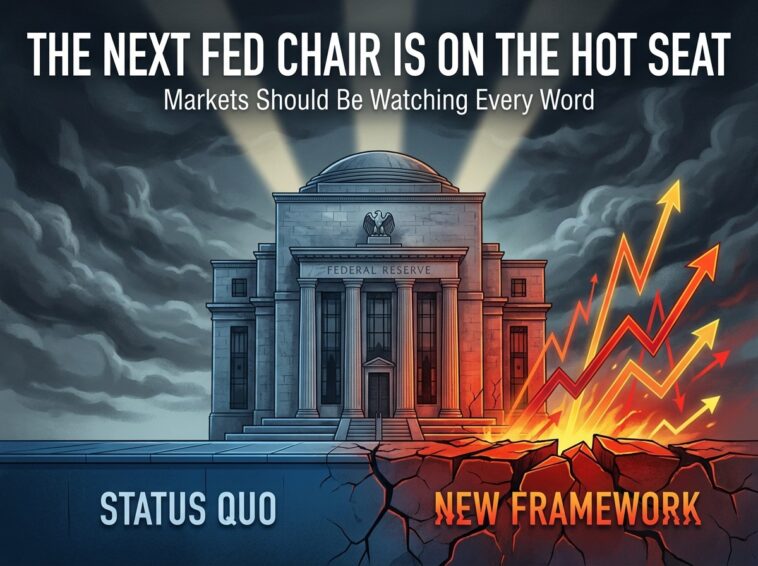
The Next Fed Chair Is on the Hot Seat. Markets Should Be Watching Every Word.
The Kevin Warsh Fed chair confirmation hearing that consumed Capitol Hill on Tuesday wasn’t just a political spectacle. It was, for U.S. investors, arguably the most consequential two hours of testimony in years — a live preview of who will control American interest rates, inflation policy, and the entire monetary architecture that underpins every asset class you own.
Warsh vowed before the Senate Banking Committee to introduce “regime change” at the Federal Reserve if confirmed, potentially reducing the number of policy meetings per year and proposing a new framework for inflation. CNN Regime change. At the Fed. Those aren’t words that pass without consequence in the bond market.
The man wants to reshape the institution. Today’s hearing showed exactly how complicated that path is going to be.
Kevin Warsh Fed Chair Confirmation: Independence or Illusion?
The central tension of Tuesday’s hearing wasn’t really about inflation targets or meeting schedules. It was about one word: independence.
In prepared testimony, Warsh wrote that he does not believe Fed independence is “particularly threatened when elected officials — presidents, senators, or members of the House — state their views on interest rates.” Yahoo Finance That’s a carefully worded statement. Diplomatically crafted. And immediately tested. Trump, in a simultaneous CNBC interview, was asked directly whether he’d be disappointed if Warsh didn’t cut rates right away. Yahoo Finance The president answered while his nominee was mid-testimony. The irony wasn’t lost on anyone in the hearing room.
Sen. Elizabeth Warren, the ranking Democrat on the committee, made her position blunt: “Warsh has really gone out of his way to demonstrate that he will be the sock puppet in chief.” NPR Warsh pushed back. Hard. He told senators he won’t be Trump’s “sock puppet,” and defended both his and the institution’s ability to operate outside political interference. CNN
The exchange was sharp. Warsh wasn’t rattled. But the substance underneath the theater deserves real attention from investors.
“What markets need to understand is that Warsh’s confirmation — or lack of it — directly affects the rate cut trajectory for 2026 and 2027,” said Jonathan Albright, Chief Rates Strategist at Meridian Fixed Income Partners in New York. “A Warsh Fed that tilts toward loosening policy would reprice the entire yield curve. We’re talking about a 30 to 50 basis point shift in expectations that would move equities, bonds, and real estate simultaneously.”
The Tillis Blockade: One Senator Holds the Keys
Here’s the piece most financial media are burying in paragraph twelve. It’s actually the most market-relevant fact of the day.
Republican Sen. Thom Tillis of North Carolina — who holds a vote that could single-handedly block Warsh’s nomination from leaving committee — said he remains determined to stop the confirmation until the Justice Department drops its criminal investigation into current Fed Chair Jerome Powell. Yahoo Finance Republicans hold a 12-10 advantage on the Senate Banking Committee. One dissent means the nomination stalls.
Powell’s term expires in less than a month — May 15 — and if Warsh is not confirmed by then, Powell has said he will serve as chair pro tempore until a successor is confirmed. Yahoo Finance That scenario — a lame-duck Fed chair operating under legal siege, a nominee stuck in committee limbo, and an administration openly pressuring both — is not a scenario the bond market has fully priced.
The Fed without a confirmed chair during an active Middle East war, with oil above $87 a barrel and a ceasefire expiring at midnight? That’s not a tail risk. It’s Tuesday.
The Counter-Narrative: Warsh May Be More Hawkish Than Markets Hope
Not everyone on Wall Street is positioning for a Warsh rate-cut bonanza.
Sandra Reyes, Senior Portfolio Manager at Lakemont Capital in Chicago, is watching this hearing differently than most. “The market is trading Warsh as a dovish Trump puppet who will slash rates,” she told Rise Investment News. “But read his actual record. He has a history as a hawk — cautious about cutting rates for fear inflation might get out of control. His recent dovish shift has been framed as AI productivity optimism, but if oil stays above $90 and CPI doesn’t cooperate, that productivity argument evaporates fast. NPR Warsh might shock rate-cut bulls by doing nothing for the first two quarters.”
That view has institutional backing: many current Fed committee members remain reluctant to cut rates until inflation is closer to the 2% target, and the Iran war’s spike in gasoline prices has made that goal harder to reach. NPR A new chair doesn’t change the math. It changes the communication.
Warsh’s prepared statement included a firm commitment to fighting inflation, with only a single mention of the labor market CNBC — a notable asymmetry for a Fed nominee in an era when maximum employment is half the dual mandate.
The Apple Subplot. And Tim Cook.
One more headline dropped Tuesday that deserves a sentence. Bank of America noted that Apple CEO Tim Cook is set to step down on September 1, 2026, with the transition described as coming “from a position of strength” and suggesting “a new era of devices” under a product-oriented leader with deep hardware design experience. 24/7 Wall St.
Apple is a $3 trillion company. Leadership transitions at that scale move markets, reweight indices, and shift sentiment in consumer tech for quarters at a time. File it. Watch it. September will come fast.
What Retail Investors Should Do Right Now
The Warsh hearing crystallizes a framework retail investors should carry into the next six weeks.
Watch the 2-year Treasury yield more than the S&P 500. The 2-year is the market’s live read on near-term Fed policy expectations. If Warsh’s confirmation stalls and Powell remains in limbo, the 2-year will tell you what the bond market thinks about rate cuts before any headline confirms it.
Don’t chase the ceasefire trade blindly. Citigroup analysts warned Tuesday that oil prices could rise to $110 per barrel if traffic in the Strait of Hormuz remains disrupted for another month TheStreet — a scenario that makes Warsh’s rate-cut mandate structurally impossible to fulfill without triggering an inflation spiral. Energy exposure remains the clearest hedge.
Retail sales surprised to the upside. March retail sales rose 1.7%, stronger than the 0.6% February gain and above the 1.5% consensus estimate — though the surge was largely driven by a 15.5% spike in gas station receipts as pump prices soared past $4 a gallon. CNBC That’s inflation-driven spending, not confidence-driven spending. A critical distinction that changes what the consumer data actually tells you.
The Fed chair who replaces Jerome Powell will set the trajectory of U.S. monetary policy through 2030. Today’s hearing was the first real look at what that future might hold. It was messy, political, and unresolved.
In other words? Perfectly on brand for 2026.