Editor
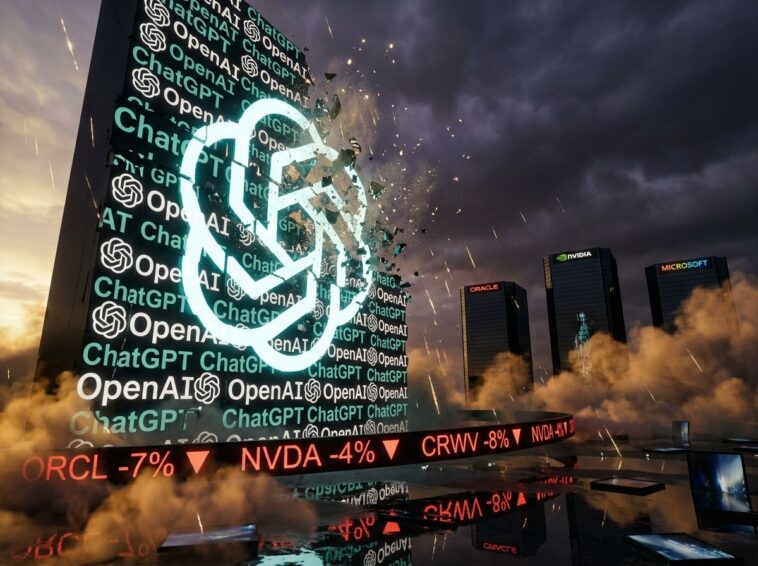
The AI Trade Just Got Its First Real Scare. And the Timing Couldn’t Be Worse.
The OpenAI revenue miss landed like a grenade on Tuesday morning — and Wall Street’s most crowded trade is now bleeding out, right before the week’s most important earnings reports hit the tape.
The Wall Street Journal dropped the bombshell overnight. OpenAI has missed its own targets for revenue and new users, raising concern inside the company about whether it can sustain its sprawling data center commitments. Tradingkey The details? Brutal. An internal milestone of one billion weekly active ChatGPT users by year’s end went unmet. ChatGPT’s annual revenue target slipped out of reach as Google’s Gemini surged and claimed a bigger slice of the market. And Anthropic’s gains in coding and enterprise pushed OpenAI below its monthly revenue goals on several occasions earlier this year. Tradingkey
OpenAI pushed back. Hard. CEO Sam Altman and CFO Sarah Friar issued a joint statement calling the report “ridiculous.” But the denial landed flat. Markets had already made up their minds.
OpenAI Revenue Miss Detonates Across the AI Infrastructure Chain
The selloff wasn’t surgical. It was a chainsaw.
Oracle, which has a $300 billion, five-year partnership to supply computing power to OpenAI, dropped more than 7%. Chipmakers including Nvidia, Broadcom, and Advanced Micro Devices declined between roughly 3% and 4%. Qualcomm pulled back 3.5%. Trefis In Tokyo, SoftBank Group, one of OpenAI’s largest investors, sank about 10%. Trefis CoreWeave, the neocloud whose entire business model is built on AI infrastructure demand, tumbled in early trading.
The logic of contagion is straightforward. If OpenAI — the company that sparked this entire AI spending supercycle — can’t hit its own revenue targets, every contract it signed with Oracle, every chip order it placed with Nvidia, every colocation deal with CoreWeave becomes a question mark. Bloomberg Intelligence’s Anurag Rana said the miss “will have an impact throughout the entire AI infrastructure ecosystem, with Oracle as the most exposed in terms of risk to its financial goals.” Meyka
The knock-on effects spread even further. Selling spread to picks-and-shovels names tied to data center buildouts — GE Vernova and Vertiv each fell more than 2%, and Caterpillar slipped about 2%. Meyka
“This is what a crowded trade looks like when it starts to unwind,” said Marcus Hale, Chief Investment Officer at Stonebridge Capital Partners in New York. “Everyone was long the AI infrastructure story. Everyone. When the anchor tenant of that story — OpenAI — shows cracks, the exit door gets very narrow, very fast.”
The CFO Who Saw It Coming
There’s a subplot here that deserves more attention than it’s getting.
OpenAI’s CFO Sarah Friar has expressed concern that the company is spending too much money on data centers and may not be generating enough revenue to support the contracts it has entered into. The Motley Fool She reportedly wanted more spending discipline — putting her directly at odds with Sam Altman’s burn-the-boats approach to AI dominance.
That internal fracture matters. A lot. Friar has also raised doubts about OpenAI’s readiness to go public on Altman’s preferred schedule, telling executives and board members that the company still lacks the financial infrastructure public-market regulators demand. Tradingkey
The IPO. That’s the number Wall Street was underwriting. A sub-$1 trillion valuation company racing toward public markets, armed with $122 billion in fresh funding and a story about inevitable AI dominance. The revenue miss doesn’t kill that story. But it complicates the pitch considerably.
Why This Week’s Timing Makes Everything Worse
Here’s the cruel irony. This report dropped on the single worst possible day for the AI trade to wobble.
Meta reports Wednesday. Amazon and Microsoft follow Thursday. Apple closes out the week. The “Magnificent Seven” companies face elevated expectations, needing to deliver solid revenue growth to validate heavy AI spending. Their shares have already surged ahead of results — Alphabet, Amazon, Meta, and Microsoft are each up more than 10% this month. umich
That run-up now looks dangerous. If investors are suddenly questioning whether AI revenue can justify AI infrastructure spending — and OpenAI just handed them that question on a silver platter — every Big Tech earnings call this week becomes a referendum on the whole thesis.
“The companies reporting this week need to do more than beat the number,” said Diana Reyes, Senior Technology Analyst at Clearfield Research Group in Boston. “They need to show that AI is generating real, measurable, accelerating revenue — not just cost savings and productivity gains that don’t show up cleanly on an income statement. The bar just got higher, not lower.”
The Counter-Narrative: One Analyst Isn’t Selling
Not everyone is reaching for the sell button. John Belton, a portfolio manager at Gabelli Funds, is holding his ground.
“I view the article as largely a rehash of what we already knew: OpenAI’s growth seems to have slowed in late-2025 into early-2026 as the business ceded some share to Anthropic and Gemini. There is nothing here that suggests this is an issue for the pace of spending across the sector as a whole.” Trefis
Belton’s point has merit. OpenAI losing market share to Anthropic and Gemini doesn’t mean AI demand is collapsing — it means competition is intensifying. The hyperscalers aren’t building data centers for OpenAI. They’re building them for themselves. Meta’s $135 billion capex plan. Amazon’s AWS expansion. Microsoft’s Azure buildout. Those trains left the station regardless of what Sam Altman’s revenue dashboard shows.
The question retail investors need to answer for themselves: Is Tuesday’s selloff a buying opportunity in beaten-down AI infrastructure names, or the first tremor of something bigger?
What to Do Before Wednesday’s Bell
Three moves worth considering right now.
Don’t panic-sell diversified AI exposure. The Nvidia thesis — data center GPU demand from multiple hyperscalers — is structurally intact. One customer’s revenue miss doesn’t change that. Watch capex commentary closely this week: any softening of AI infrastructure spending guidance would extend today’s pullback well beyond the OpenAI orbit. Meyka That’s the real tell.
Watch the Fed on Wednesday. All eyes turn to the Federal Reserve on Wednesday as officials deliver their third rate decision of 2026 — almost certainly the last under Chair Jerome Powell. With inflation creeping higher and the job market losing steam, the FOMC is expected to stand pat, keeping its benchmark rate in the 3.5%–3.75% range. Meyka A hawkish statement on inflation crushes high-multiple tech even further. A neutral tone could stabilize things fast.
Separate the picks-and-shovels from the storytellers. Oracle’s exposure to a single AI customer is very different from Nvidia’s diversified demand base. Know what you own and why you own it. Tuesday’s indiscriminate selling created mis-pricings — but also genuine risks that deserve a harder look.
The AI trade isn’t dead. Not even close. But its first real stress test just began — and the next 72 hours will determine whether this is a healthy correction or something that requires a full portfolio rethink.
Buckle up.