Editor
Stock Market Today Faces 19-Year Treasury Reckoning as Nvidia Verdict Looms
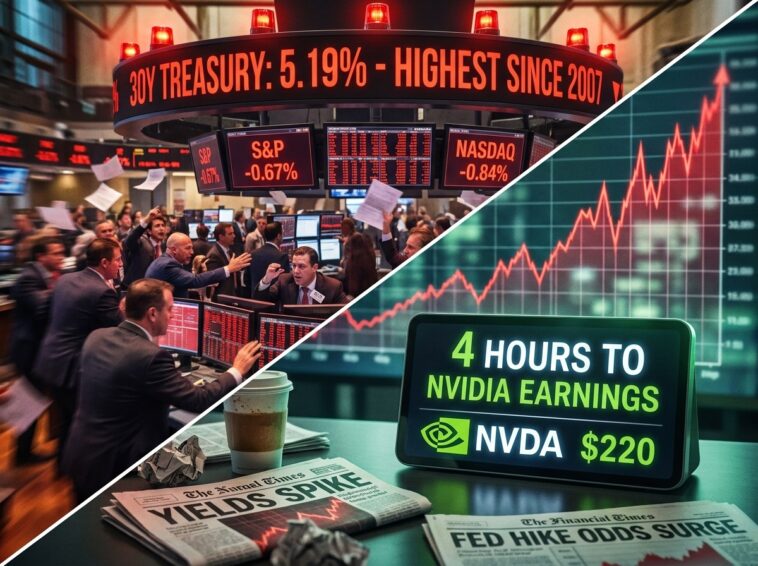
The stock market today is caught in a vise nobody saw coming six months ago: the 30-year Treasury yield hit 5.197% during Tuesday’s session, marking its highest level since July 2007—nearly 19 years. The 10-year yield climbed to 4.687%, the highest since January 2025. And Nvidia, the world’s most valuable company, reports earnings in four hours. TRADING ECONOMICSTRADING ECONOMICS
Wall Street’s holding its breath.
The S&P 500 closed down 0.67% at 7,353.61, the Nasdaq fell 0.84% to 25,870.71, and the Dow shed 322 points, marking three consecutive losing sessions. That’s not volatility. That’s repricing. When bond yields surge 80 basis points in two weeks while the market sits at all-time highs, something breaks—either yields collapse back down, or equity valuations crater. TRADING ECONOMICSTheStreet
“We’re watching a slow-motion collision between fiscal reality and AI euphoria,” says Richard Chen, Chief Market Strategist at Apex Capital in New York. “A Bank of America survey shows 62% of global fund managers expect 30-year yields to hit 6%—that’s 85 basis points higher from here. If they’re right, every growth stock multiple gets destroyed. Nvidia included.” TRADING ECONOMICS
Why Treasury Yields Hitting 5.19% Changes Everything for the Stock Market Today
Here’s the math Wall Street doesn’t want retail investors to understand: when the 30-year Treasury—the safest asset on Earth—yields 5.2%, why would anyone accept the risk of owning tech stocks trading at 35x forward earnings? The answer used to be “because tech grows at 30% annually.” But the 20-year and 30-year Treasuries are now at levels not seen since 2007, and suddenly that growth premium doesn’t compensate for the risk. 24/7 Wall St.
Ian Lyngen, BMO’s head of U.S. rates, warned that if 30-year yields reach 5.25% in the next few weeks, there will be a “more durable pullback” in equity valuations. Translation: the selloff you’ve seen so far? Warmup act. TRADING ECONOMICS
The inflation data that triggered this bond massacre came from dual shocks—consumer prices in April rose at the highest annual rate in three years, driven by oil above $100 and food costs spiking on drought conditions. The Fed’s new chairman Kevin Warsh inherits a nightmare: cut rates and fuel inflation, or hold steady and watch markets implode. TheStreet
CME Group’s FedWatch is now estimating an 80% chance of a rate hike by July 2027. Not a hold. Not a cut. A hike. The playbook flipped overnight. 24/7 Wall St.
Nvidia Earnings: The Ultimate Stock Market Stress Test Today
Analysts expect Nvidia to report earnings of $1.78 per share, up 120% year over year, on revenue of $79.2 billion. The chipmaker exceeded revenue expectations in all four quarters of fiscal 2026, so a beat is essentially priced in. The number that actually matters? Forward guidance for Q2. TheStreet + 2
Meta increased its capex estimates by $10 billion to between $125-145 billion, while Microsoft raised its 2026 forecast to $190 billion. But both companies are simultaneously investing in custom AI chips to reduce Nvidia dependence. Analysts expect forward guidance of about $87 billion for Q2 2027. Anything below that triggers violent repricing. TRADING ECONOMICSTRADING ECONOMICS
Richard Reyle, chief investment officer at Questar Capital Partners, called Nvidia’s earnings “the ultimate test for a stock market that is not only trading at record highs, but one that also had a breathtaking bounce off of the March lows”. TheStreet
Here’s the uncomfortable reality: Nvidia stock has fallen to around $220 after trading at higher levels, reflecting concerns about China export restrictions eliminating an $8 billion revenue opportunity. The H20 chip restrictions wiped out the company’s China market share completely. Nvidia maintains an estimated 81% market share in AI accelerators despite intensifying competition, but AMD and Intel are gaining ground with every passing quarter. TheStreetTheStreet
The Contrarian Take: Why One Strategist Says Buy the Chaos
Patricia Nguyen, Senior Portfolio Manager at Riverside Equity Management in Chicago, sees today’s turmoil as classic capitulation before a rally. “Everyone’s panicking about yields when they should be reading the manufacturing data,” she argues. “Empire State Manufacturing jumped to 19.6—the highest since April 2022. That’s growth accelerating, not contracting.”
Nguyen’s prescription? Ignore the bond market theatrics and focus on Nvidia’s earnings power. “Data center revenue is growing 200% year-over-year. Hyperscalers are spending half a trillion building AI infrastructure. That demand doesn’t vanish because the 30-year hit 5.2%. The selloff is giving you a gift—take it.”
Maybe she’s right. Or maybe we’re watching the exact moment when two years of zero-rate muscle memory collides with 2007-level borrowing costs and concentration risk becomes catastrophic.
What Retail Investors Must Do Right Now
First, understand that higher yields are structural, not temporary. Oil above $100, inflation reaccelerating, geopolitical chaos—none of that resolves quickly. The Fed can’t cut into rising inflation, which means real rates stay elevated for quarters, not weeks.
Second, reassess concentration. If your portfolio is 40%+ in the Magnificent Seven, you’re not diversified—you’re making a leveraged bet that seven companies can sustain impossible growth while macro conditions deteriorate.
Third, consider rotating into yield beneficiaries. Financials profit from wider spreads. Value stocks with cash flows become attractive. Even Treasury bonds yielding 5.2% offer real returns if inflation moderates.
The whisper number for Nvidia is $80 billion revenue. Results drop at 4:20 PM Eastern. By 4:30 PM, we’ll know whether the AI trade still has legs—or whether the stock market today just marked the top.