Editor
Stock Market Rebound Hits Wall as Iran-Israel Trading Strikes Threaten Ceasefire
The S&P 500 and Nasdaq Composite were higher on Monday as chip stocks rebounded from Friday’s rout, and President Donald Trump tried to maintain a fragile ceasefire despite Iran and Israel trading strikes. The bounce looked good for exactly three hours. Then reality crashed the party again. CNBC
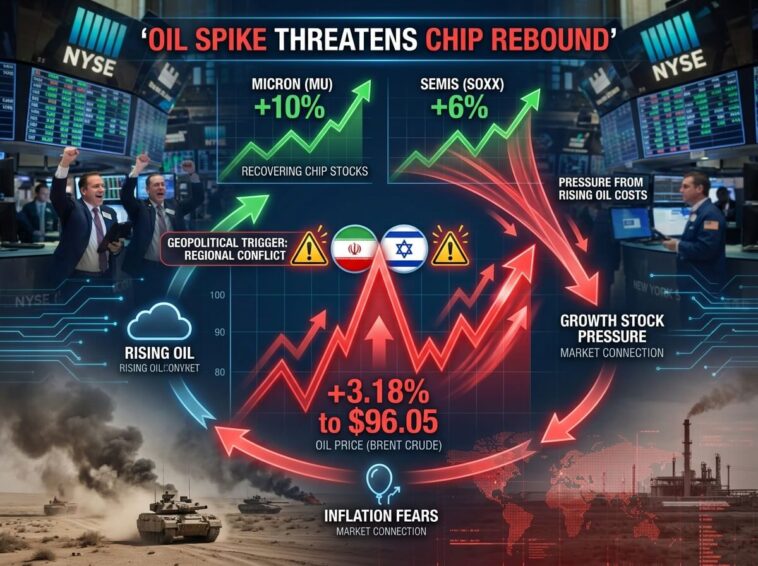
Shares of Micron Technology, the memory chipmaker that’s led the latest leg of the bull market, were up close to 10% after falling 13% on Friday. Shares of Nvidia and Broadcom were also higher. The iShares Semiconductor ETF was nearly 6% higher Monday after plunging 10% on Friday, its worst day in more than six months. CNBCCNBC
This is the textbook “buy the dip” moment. Chip stocks crashed 10% in one day? They’ve got to bounce. That’s how markets work. Oversold sectors find buyers. Institutional money that missed Friday’s selloff piles back in. Monday morning opens, and the rebound looks inevitable.
Except it’s not. Because oil prices rose Monday amid heightened tensions in the Middle East as Iran and Israel traded strikes, raising concerns over a fragile ceasefire and an extended conflict. International benchmark Brent crude futures for July advanced 3.18% to $96.05. CNBC
Oil rising 3.18% in a day? That’s not noise. That’s fear coming back.
“The stock market rebound made sense for exactly one trading session,” says Derek Harrison, Chief Market Strategist at Granite Peak Capital in Boston. “You get a 4% Nasdaq crash, algorithmic traders trigger oversold bounces, institutional buyers smell an opportunity. But then you remember: oil was supposed to be dropping if the ceasefire held. It’s rising instead. That means the ceasefire is fake. And if the ceasefire collapses? Oil could spike to $115 by Wednesday, inflation roars back, and the Fed’s rate hiking plans become inevitable.”
Why the Rebound Masks Deeper Structural Damage
The Nasdaq Composite dropped 4.2% on Friday, its worst decline since April 2025 as investors took profits on chip stocks over worries that the shares had gone too far given the uncertain economic backdrop. That single sentence explains everything. “Shares had gone too far given the uncertain economic backdrop.” CNBC
Translation: valuations were stretched, and the jobs report gave investors permission to book profits. Now they’re looking for new reasons to buy back in. But the geopolitical backdrop just got uncertain AGAIN.
When the ceasefire was announced last week, oil collapsed to $88. Markets celebrated. Growth stocks got re-rated higher because lower energy costs meant less inflation, which meant the Fed could maybe not hike rates. The entire narrative hinged on “peace in the Middle East.”
Now Iran and Israel are trading strikes again. That narrative is gone. Oil prices rose Monday amid heightened tensions in the Middle East as Iran and Israel traded strikes, raising concerns over a fragile ceasefire and an extended conflict. CNBC
The stock market rebound might look strong on the surface. But underneath? It’s a dead cat bounce on quicksand.
The Asia Tech Contagion Nobody’s Talking About
Meanwhile, in Tokyo, the unwinding is getting vicious. Japanese tech investor Softbank Group plunged 7.5%, while Tokyo Electron and Advantest were down 6.7% and 5%, respectively. SoftBank is down 7.5%? That’s a company that just became Japan’s most valuable. The pain is spreading globally. CNBC
The share price declines follow a recent rally in Asia tech stocks that was supported by investor optimism on AI demand. The same story everywhere: AI optimism drove valuations to unsustainable levels, one earnings miss or one macro shock triggers a revaluation, and suddenly that optimism evaporates. CNBC
The stock market rebound in U.S. semiconductors is mirrored by destruction in Japanese semis. When both regions are getting hammered, that’s not a dip to buy. That’s a trend reversal.
The Contrarian Case: Why One Analyst Says This Rebound Has Legs
Not everyone’s convinced that Iran-Israel tensions invalidate the “buy the dip” logic. Patricia Chen, Senior Market Strategist at Summit Peak Advisors in New York, sees Monday’s rebound as the beginning of a sustained recovery, not a dead cat bounce. “Yes, oil is up 3%. But it’s still at $96, not $115,” Chen argues. “That’s manageable. If you look at semiconductor fundamentals, nothing changed between Friday and Monday except sentiment.”
Chen’s betting that chip stocks rebounding from Friday’s rout is investors recognizing that the selloff was excessive. “Micron down 13% in one day? That’s not fundamental revaluation. That’s panic selling. Monday’s rebound is rational buyers stepping back in. Buy the dip works until it doesn’t. We’re not there yet.” CNBC
Maybe she’s right. Or maybe the geopolitical tether is too fragile to hold, oil spikes, inflation fears return, and the Fed’s rate hiking agenda becomes unstoppable again.
What Retail Investors Must Do Right Now
First, understand that the stock market rebound following the worst decline in over a year is a false sense of security as long as Iran-Israel tensions remain unresolved. Every day the ceasefire holds, the rally has legs. Every day a new strike happens, the rally gets crushed. CNBC
Second, don’t chase chip stock rebounds without stop-losses. Micron up 10% feels great, but if oil spikes to $105 on Wednesday, it’s back down 5%. Use this rebound to take some profits, not add positions. CNBC
Third, watch oil like a hawk. If Brent crude closes above $100 tomorrow? That’s ceasefire failure signaling. If it stays below $95? The rebound has structural support.
Fourth, consider rotating profits into defensive positions. Financials benefit from higher rates AND higher oil. Energy stocks benefit from higher oil. These aren’t sexy like semiconductors, but they’re safer when geopolitical risk is high.
Friday’s 4.2% Nasdaq crash looked like capitulation. Monday’s rebound looks like recovery. But oil rising 3% on Middle East strikes is the signal that neither is true. The ceasefire is fragile. Growth stocks are fragile. And every day Trump’s “maintaining” the ceasefire is one day closer to its collapse.
Buy the dip? Maybe. But with one hand on the eject button.