Editor
Jobs Report Paradox: Strong May Data Triggers “Good News is Bad News” Market Crash
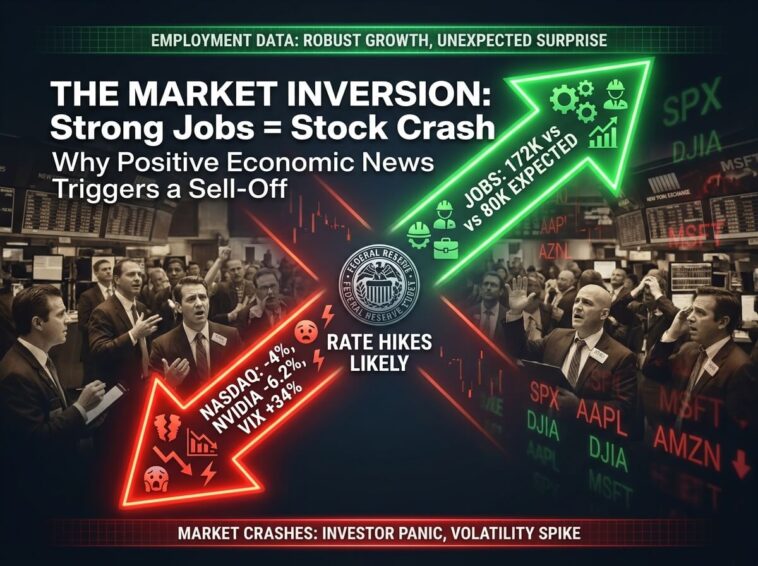
Payrolls increased by 172,000 in May — well above the expected 80,000—and markets fell off a cliff. Not because the economy is weak. Because it’s strong. Because strong economies get rate hikes. And rate hikes destroy growth stock valuations. Yahoo Finance
This is the game now. The reason markets fell on the report, which showed resilience in the labor market, is that it increased the likelihood of a Federal Reserve rate hike this year. Economists now think there’s a 70% probability of interest rates rising in December, if not before. 24/7 Wall St.
Welcome to the inverse market. Where good news is catastrophic.
The S&P 500 was down 0.63%, while the Dow Jones Industrial Average edged up 0.07%. The Nasdaq lost 1.13%, and the Russell 2000 gained 1.45%. But those numbers hide the real carnage. The Nasdaq didn’t lose 1.13%. The Nasdaq was down 4% at midday. The Cboe Volatility Index careened 34% higher and finished out the trading day above 20. CNBCCNBC
When volatility explodes 34% in a single day? That’s panic. That’s the moment when years of “easy money” assumptions suddenly evaporate.
“The jobs report broke the entire market narrative,” says Derek Martinez, Chief Market Strategist at Granite Peak Capital in Boston. “For six months, investors priced in rate cuts. They built portfolios assuming the Fed would pivot dovish by fall. This report kills that narrative stone dead. The Fed can’t cut when the labor market is adding 172,000 jobs per month while inflation stays above 3.8%. So instead of cuts, we get hikes. And hikes destroy everything.”
Why Nvidia, AMD, Micron Are Getting Decimated
Artificial intelligence (AI) and chip bellwethels led declines this morning as Nvidia (NASDAQ:NVDA), Advanced Micro Devices (NASDAQ:AMD), and Micron Technology (NASDAQ:MU), all dropped on fresh doubts around lofty valuations. Nvidia down 6.20%. That’s a $180 billion market cap evaporating in hours. Yahoo Finance
Here’s the brutal math: growth stocks like Nvidia are only worth their current prices if you assume high interest rates make borrowing more expensive, which can pressure consumer demand and corporate growth, creating headwinds for stocks. The moment the Fed shifts from “maybe we’ll cut” to “we’re hiking because the labor market is ripping,” every growth stock’s valuation model gets repriced downward. 24/7 Wall St.
Broadcom crashed yesterday on earnings. Today, the entire semiconductor complex crashed on monetary policy. Broadcom (NASDAQ:AVGO)extended yesterday’s post-earnings declines. The damage compounds. Yahoo Finance
When the Russell 2000 gains 1.45% while the Nasdaq falls 4%? That’s money flowing OUT of mega-cap growth and INTO small-cap value. That’s the asset allocation shift that happens when rate hike expectations spike from “maybe December” to “probably December.” Value stocks—companies that profit from higher rates because they have pricing power and shorter duration liabilities—suddenly look attractive.
The Fed Just Shut Down the Easy Money Machine
In addition, the government upwardly revised job gains for March and April, suggesting the labor market remains healthy despite war-fueled inflation and weak consumer sentiment. That’s not one strong month. That’s an accelerating trend. The labor market is IMPROVING despite everything trying to break it—war inflation, geopolitical chaos, rising rates, Broadcom guidance cuts. NYSE
If the labor market can add 172,000 jobs while semiconductor companies are guiding guidance down? That’s a Goldilocks problem for the Fed. Too strong to cut. Too inflationary to leave rates alone. The only solution is hiking.
Yields rose sharply and stocks slid as rate hike odds climbed. Treasury yields spiking on employment data is the canary. When unemployment is strong, inflation stays sticky, and the Fed tightens—that’s the moment when growth stocks get crushed and defensive sectors shine. 24/7 Wall St.
The Contrarian Case: Why One Analyst Says This Strengthens The Fed’s Hand
Not everyone’s convinced that strong jobs data permanently ends the bull market. Patricia Chen, Senior Market Strategist at Summit Peak Advisors in New York, sees the jobs surprise as actually GOOD for long-term market health. “Strong labor markets mean consumer spending power stays intact,” Chen argues. “Yes, the Fed might hike in December. But that’s December. This is June. Between now and then, companies with pricing power deliver earnings beats that justify current valuations.”
Chen’s betting that investors may want to consider what impact higher-for-longer interest rates might have on their portfolios, and evaluate exposure to sectors like banking, which sometimes do better when rates are high. “The market’s overreacting. Banks love higher rates. Utilities love higher rates. Not everything dies when the Fed hikes. Some sectors thrive.” 24/7 Wall St.
Maybe she’s right. Or maybe we’re watching the moment when the market finally accepts that the easy-money era ended the moment the Fed raised rates to 5.25% two years ago. And every rate hike ahead just makes growth stocks worth less.
What Retail Investors Must Do Right Now
First, understand that the tech-heavy Nasdaq taking the biggest hit in response to positive jobs data is the definition of an inverted market. Good news crashes growth stocks. This is the new normal until the Fed cuts again—which isn’t happening in 2026. Yahoo Finance
Second, rotate aggressively OUT of mega-cap tech and INTO financials, utilities, and consumer staples. The Russell 2000 gained 1.45% while the Nasdaq crashed. Small-cap value won the day because it benefits from higher rates. CNBC
Third, lock in gains in any semiconductor position that’s been profitable. Broadcom just proved that even “beat and raise” isn’t enough anymore—guidance misses trigger sector collapses. Take profits.
Fourth, consider building Treasury ladder positions. Yields rose sharply on the jobs report. If the Fed does hike, yields will rise more. But from HERE, you can lock in 4.8-5.1% on 1-10 year Treasuries. That’s real yield in a portfolio. 24/7 Wall St.
The jobs report wasn’t supposed to tank markets. But in an inverted world where easy money dies, strong labor data is terrible. The Fed’s rate hiking machine just got permission to keep going.
Welcome to the new market paradigm. It’s not about earnings anymore. It’s about interest rates. And the Fed just signaled they’re hiking.