Editor
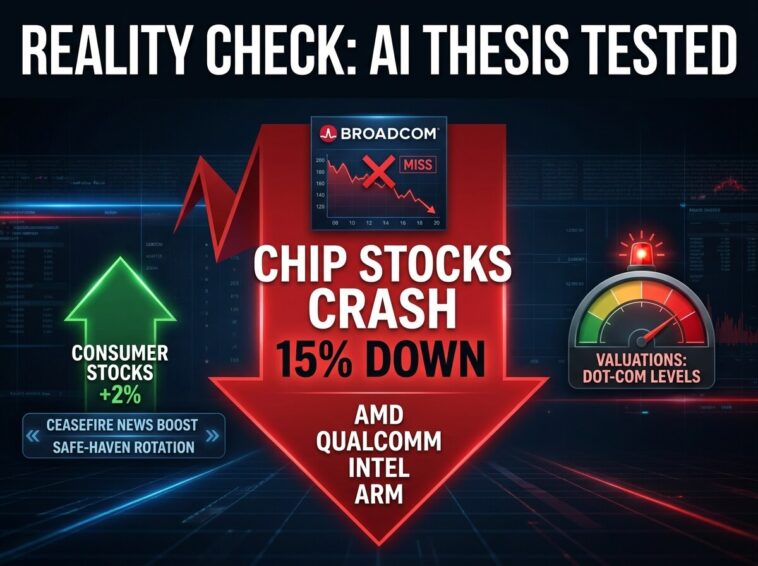
Chip Stocks Crash as Broadcom’s Weak Guidance Tests the Entire AI Thesis
Broadcom Inc.’s underwhelming outlook tested the artificial-intelligence trade that has powered the market from war-driven lows, driving shares down 15%. One earnings miss. One guidance cut. And suddenly everything investors believed about AI infrastructure gets questioned. CNBC
Investors hoping for a stronger forecast from Broadcom were disappointed by guidance that was not enough to buoy Wall Street sentiment, sending the chipmaker into free fall and dragging the entire semiconductor sector down with it. Broadcom sank nearly 14% after reporting fiscal second-quarter revenue below expectations, while cybersecurity firm CrowdStrike dropped more than 11% following soft second-quarter sales guidance. CNBC24/7 Wall St.
The weakness spread like contagion. Intel (-2%), AMD (-2.9%), Palantir (-1.5%), Qualcomm (-1.9%), and Arm Holdings (-4.3%) also posted notable losses. This isn’t rotation. This is capitulation. This is the moment when the market realizes that two months of relentless chip stock gains might have gotten ahead of reality. 24/7 Wall St.
The S&P 500 declined 0.14%, the Dow Jones Industrial Average rose 1.08%, and the Nasdaq dropped 0.76%. The Russell 2000 lost 1.31%. Notice what’s NOT in those headlines? The Dow is up. Energy and defense are holding. Consumer stocks are recovering as oil and yields dip on ceasefire news. The market’s rotating AWAY from chip stocks and INTO everything else. TheStreet
That’s not healthy. That’s panicked.
“Broadcom didn’t just miss earnings. They broke the AI narrative,” says Marcus Richardson, Chief Market Strategist at Granite Peak Capital in Boston. “When the CEO of a $200 billion chipmaker says demand is softer than expected, that’s not a company-specific issue—that’s a thesis issue. If hyperscalers are pulling back orders, the entire infrastructure buildout story gets rewritten.”
The Valuation Reckoning That Nobody Wanted to Acknowledge
Here’s what Bank of America was warning about last week when they talked about “summer pullback” and “deteriorating risk-reward.” They weren’t talking about recession. They were talking about THIS. Reality catching up to valuations that priced in perfection.
The S&P 500 was up more than 16% over April and May, a magnitude that’s only happened in four other instances since World War II. Four times. In 80 years. The last time the S&P 500 rose like it is now outside of a recession period was the few months before the 1987 crash. NYSENYSE
That’s not analysis. That’s history. And history rhymes.
If we look at the Case Shiller P/E ratio, it currently stands at 42.53—its second-highest point since its 1999 high of 43.21. That was also right before the dot-com crash. We’re sitting at valuations that only existed once before in modern market history—right before a 78% decline in the Nasdaq. NYSE
Broadcom’s miss isn’t a data point. It’s a trigger. A double-digit plunge in Broadcom on disappointment around its earnings clipped the tech market today, but consumer stocks rose as oil and yields dipped. Investors selling tech on relief that Israel and Lebanon agreed to a ceasefire. Translation: they’re taking Broadcom’s weakness as permission to exit before it gets worse. CNBC
The Contrarian Case: Why One Analyst Says This is Overblown
Not everyone’s convinced that Broadcom’s miss invalidates the AI thesis. Patricia Chen, Senior Technology Analyst at Summit Peak Advisors in New York, sees the weakness as healthy profit-taking after an unsustainable rally. “Yes, Broadcom missed. But look at the broader data center spend. Broadcom reported fiscal second-quarter revenue below expectations, but that doesn’t mean the entire AI capex cycle is over,” Chen argues. 24/7 Wall St.
Chen’s betting that the weakness spread across the tech sector, with Intel (-2%), AMD (-2.9%), Palantir (-1.5%), Qualcomm (-1.9%), and Arm Holdings (-4.3%) also posting notable losses is sector rotation, not thesis destruction. “After 16% in two months, some pullback was inevitable. Broadcom’s miss is the excuse, not the reason. Buy this dip in six months you’ll look genius.” 24/7 Wall St.
Maybe she’s right. Or maybe we’re watching the exact moment when four decades of easy money gets replaced by reality. When AI mania collides with actual demand data. When the case Shiller P/E at 42.53 finally matters.
What Retail Investors Must Do Right Now
First, understand that the record-breaking run in equities took another breather amid signs of overheating, particularly in tech companies that have largely outperformed since the end of March. Overheating. That’s the polite way of saying “bubble.” CNBC
Second, take profits in chip stocks that have doubled or tripled in 2026. Micron’s up 200%. Marvell surged on Nvidia endorsements. These are not sustainable gains. Lock in winners before Broadcom’s miss becomes contagion.
Third, rotate into sectors that benefit from geopolitical de-escalation. Consumer stocks rose as oil and yields dipped after Israel and Lebanon agreed to a ceasefire. Lower energy costs = consumer spending power. That’s real. CNBC
Fourth, watch the May jobs data that drops Friday morning. If employment disappoints AND Broadcom misses? That’s Fed pivot signal. And when the Fed pivots from hawkish to dovish, growth stocks get crushed because the multiple expansion that drove returns disappears.
The S&P 500 just broke its winning streak. Chip stocks just got reality-checked. The case Shiller P/E is back at dot-com levels. And Broadcom just told you the AI demand story is slowing.
This isn’t a flash crash. This is the beginning of the summer pullback everyone should’ve seen coming.