Editor
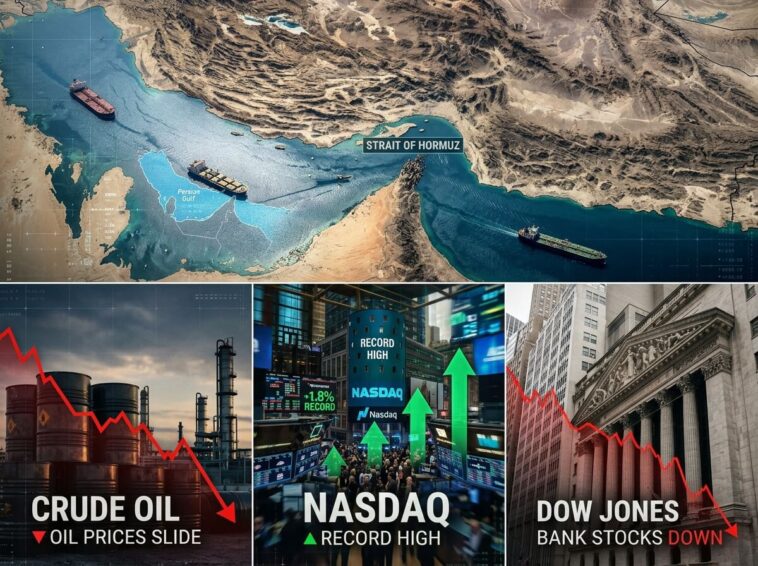
Reports the Strait of Hormuz Reopens Send Oil Sliding. Banks Didn’t Get the Relief.
The Strait of Hormuz reopens within seven days, according to reports Tuesday citing an Iranian offer, unverified but market-moving all the same. Oil fell for a fifth straight session, Brent briefly dipping below $98 before recovering toward $100. Saudi Arabia is reportedly planning to restart its East-West pipeline as early as this week too.
The Nasdaq Composite closed at a fresh record, 27,244.28, up 0.45%, its second straight day at an all-time high after Monday’s blowout 2.3% surge. Sandisk jumped nearly 7% on a bullish analyst call. The S&P 500 finished essentially flat at 7,764.64.
The Dow fell 185.14 points, down 0.36%, to 51,863.69. Financial stocks did almost all the damage. JPMorgan Chase and Wells Fargo each dropped close to 4% at points during the session, on what The Motley Fool’s own reporting called “little news.”
Why the Strait of Hormuz Reopening Isn’t Helping Every Sector Equally
Here’s the disconnect worth understanding. An unverified diplomatic offer to reopen a critical oil chokepoint should, in theory, be good news across the board, lower energy costs, easing inflation pressure, room for the Fed to stay patient. Tech took that signal and ran with it. Banks did the opposite.
“This is a genuinely lopsided reaction to what should be broadly positive news, if it holds up,” said Marcus Thorne, Head of Macro Strategy at a New York boutique advisory firm. “Falling oil and falling yields are exactly the tailwind growth stocks needed after weeks of pressure, and tech’s capturing that relief cleanly. Financials should benefit too, in theory, from calmer markets and reduced systemic risk. Instead we’re watching JPMorgan and Wells Fargo shed four percent on no specific headline. That smells like profit-taking after a strong run, or positioning ahead of something investors aren’t saying publicly yet, not a rational read of Tuesday’s actual news.”
The 10-year Treasury yield edged lower Tuesday to 4.959%, continuing to pull back from the multi-decade highs touched just last week around the Fed’s rate hike. That’s real, tangible relief for rate-sensitive sectors, and it’s the mechanical reason tech’s rally has legs beyond a single day’s headline. Even before the Fed’s move last week, yields had been trending higher for weeks on rising debt concerns, elevated oil, and stubborn inflation. Tuesday’s pullback, however modest, breaks that streak.
Oppenheimer raised its price target on Microsoft during the session, another data point feeding into tech’s continued strength, with the stock up 35% over the past three months. That’s the kind of momentum that compounds on good macro news rather than needing it to start from scratch.
The Skeptic Who Says the Hormuz Report Deserves Real Caution
Not every strategist thinks Tuesday’s oil relief should be taken at face value.
“We’re rallying hard on a report CNBC itself flagged as unverified,” countered Elena Voss, senior equity strategist at a Chicago research shop. “Iran offering to reopen a strategic waterway within seven days is the kind of headline that’s moved markets before and then quietly failed to materialize on schedule. I’ve watched this pattern play out multiple times this year, a diplomatic signal sends oil lower for a few sessions, then either falls through or gets walked back, and crude snaps right back. The banking selloff might actually be the more honest signal here, professional money hedging against exactly that kind of reversal risk, rather than tech’s rally being the correct read.”
Voss raises a fair point about the reliability of unverified diplomatic reports specifically. This year’s pattern of Iran-related headlines has included both genuine de-escalation and reports that didn’t ultimately hold, and Tuesday’s offer hasn’t been independently confirmed.
What This Means for Your Portfolio
Here’s the practical takeaway from a session where two of the four major benchmarks told genuinely different stories about the same news.
When oil relief and yield relief show up together, that combination has real fundamental support for the growth and tech names that have struggled most under this year’s higher-rate environment. Tuesday’s Nasdaq record reflects that dynamic, and it’s not purely sentiment-driven the way some rallies are. But the banking sector’s unexplained weakness on the same day is worth watching closely rather than dismissing.
The practical move: don’t assume Tuesday’s oil relief is fully locked in just because the Nasdaq hit a record on the back of it. Watch whether Iran’s reported offer actually translates into verified shipping activity through the strait over the coming days, the real test of whether this de-escalation holds. And keep an eye on financials specifically. A near-4% single-session drop in two of the largest U.S. banks with no clear catalyst is the kind of move that sometimes precedes news the market’s already sensing, rather than reacting to. If that weakness spreads to other financial names later this week, it may be telling you more about what’s coming than Tuesday’s tech-led record high is.