Editor
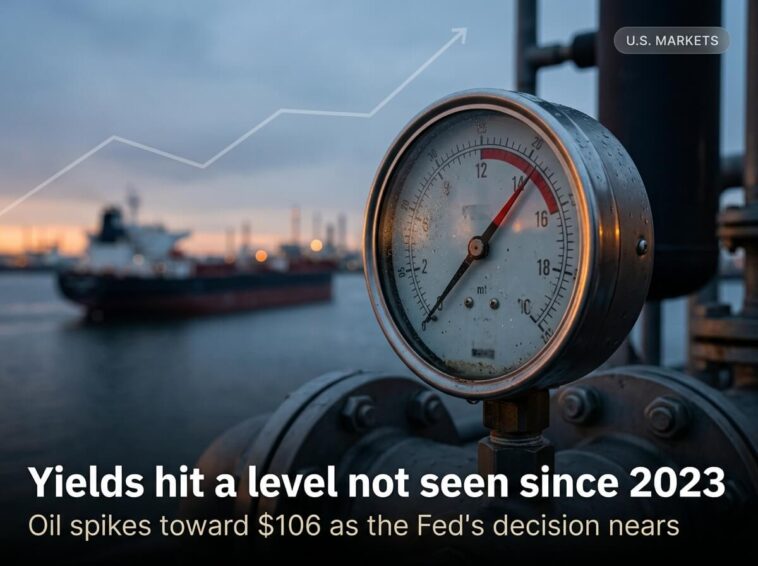
The 10-Year Treasury Yield Just Touched 5%. The Fed’s Decision Is Basically Written.
The 10-year Treasury yield briefly touched 5% Monday, its highest level since 2023. That single number tells you almost everything about why this market fell for a fourth straight session, and why Wednesday’s Fed decision has stopped being much of a question at all.
Fed funds futures now price a 92% likelihood of a rate hike, according to CME’s FedWatch tool. Ninety-two percent isn’t a forecast anymore. It’s close to a foregone conclusion.
The S&P 500 closed down 0.78% at 7,597.83, roughly 59 points below Friday’s close. The Nasdaq fell hardest, dropping 1.09% to around 26,046. The Dow lost 0.48%. Semiconductor stocks bore the brunt of it, extending Monday’s Anthropic-safety-essay selloff into a broader rout as Nvidia, AMD, and Sandisk all stayed pressured through the close.
Why the 10-Year Treasury Yield Hitting 5% Changes the Whole Week
Here’s the mechanical chain worth tracing. Brent crude jumped more than 3%, pushing toward $106, after fresh attacks on shipping in the Strait of Hormuz and a drone strike that prompted Saudi Arabia to temporarily shut its East-West pipeline. That’s a real, physical supply disruption, not just rhetorical escalation. Oil at that level feeds directly into inflation expectations. Inflation expectations push long-term yields higher. And a 10-year touching 5% is the bond market’s clearest possible statement that it expects the Fed to respond forcefully.
“We’ve watched yields grind higher all month, but touching five percent is a genuinely different psychological level,” said Marcus Thorne, Head of Macro Strategy at a New York boutique advisory firm. “This isn’t the bond market hedging against a possible hike anymore. Ninety-two percent odds means the market’s already priced the decision. What actually matters now is what Warsh says Wednesday afternoon about where policy goes after this one. A single hike that gets described as a one-off inflation response is very different from a hike that signals a longer tightening campaign. That’s the real question this week, not whether the hike happens.”
The semiconductor selloff, while getting attributed heavily to Dario Amodei’s safety essay Monday morning, deepened through the session as the yield story compounded on top of it. Growth stocks priced on multi-year earnings assumptions get hit hardest when the discount rate applied to those future earnings jumps this sharply, this fast. Nvidia, AMD, and the broader chip complex sit squarely in that category, which is why Monday’s tech-specific news and the macro yield story reinforced each other rather than competing for attention.
Options markets are bracing for real movement around Wednesday’s decision specifically. SPX options implied a 1.33% move spanning through Thursday, September 18, according to Saxo’s market data, a materially larger range than the 0.51% priced for an ordinary single trading day. That’s the market pricing genuine uncertainty into the days immediately following the announcement, even with the hike itself now looking close to certain.
The Skeptic Who Says This Yield Spike Overstates the Danger
Not every strategist thinks touching 5% signals a lasting problem.
“We’re treating one intraday touch of five percent like it’s a permanent new regime. It might just be a spike tied to a specific, physical oil supply shock that resolves within days,” countered Elena Voss, senior equity strategist at a Chicago research shop. “The Saudi pipeline shutdown is temporary by nature. Once shipping through Hormuz stabilizes, and it likely will once naval escorts or diplomatic pressure kick in, oil eases and yields probably follow it back down. A single hike this week that gets framed as a targeted, one-time response to an energy shock, rather than the start of a sustained tightening cycle, wouldn’t be the disaster markets are currently pricing into these yield levels.”
Voss’s read hinges on a specific assumption: that this week’s oil disruption is genuinely temporary rather than a marker of sustained regional instability. That’s the open question the next several days of shipping data will answer.
What This Means for Your Portfolio
Here’s the practical takeaway from a session that pushed long-term borrowing costs to a three-year high and effectively locked in this week’s Fed decision before it’s even been announced.
With hike odds sitting at 92%, the practical question for retail investors isn’t whether Wednesday brings a rate increase. It’s how the Fed frames what comes after it. A hike paired with language suggesting this is a targeted, one-time response to an oil-driven inflation spike is a very different signal than a hike paired with hints of further tightening ahead. The first scenario likely lets yields ease back from Monday’s 5% touch relatively quickly. The second extends the pressure that’s already produced a four-day losing streak.
The practical move: keep position sizing conservative in rate-sensitive names, growth stocks, small caps, and especially the AI-adjacent semiconductor names caught in Monday’s dual selloff, heading into Wednesday afternoon. Watch how Brent crude behaves over the next 48 hours as your leading indicator. If oil eases back from $106 as shipping stabilizes, Voss’s more contained scenario gains ground. If it keeps climbing into the Fed’s announcement, expect Wednesday’s press conference to lean firmer than markets are currently hoping, and expect this week’s volatility to extend well past the decision itself.