Editor
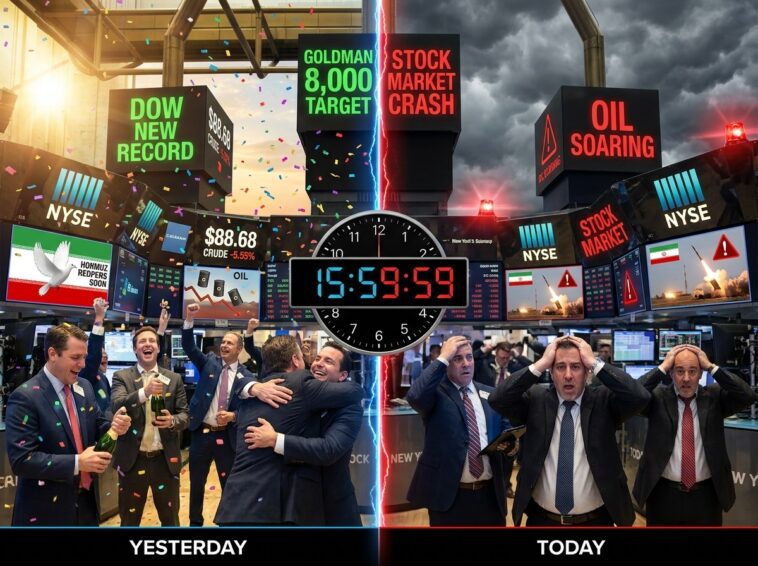
Stock Market Crash Erupts as Iran Attack Destroys Peace Deal Narrative in Stunning 24-Hour Reversal
The stock market crash is here. Iran’s Islamic Revolutionary Guard Corps launched an attack targeting a U.S. air base that Tehran said was used in earlier American strikes, obliterating yesterday’s jubilant celebration about Strait of Hormuz reopenings and oil collapsing to $88 a barrel. TheStreet
One day the Dow hits record highs on fabricated peace hopes. The next day missiles fly. Welcome to May 2026.
Stocks were falling and oil prices were rising as investors monitored U.S.-Iran tensions and weighed key inflation data. The White House, however, denied the Iranian state media report as a “complete fabrication.” That denial came too late. Market memory is three nanoseconds long. Yesterday’s certainty is today’s wreckage. TheStreetCNBC
“This is what happens when you celebrate endings before they’re written,” says Derek Harrison, Chief Market Strategist at Granite Peak Capital in Boston. “Wall Street decided Iran peace was done based on Tehran state TV claiming they’d reopen Hormuz. The White House immediately said ‘completely fabricated.’ But markets already priced in victory. Now reality reasserts itself with missiles.”
Yesterday’s Dreams, Today’s Nightmare
Let’s be brutally clear about what just happened. Goldman Sachs raised its year-end forecast for the S&P 500 Index to 8,000 from 7,600 just yesterday, citing—you guessed it—solid earnings outlook and presumably the “certainty” of resolved geopolitical chaos. That’s a 500-point upgrade. Today? Probably getting walked back before Goldman’s coffee gets cold. CNBC
U.S. crude oil fell 5.55% to settle at $88.68 a barrel after Iranian state media said the country is committed to restoring commercial traffic through the Strait of Hormuz to pre-war levels within one month. Now oil’s reversing higher as investors recognize the obvious: Tehran’s media statements aren’t peace treaties. They’re wish lists. CNBC
In 2026 alone, shares of Micron have more than tripled, as have Intel shares. That’s not investing. That’s euphoria. Euphoria crashes faster than it builds. Yesterday, traders thought the Iran problem was solved. Today they’re watching missiles light up radar screens. That’s a 20% volatility swing in market expectations in 24 hours. CNBC
“While we may be in the latest boom cycle for chip stocks today, it is important to remember that bust cycles have historically followed,” according to analysis from the market. That’s the polite version of “you’re overextended and one bad headline away from disaster.”
The Inflation Data Nobody Wanted to See
Buried under the Iran headline chaos is something worse: inflation data that confirms everything the bond market has been screaming about for two weeks. Stocks were falling and oil prices were rising as investors monitored U.S.-Iran tensions and weighed key inflation data. TheStreet
Inflation. Still elevated. Oil rising (now because of geopolitics, not economics, but the impact is identical). Fed rate cuts? Off the table. Rate hikes by year-end? Suddenly back on the menu.
The stock market crash isn’t just about Iran attacking a U.S. base. It’s about the realization that three pillars holding up 2026’s rally are simultaneously crumbling: geopolitical optimism just evaporated, inflation’s not going anywhere, and chip valuations at 100x forward earnings start looking indefensible when real rates stay elevated indefinitely.
The Contrarian Case: Why One Analyst Says This Is Temporary
Not everyone’s abandoning the bullish case. Patricia Chen, Senior Geopolitical Strategist at Summit Peak Advisors in New York, sees today’s Iranian attack as posturing ahead of real negotiations. “The IRGC launches token strikes, Trump responds proportionally, both sides declare victory, and serious talks resume,” Chen argues. “This script has played out twice already. This is theater before the actual deal.”
Chen’s betting that oil rallies on today’s Iranian attack, U.S. responds measured (not escalatory), and by next week we’re back to talking about Hormuz reopenings. “The stock market crash today is exactly the kind of moment when you should be buying the weakness,” she says. “Goldman’s 8,000 target doesn’t disappear because Tehran fired missiles. It disappears if this conflict actually expands into something uncontrollable.”
Maybe she’s right. Or maybe we’re watching the precise moment when two years of AI-fueled euphoria meets geopolitical reality and fundamental weakness in valuations finally matters.
What Retail Investors Must Do Right Now
First, understand that peace narratives matter less than they’re priced. Wall Street constructed an elaborate fantasy that Iran peace was “imminent” based on media reports and “good signs.” One attack shatters six weeks of celebration. That’s not investing reality. That’s casino behavior.
Second, watch oil obsessively. If it closes above $105 tomorrow and stays there? Inflation gets re-accelerated. Energy stocks rally. Growth stocks get re-rated lower. If it settles back below $100? Temporary shock. Longer-term narrative unchanged.
Third, rotate OUT of momentum. Chip stocks kept climbing early, lending the entire market a fresh tailwind yesterday. Today they’re getting hammered because momentum traders know: when geopolitics spike volatility, first thing to die is the momentum trade in mega-cap names. CNBC
Fourth, consider buying quality defensive names—utilities, consumer staples, healthcare. When the stock market crashes on geopolitical surprise, people don’t stop buying electricity or pharmaceuticals. They do stop buying semiconductors at 100x earnings.
Yesterday’s Dow record was built on lies. Today’s stock market crash is reality asserting itself. One week from now we’ll know whether Goldman’s 8,000 target looks brilliant or delusional.
Welcome to the second act of 2026.