Editor
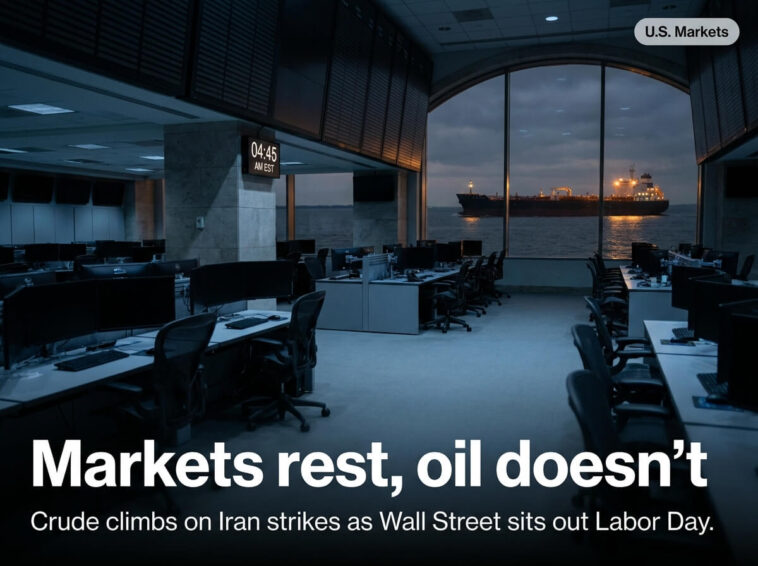
Oil Prices Rise While Wall Street Takes the Day Off. Tuesday Won’t Be So Quiet.
Oil prices rise Monday morning, and the timing couldn’t be worse for anyone hoping for a calm return from the long weekend. U.S. markets are closed for Labor Day. The Strait of Hormuz isn’t taking the holiday off.
Brent crude climbed to $97.57 a barrel, up 1.34%. WTI added nearly a percent, trading near $92.30. The moves came after the U.S. struck three Iranian oil tankers over the weekend. Iran retaliated, targeting American warships with what Central Command described as ballistic missiles, then hit three additional tankers using an unauthorized route through the strait.
None of this touched a single U.S. equity ticker Monday. That’s the strange part. The real trading happened everywhere except the market that actually matters most for American retail investors.
Why Oil Prices Rising on a Holiday Sets Up a Rough Reopen
Here’s the mechanic worth understanding before Tuesday’s bell rings. When U.S. cash equity and bond markets close, price discovery doesn’t stop. It just moves. Global energy futures, currency pairs, and index futures kept trading through the holiday, and Monday’s action there was anything but quiet.
“This is exactly the setup that produces gap-open volatility,” said Marcus Thorne, Head of Macro Strategy at a New York boutique advisory firm. “U.S. desks go dark for a long weekend, and Iran picks that exact window to escalate. Thin holiday order books amplify every headline. By the time equity markets reopen Tuesday morning, they’re not reacting to Monday’s news gradually. They’re reacting to an entire weekend’s worth of accumulated risk premium, all at once, in the first few minutes of trading.”
The currency market gave the clearest signal of how seriously global traders are taking this. USD/JPY tumbled below 155 for the first time since February, a full percent drop, as investors piled into the yen as a safe haven. Gold, oddly, slipped 0.8% to $4,390, easing after Friday’s blowout jobs report reduced the case for near-term Fed rate cuts, even as oil-driven inflation risk built simultaneously elsewhere. That combination, gold falling while oil climbs, is a genuinely unusual pairing, and it reflects two separate forces pulling in different directions at once.
Adding to the tension: U.S. Secretary of Energy Chris Wright told ABC News’ “This Week” that a nuclear deal with Iran “may not happen anytime soon,” suggesting the administration might pursue eliminating Iran’s weapons capability through force rather than negotiation. “An agreement may await the next administration in Iran,” Wright said. That’s a materially more pessimistic diplomatic outlook than markets had priced just a week earlier.
Asia-Pacific markets, trading live while the U.S. sat out, reacted with surprising resilience. Japan’s Nikkei closed 2.12% higher. South Korea’s Kospi jumped 4.61%. That’s not the behavior of markets bracing for catastrophe, even against a backdrop of genuine military escalation.
The Skeptic Who Says This Spike Fades Fast
Not every strategist thinks Monday’s oil move signals a lasting crisis.
“The crowd is rushing to buy oil futures on fears of an uncontained Middle East war. History says that’s usually the wrong trade,” countered Elena Voss, senior equity strategist at a Chicago research shop. “Geopolitical crude spikes that lack sustained physical infrastructure damage tend to fade aggressively within forty-eight to seventy-two hours. We’ve watched this exact pattern play out multiple times this year already, escalation, spike, partial reversal within days. OPEC+ held output quotas flat for October despite the disruption, which tells you the supply side isn’t panicking the way spot prices might suggest. I’d wait for the initial reaction to stall before treating this as anything more than another headline-driven spike.”
Voss’s read has real precedent behind it this year. Several earlier Iran-related oil spikes have partially unwound within days once the immediate shock passed, even when the underlying tensions didn’t fully resolve.
What This Means for Your Portfolio
Here’s the practical read heading into what’s likely to be a genuinely volatile Tuesday morning.
When oil and currency markets move sharply while U.S. equities sit closed, the resulting gap can be jarring, but it’s not always predictive of a sustained trend. The practical move for retail investors: don’t panic into Tuesday’s opening bell based purely on the size of an overnight or holiday-weekend gap. Thin holiday liquidity in futures markets tends to exaggerate moves that often partially correct once full trading volume returns.
That said, this weekend’s escalation is genuinely more serious than several of this year’s earlier flare-ups, given the direct exchange of tanker and warship strikes rather than just rhetorical threats. Watch how oil behaves in the first hour of Tuesday’s session specifically. If Brent and WTI hold most of their weekend gains once full liquidity returns, that’s a signal this round of tension carries more staying power than prior spikes. If prices retreat quickly the way several previous flare-ups have, Voss’s fade-the-panic thesis likely proves right again.
Either way, keep an eye on the 10-year Treasury yield’s reaction Tuesday morning too. Friday’s blowout jobs report already pushed hike odds higher before this weekend’s Iran news even broke. Oil-driven inflation pressure stacked on top of that jobs data makes Tuesday’s open one of the more consequential single sessions this market’s had in weeks.