Editor
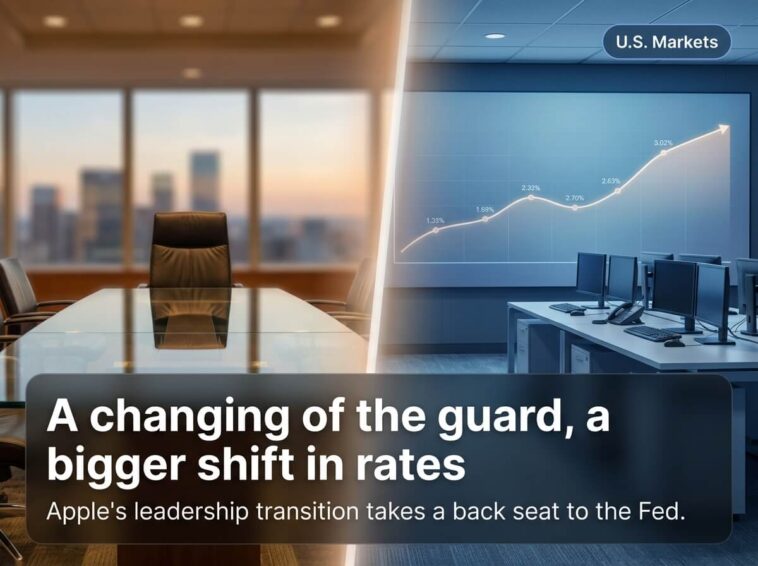
Tim Cook Steps Down Today. The Bond Market Didn’t Even Notice.
Tim Cook steps down as Apple’s CEO tomorrow, September 1, ending fifteen years at the helm of the world’s most valuable company. Apple shares slipped less than a point Monday morning.
That’s it. That’s the whole market reaction to the end of an era.
Compare that to what’s happening in bonds. Odds of a September rate hike sit at 64% today, up from 40% a week ago. The 2-year Treasury yield jumped more than 10 basis points Friday. The Russell 2000 got hit for 1.4% to close out the week. One story that should’ve dominated headlines barely moved a stock. One story most retail investors haven’t fully clocked yet is quietly repricing the entire market.
Why Tim Cook Stepping Down Mattered Less Than Warsh’s Speech
Here’s the asymmetry worth understanding. Cook’s transition to executive chairman, handing the CEO title to hardware chief John Ternus, has been telegraphed for months. Wall Street priced it in gradually, not all at once. Fed Chair Kevin Warsh’s Jackson Hole speech Friday, by contrast, landed as a genuine surprise in tone, even though everyone knew the speech was coming.
“Cook’s exit is a known quantity. Markets had four months to digest it,” said Marcus Thorne, Head of Macro Strategy at a New York boutique advisory firm. “Warsh’s speech wasn’t like that. He described financial conditions as not being broadly restrictive, a meaningful shift from his July stance, where he called them uneven. That single phrase told the bond market he’s more comfortable with a hike than anyone assumed a week ago. That’s why the two-year moved ten basis points in a single session. Cook leaving didn’t reprice anything. Warsh’s word choice repriced an entire meeting.”
The mechanics compound from there. Warsh explicitly declined to rule out a hike, framing his approach as “committed to a discipline, not to a decision.” Markets have spent three straight events, July’s PCE data, Nvidia’s earnings, and Friday’s speech, treating each one like a coin flip with real consequences. NYSE’s own morning note Monday compared the stretch to the Three Amigos, PCE as Chevy Chase, Nvidia as Martin Short, Warsh’s speech playing the anchor role. All three landed within eight trading days of each other.
Tech stocks reflected the split mood Monday. Semiconductor names edged higher, still riding momentum from Nvidia’s strong earnings beat last week. Several Magnificent Seven names dropped instead, as concerns about higher borrowing costs and elevated capital expenditure plans reasserted themselves now that the AI-earnings relief has faded and rate anxiety has taken its place.
The Skeptic Who Says the Rate-Hike Repricing Is Overdone
Not every strategist thinks Friday’s move from 40% to 64% hike odds deserves this much weight.
“We’ve swung this hard on Fed odds multiple times this year already, and it’s mean-reverted every time,” countered Elena Voss, senior equity strategist at a Chicago research shop. “Warsh explicitly avoided forward guidance. He gave a philosophy speech, not a decision. Markets are treating one adjective, ‘restrictive’ versus ‘uneven,’ like it’s a policy commitment. It isn’t. We’ve got a full month of data, including another jobs report, before the September meeting actually happens. I wouldn’t build a portfolio around Friday’s odds holding through mid-September.”
Voss has precedent working in her favor. Rate-hike probabilities have whipsawed all summer, from near-zero to over 50% and back multiple times, each shift driven by a single data point or speech that later got reinterpreted once more information arrived. Friday’s jump could easily fade the same way once the next jobs report or inflation print lands.
What This Means for Your Portfolio
Here’s the practical lesson from a Monday that delivered a landmark corporate transition and a genuine rate-path surprise on the same trading day, with the market only really reacting to one of them.
Leadership transitions at even the largest companies rarely move markets much when they’re well-telegraphed in advance. What moves markets is unexpected shifts in tone from people who control the cost of money, and Warsh just delivered exactly that kind of shift. The Russell 2000’s outsized 1.4% Friday decline versus the S&P’s more modest 0.3% drop tells you precisely where that rate sensitivity concentrates: smaller, more debt-dependent companies feel a hike scare faster and harder than mega-cap tech does.
The practical move for retail investors: don’t let a headline-grabbing CEO transition distract from the more consequential story sitting right next to it. Watch the incoming jobs report and any Fed speakers between now and the September meeting for confirmation or reversal of Friday’s repricing. If hike odds keep climbing toward that meeting, expect continued pressure on small caps and rate-sensitive sectors specifically, separate from whatever’s happening with any individual company’s leadership. If odds fade the way they have all summer, this week’s anxiety was another false alarm in a year that’s had several.
Apple’s transition to the Ternus era starts tomorrow. It’s a genuinely significant moment for the company. It just isn’t the thing currently deciding where your portfolio’s headed this month. That’s still the Fed’s call, and Friday made clear it’s closer than anyone assumed a week ago.