Editor
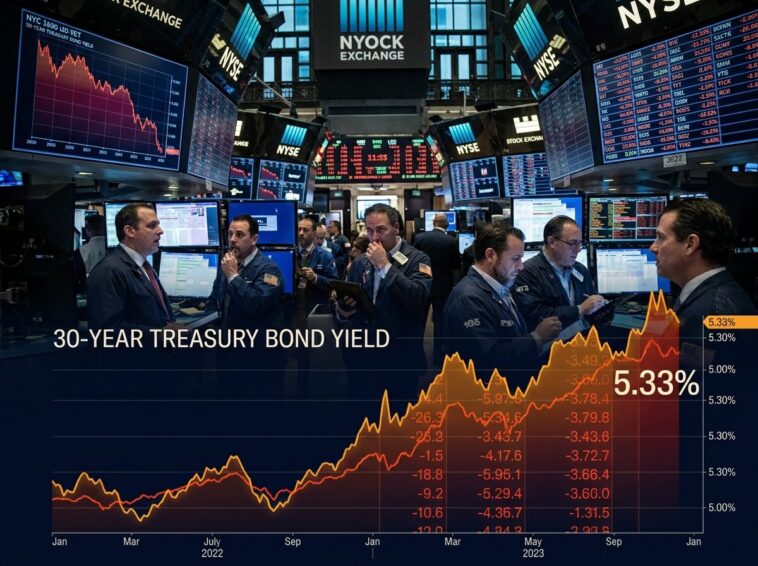
The Bond Market Is Screaming. Is Wall Street Finally Listening?
Treasury bond yields just hit levels not seen since 2007 — and the stock market is paying the price.
Tuesday started ugly on the floor of the New York Stock Exchange, and it only got worse from there. The yield on the 30-year U.S. Treasury bond climbed to 5.327%, its highest level in 19 years, rattling investors already on edge from surging oil prices and a U.S.-Iran conflict showing no signs of resolution. The tech-heavy Nasdaq Composite fell 1.3%, leading the major indexes lower. The S&P 500 pulled back by 0.6%, while the Dow Jones Industrial Average declined 0.2%. Yahoo FinanceYahoo Finance
This wasn’t a one-day blip. It was a warning shot.
What’s Really Driving Treasury Bond Yields to Multi-Decade Highs
The surface explanation is simple enough: inflation won’t quit, oil is climbing, and the bond market is repricing risk. But dig a layer deeper and the story gets messier — and more troubling.
Rising concerns over fiscal spending, amid increasing debt issuance, are weighing on bond markets even as investors digest a recent run of soft U.S. economic data that has led traders to scale back rate hike expectations. In other words, the government keeps borrowing at a blistering pace, flooding the market with new supply. Buyers are demanding higher yields to absorb the flood. Simple economics. Brutal consequences. Yahoo Finance
The interest rate on the so-called long bond reflected investor angst over surging government spending, a flood of long-dated bond sales, and inflation that’s been stuck above the Federal Reserve’s target for the past five years. Five years. Let that sink in. Bloomberg
“What we’re watching right now is a structural repricing of long-duration risk,” said Daniel Kroft, Head of Macro Strategy at Meridian Capital Partners in New York. “The market is telling you that it no longer believes the Fed can engineer a soft landing without accepting higher inflation for longer. That’s a seismic shift in the Treasury market’s psychology.”
The geopolitical angle is pouring gasoline on the fire. Investors are concerned after President Trump said he would not try to revive a stalled truce with Iran, sending oil prices spiking back above $90 a barrel. Energy costs feed directly into producer prices, consumer prices, and — eventually — into the Fed’s calculus on rates. The chain reaction is already underway. TheStreet
The selloff spread globally. Japan’s 10-year government bond yield surged to a 30-year peak. Germany’s 30-year bond yield hit its highest since 2011, while French 30-year yields reached a post-2008 high. This isn’t a U.S.-specific problem anymore. The entire sovereign bond complex is repricing simultaneously. That’s rare. That’s significant.
Tech Gets Crushed. Semis Lead the Carnage.
When yields surge, high-multiple tech stocks suffer the most. The math is unforgiving: higher risk-free rates make future earnings worth less today. Valuations compress. Sellers move first. Western Digital fell almost 7%. Sandisk dropped 8%. Marvell Technology and Seagate Technology were also both down by around 8%. CNBC
The semiconductor sector, which had been a darling of AI-fueled optimism just weeks ago when the S&P 500 cleared 7,800 for the first time, suddenly looked vulnerable. It’s a familiar script — AI euphoria meets bond market reality, and the bond market wins.
Not all the news was grim. Home Depot shares rose roughly 1% after the home improvement giant posted a second-quarter earnings beat, helping limit the Dow’s losses. A reminder that even in brutal macro environments, fundamentally sound businesses can shine through. CNBC
The Counter-Narrative: Don’t Panic Just Yet
Not everyone is bracing for Armageddon. Victoria Landers, Chief Investment Officer at Clearfield Asset Management in Chicago, thinks the market is overreacting to the yield spike. “The 30-year touching 5.33% feels dramatic, but real yields still aren’t high enough to kill corporate borrowing permanently,” she told Rise Investment News. “What we’re seeing is a panic-flush, not a structural breakdown in equities. Selective buyers should be circling right now.”
Landers points to the resilience of consumer-facing stocks and notes that U.S. industrial production rose 0.2% in July, with high-technology production linked to the AI buildout rising 1.9% on the month, as evidence the underlying economy isn’t rolling over. She’s not wrong that the data is mixed. But with the 30-year yield at a level last seen when George W. Bush was in the White House, the burden of proof falls on the bulls. TS2
What This Means for the Yield Curve — and Your Portfolio
Here’s where it gets practical.
The 10-year Treasury note yield was at 4.732%, while the 2-year Treasury note yield edged up to 4.186%. That spread — the 10-year yielding more than the 2-year — means the yield curve is re-steepening after years of inversion. Historically, a steepening curve after a prolonged inversion has been an early signal that recession risk is fading, but it also tends to precede a period of heightened volatility in equities as the market recalibrates.
The gap between the 30-year at 5.33% and the 2-year at 4.19% is now more than 110 basis points. That’s a significant premium for going long on duration — and a real opportunity, or a real trap, depending on where inflation heads next.
Retail Investor Tip: Resist the urge to reach for long-duration bonds right now chasing that 5.33% yield. Bond investors are best placed to manage this risk by focusing on shorter-duration bonds. A ladder of 2-year and 5-year Treasuries locks in solid yields without betting that the long end has peaked — a bet the market has burned itself on twice in the past three years. Let the dust settle. The 30-year will still be there when the Iran situation clarifies and inflation prints give the Fed a clearer path. Yahoo Finance
The Bottom Line
The bond market doesn’t lie. It doesn’t spin earnings. It doesn’t run ad campaigns. When the 30-year yield reaches a 19-year high while global peers hit their own multi-decade records simultaneously, the message is uniform: money is more expensive, risk premiums are rising, and the era of easy returns is not coming back anytime soon.
Tech will find its footing eventually. AI spending isn’t going away. But right now, the bond market is the story — and Tuesday made sure everyone on Wall Street knew it.