Editor
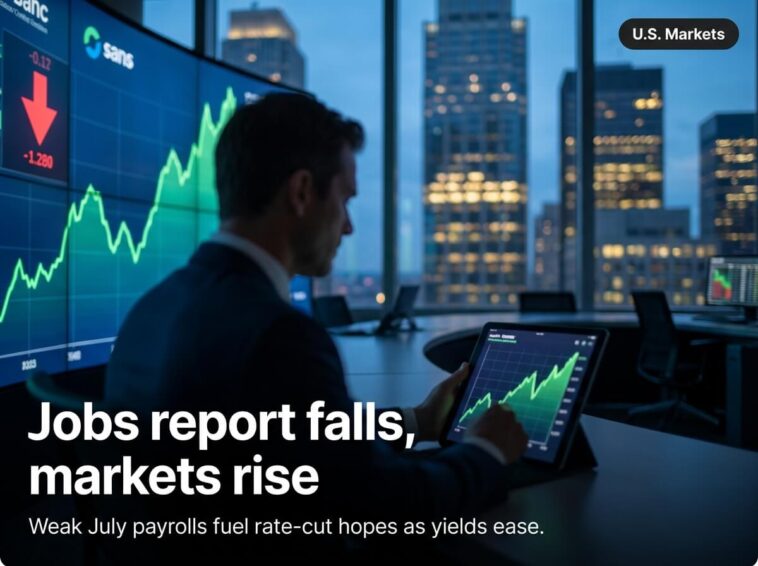
The July Jobs Report Showed a Loss. Wall Street Threw a Party.
The July jobs report landed Friday morning with a number nobody had on their bingo card. The U.S. economy lost 23,000 jobs last month. Economists expected a gain of 83,000.
That’s not a miss. That’s a hundred-thousand-job gap between forecast and reality.
Stocks went up. The Dow climbed. The S&P 500 gained roughly half a percent. The Nasdaq jumped over a percent. Bond yields fell. The 10-year Treasury dropped five basis points to 4.63%. Bad economic news, and the market’s reaction was almost giddy.
Welcome to the strangest recurring theme of this earnings season. Bad news, good stock reaction. Good news, bad stock reaction. Friday just delivered the cleanest version yet.
Why the July Jobs Report Sent Stocks Higher, Not Lower
The logic isn’t actually that strange once you walk through it. A weak labor market gives the Federal Reserve more room to cut rates, or at least less reason to raise them. Traders read Friday’s number as exactly that kind of signal.
“A negative payroll print used to be an automatic risk-off day. Not anymore, not in this cycle,” said Marcus Thorne, Head of Macro Strategy at a New York boutique advisory firm. “The market’s been trading a very specific script all summer. Weak data means the Fed backs off. Strong data means the Fed stays hawkish. Friday’s jobs report checked the box traders wanted checked. Money markets are now pricing essentially no chance of a hike before December. That’s the whole rally, right there, in one sentence.”
He’s got the mechanics right. Unemployment held steady at 4.1%, a detail that mattered almost as much as the headline loss. A steady jobless rate alongside a negative payroll number tells a specific story: fewer people looking for work, not necessarily a wave of layoffs cascading through the economy. That distinction gave bulls room to argue this wasn’t the start of a real downturn, just a labor market cooling exactly as much as the Fed needs it to.
The rally also capped an unusually volatile week. Thursday saw a pullback, the Dow down 0.85%, as investors weighed renewed Strait of Hormuz uncertainty against a batch of mixed corporate earnings. Wednesday halted an August rally that had briefly pushed the Dow and S&P to fresh records earlier in the week on strong earnings. Friday’s jobs-driven bounce arrived right as Polymarket traders had already priced a 67% probability of an up open, before the data even landed.
Layer in one more wrinkle. Momentum-focused funds just posted one of the best rebound days on record earlier in the week, clawing back from a brutal July that saw a 12% monthly decline in a widely tracked momentum ETF. Part of that swing traced to Situational Awareness, a hedge fund founded by a former OpenAI researcher, unwinding large AI-stock positions after steep losses. That kind of forced deleveraging tends to exaggerate whatever the market’s already doing, in either direction.
The Skeptic Who Says This Rally Is Reading the Data Wrong
Not every strategist is comfortable with Friday’s cheerful reaction, though.
“Everyone’s celebrating this as a green light for rate cuts. I’d call it a genuine warning sign getting misread,” countered Elena Voss, senior equity strategist at a Chicago research shop. “Losing jobs in July, when forecasters expected solid growth, isn’t a minor miss. It’s a real crack in labor demand. If this becomes a trend over the next two or three reports, the market won’t be cheering rate cuts anymore. It’ll be pricing in the reason the Fed had to cut. Those are two very different stories, and right now, Wall Street’s only pricing the flattering one.”
Voss has precedent worth taking seriously. Labor-market weakness has, more than once historically, arrived as the leading indicator of a slowdown rather than a tidy setup for a soft landing. The market’s current read, one clean data point equals more Fed flexibility, assumes this stays a one-off. That assumption hasn’t been tested yet.
Aggregate corporate profits are still tracking to grow more than 47% this earnings season, with roughly 85% of reporting S&P 500 companies beating estimates, according to FactSet data compiled through early August. That backdrop gives bulls real ammunition. It doesn’t, on its own, resolve whether Friday’s jobs miss is noise or signal.
What This Means for Your Portfolio
Here’s the practical lesson from a week that whipsawed on nearly every kind of data imaginable.
When labor data disappoints and markets rally anyway, that’s the market betting on future Fed accommodation, not celebrating the underlying economic reality. Those two things can diverge for a while. They eventually have to reconcile, one way or another, either through actual rate cuts validating the optimism, or through weakening data eventually catching up to stock prices that got ahead of it.
For retail investors, the discipline here is straightforward. Don’t confuse a market rally on weak data with confirmation that the economy is fine. Watch the next two jobs reports closely. A single negative print with steady unemployment is plausibly noise. A second or third consecutive miss would be a genuinely different story, one the bond market, not just the Fed, would start pricing far more aggressively than Friday’s five-basis-point yield move suggests.
Keep an eye on the 10-year yield specifically. It’s been the most honest signal all summer, reacting to real shifts in rate expectations faster than equities usually do. If yields keep drifting lower on soft labor data through August and September, that’s the market genuinely believing in a cutting cycle. If yields stabilize or reverse even as jobs data stays weak, that’s the bond market starting to worry about growth instead, a much less comfortable setup for the rally Friday just delivered.
Momentum’s violent bounce this week is its own caution flag too. A trade that fell 12% in July and then surged over 5% in a single session isn’t stability. It’s volatility looking for a direction. Size positions accordingly heading into a historically rocky stretch for stocks, August and September, seasonally, rarely go quietly.