Editor
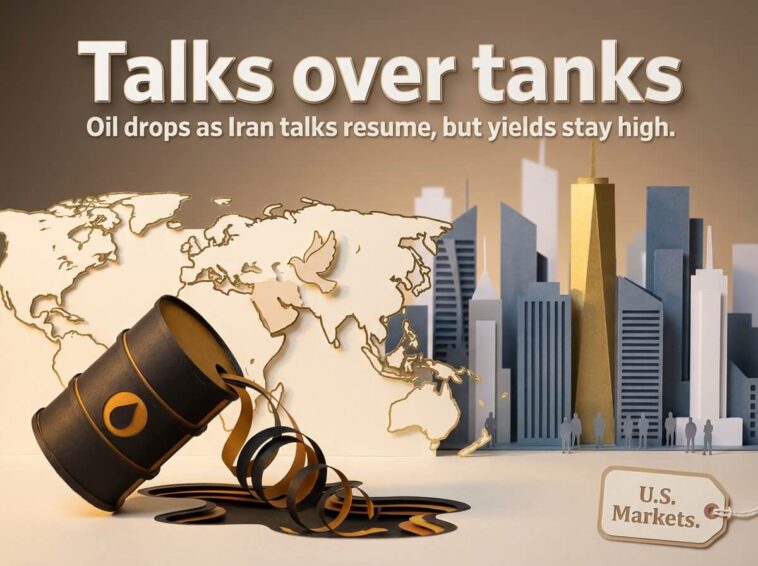
Oil Prices Drop 6%. Wall Street Finally Gets to Exhale.
Oil prices drop nearly 6% Monday morning. President Trump called off what he described as a “massive” strike on Iran. Talks start today instead.
Markets took the news and ran. The Nasdaq climbed nearly 2%. The Dow gained a full percent. The S&P rose 1.28%. Crude fell almost $5 a barrel, back near $79.69. Gold slipped too, another signal that fear was genuinely draining out of the market, not just pausing.
“Get to work, everybody, and get it DONE,” Trump posted Sunday night. Blunt. Optimistic. Markets liked the tone as much as the substance.
Why Oil Prices Dropping Doesn’t Erase the Yield Problem
Here’s the part investors shouldn’t lose track of amid Monday’s relief. The 10-year Treasury yield still sits near 4.7%. The 30-year is parked close to a 19-year high. Oil calming down helps the inflation outlook at the margins. It doesn’t undo months of borrowing costs climbing for entirely separate reasons.
“Everyone’s celebrating the oil headline, and fair enough, it’s genuinely good news,” said Marcus Thorne, Head of Macro Strategy at a New York boutique advisory firm. “But the yield curve didn’t rally nearly as hard as equities did this morning. That tells you the bond market isn’t fully buying that this fixes the inflation picture. Oil was one input. Rate expectations tied to Fed policy and fiscal issues are a separate, stickier problem that one weekend of diplomacy doesn’t solve.”
That distinction matters more this week than usual. Four hyperscalers, Google, Amazon, Meta, and Microsoft, all raised or held steady on 2026 capex guidance last week, collectively guiding toward $720 billion to $745 billion in spending. Big commitments are much easier to stomach when borrowing costs are falling. They get harder to justify the longer yields stay elevated, oil relief or not.
JPMorgan strategists added their own note of caution Monday, forecasting tech stocks will underperform for the rest of 2026 and signaling a preference for semiconductor names over hyperscalers specifically. A rotation call, not a full retreat, but a clear signal that not every part of the AI trade gets treated the same going forward.
The Skeptic Who Says This Rally Has Real Legs
Not everyone’s hedging their enthusiasm, though.
“This isn’t just an oil bounce. It’s a real de-escalation with actual talks scheduled, which is a different animal than a one-day ceasefire that collapses by Wednesday,” countered Elena Voss, senior equity strategist at a Chicago research shop. “Amazon just crossed a three-trillion-dollar market cap on real cloud growth, not hype. The ISM manufacturing index rose to 55.6 in July, above expectations, with new orders and employment both improving. That’s broad economic strength showing up alongside the geopolitical relief, not despite it. I’d take this rally at face value.”
Voss has real data behind her. Friday’s close was already strong before this weekend’s news, with the Dow gaining nearly 277 points to end a volatile month on a high note. Monday’s move builds on genuine momentum, not just a single headline.
What This Means for Your Portfolio
The practical lesson this week is about not confusing relief with resolution.
Oil dropping nearly 6% removes one source of pressure on inflation and, by extension, on the Fed’s rate path. That’s real and worth some optimism. But Treasury yields near multi-year highs reflect a broader set of concerns, fiscal policy, term premium, sustained deficit spending, that a single diplomatic opening doesn’t resolve overnight. Watch how the 10-year and 30-year actually move over the coming days, not just Monday’s equity rally, for the truer signal.
For retail investors, JPMorgan’s rotation call is worth taking seriously even if you don’t act on it wholesale. A preference for semiconductor names over hyperscalers specifically suggests the smart money is getting choosier within the AI trade, not abandoning it. That argues for the same discipline that’s applied all earnings season: separate genuine monetization stories, like Amazon’s cloud growth, from spending commitments still waiting to prove out.
This week brings the July jobs report and fresh ISM services data. Both will tell you more about where the economy, and the Fed’s next move, actually stand than one weekend of Iran diplomacy ever could. Enjoy Monday’s rally. Just don’t mistake it for the all-clear.