Editor
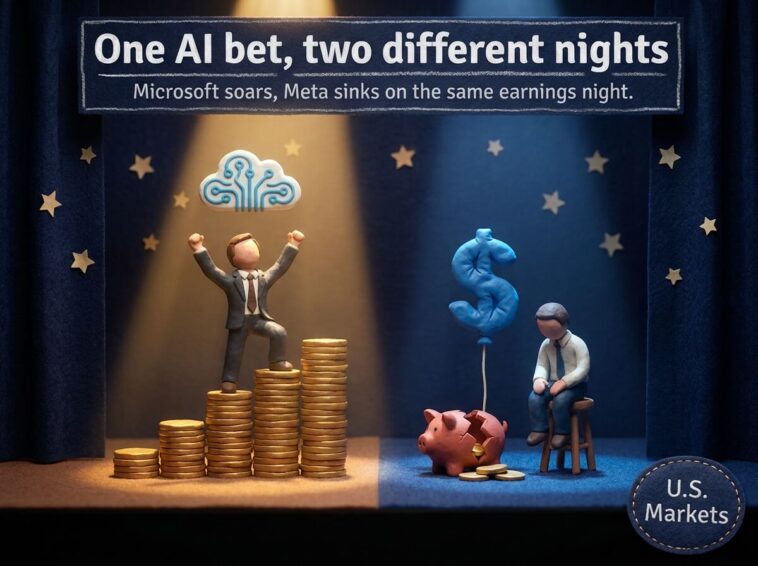
Microsoft Meta Earnings Landed the Same Night. One Soared. One Sank.
Microsoft Meta earnings hit Wednesday after the bell, and the split was almost violent. Microsoft jumped 8.5%. Meta dropped 9%. Same night. Same AI spending story, told two different ways.
Both companies raised capital expenditure guidance. Both are pouring tens of billions into AI infrastructure. One got rewarded for it. One got punished. That’s a seventeen-point swing between two companies pursuing, on paper, nearly identical strategies.
Something in the details mattered enormously.
What Actually Separated Microsoft From Meta’s Earnings
Azure. That’s the one-word answer.
Microsoft’s cloud business grew 43% at constant currency, blowing past Street estimates of roughly 40%. Azure revenue crossed $100 billion for the fiscal year, a first. Guidance for steady 2026 capex, not another escalation, gave investors exactly what they’d been begging for all month: proof that spending translates into measurable, growing revenue.
Meta told a murkier story. Quarterly profit fell 14%, to $18.3 billion. Free cash flow came in under $1 billion, a number that startled analysts given the scale of the business. Capex guidance rose again, this time to as much as $145 billion for the year. Revenue guidance for the current quarter missed expectations. And the company flagged ongoing legal cases tied to social media’s effects on young users as a real financial risk.
“This is the clearest proof yet that the market stopped rewarding AI spending months ago and started demanding AI results,” said Marcus Thorne, Head of Macro Strategy at a New York boutique advisory firm. “Microsoft showed the market a number, forty-three percent Azure growth, that justifies the spend. Meta showed rising costs, falling cash flow, and a promise that monetization is still coming. Same dollar amount going out the door. Completely different story about what’s coming back in.”
The Fed added its own complication to the backdrop. Rates held steady, as expected, but three of twelve FOMC members dissented, preferring a hike. That’s a genuinely split committee, and it kept the 30-year Treasury yield hovering near its highest level since 2007, north of 5.2%. High yields punish long-duration growth bets across the board, Microsoft included. It just didn’t matter Wednesday night, because Azure’s growth number overwhelmed everything else in the room.
The Skeptic Who Says Meta’s Selloff Is the Overreaction
Not everyone thinks Meta deserved a 9% haircut.
“Investors are punishing Meta for the exact same forward-looking bet Microsoft just got applauded for,” countered Elena Voss, senior equity strategist at a Chicago research shop. “A temporary dip in free cash flow while you’re building out infrastructure isn’t automatically a red flag. It’s the cost of the buildout. Give Meta two more quarters before deciding its spending doesn’t convert the way Microsoft’s did. Nine percent in a single session, on largely the same fundamental thesis Microsoft has, looks like sentiment, not analysis.”
Voss has a fair point buried in the panic. Meta’s core advertising business, the thing that actually pays the bills today, wasn’t the headline problem. The market reacted to guidance and cash flow optics more than to any collapse in the underlying business.
What This Means for Your Portfolio
The lesson from Wednesday night applies to every AI-adjacent stock reporting the rest of this earnings season, not just these two.
Capex guidance alone no longer moves stocks. What moves them now is whether that spending shows up as visible, current revenue growth, the way Azure’s number did, or whether it shows up as a promise still waiting to materialize, the way Meta’s did. The market has officially stopped taking the “trust us, it’ll pay off” pitch at face value.
For retail investors, the practical move is to stop treating “AI spender” as a single category. Within that group, some companies are already converting spend into measurable growth. Others are still building. That distinction, not the capex headline itself, is what should drive position sizing from here. Amazon and Apple report Thursday. Watch for the same split: does their spending show up as a growth number analysts can point to, or as a promise analysts have to take on faith?
The Fed’s dissent and elevated long-term yields mean the cost of that patience keeps rising too. In a market this unforgiving about proof of return, “still building” is getting a much shorter leash than it did a year ago.