Editor
Apple Amazon Earnings Both Beat. Wall Street Still Picked a Winner.
Apple Amazon earnings landed Thursday night, and both companies delivered records. Apple posted its strongest June quarter ever. Amazon crushed estimates across the board.
Apple fell 8%. Amazon jumped 12%.
Two record quarters. Two opposite verdicts. This is now the third straight earnings night this week that’s ended this exact way. Microsoft soared 15%. Meta sank 8%. Now Apple and Amazon just ran the same play in reverse order.
Why Apple Amazon Earnings Split So Sharply
The headline numbers alone don’t explain it. Apple’s revenue hit $109.4 billion, up over 16% year over year. Amazon’s came in at $200.6 billion, up nearly 20%. Both beats. Both records.
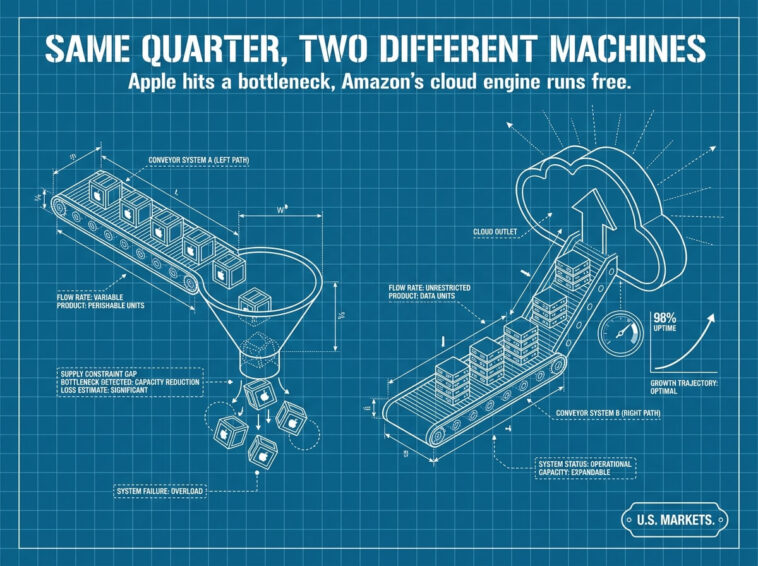
The guidance is where the stories diverge. Apple projected September-quarter revenue growth of just 9% to 11%, below the 12% Wall Street wanted, citing chip and memory supply constraints alongside currency pressure. Not weak demand, management insisted. A supply squeeze. Services revenue and Greater China both missed too, adding weight to the disappointment. Barclays cut its price target. So did Goldman Sachs and Morgan Stanley.
Amazon told the opposite story entirely. AWS revenue jumped 37% to 39%, its fastest cloud growth in roughly four years. Management raised 2026 capex guidance to around $220 billion, aimed squarely at AI workloads, and investors cheered the exact kind of spending they’d been booing all month from other names.
“Same macro backdrop, completely different exposure to it,” said Marcus Thorne, Head of Macro Strategy at a New York boutique advisory firm. “Amazon’s spending is producing a monetization number Wall Street can point to right now, AWS at its fastest growth in years. Apple’s constrained by the exact supply chain everyone else is racing to build. That’s not a demand problem for Apple. It’s a bottleneck problem, and bottlenecks show up in guidance before they show up in headline revenue.”
Treasury yields made the backdrop even less forgiving. The 10-year hit 4.737% Friday, its highest since January 2025. The 30-year sat near 5.22%, a level unseen since 2007. Rising yields punish any stock trading on future growth assumptions, and Apple’s guidance miss gave the market a reason to apply that pressure immediately.
The Skeptic Who Says Apple’s Selloff Overreaches
Not everyone thinks an 8% drop is the right call.
“Apple just posted double-digit growth across every product line and every region on the planet, in its outgoing CEO’s final earnings call. That’s not a company in trouble,” countered Elena Voss, senior equity strategist at a Chicago research shop. “A supply constraint hitting one quarter of guidance isn’t the same as a demand collapse. BofA kept a Buy rating and an $380 target for a reason. This looks like a market punishing Apple for not being Amazon, rather than judging Apple on its own results.”
Voss has a point worth sitting with. Apple’s stock is still up 23% year to date, even after Friday’s drop, partly because investors have treated it all year as the safer alternative to the hyperscalers’ spending spree. That reputation took a hit Thursday night, fairly or not.
What This Means for Your Portfolio
Four straight nights this week have delivered the same lesson, and it’s worth internalizing before next earnings season, not just this one.
Beating estimates no longer guarantees a rally. What moves these stocks now is whether the report answers the market’s specific worry about that company. For hyperscalers, the worry was capex without payoff, and Amazon and Microsoft each answered it with cloud growth numbers. For Apple, the worry was supply-chain exposure to the same AI-driven chip crunch benefiting everyone else, and Thursday’s guidance confirmed that worry instead of easing it.
The practical takeaway for retail investors: read guidance language as closely as the beat-or-miss headline, and understand what specific narrative each stock is fighting against before earnings land. With Treasury yields sitting at multi-year highs, the room for error keeps shrinking. A single quarter of soft guidance, even wrapped around a record top line, is enough to trigger a swift, sharp repricing in this environment.
Four hyperscalers now guide toward $720 billion to $745 billion in combined 2026 capex. That spending isn’t slowing down. Whether it keeps paying off the way Amazon’s just did, or strains supply chains the way Apple’s quarter just showed, will keep deciding which stocks get rewarded and which get punished, one earnings night at a time.