Editor
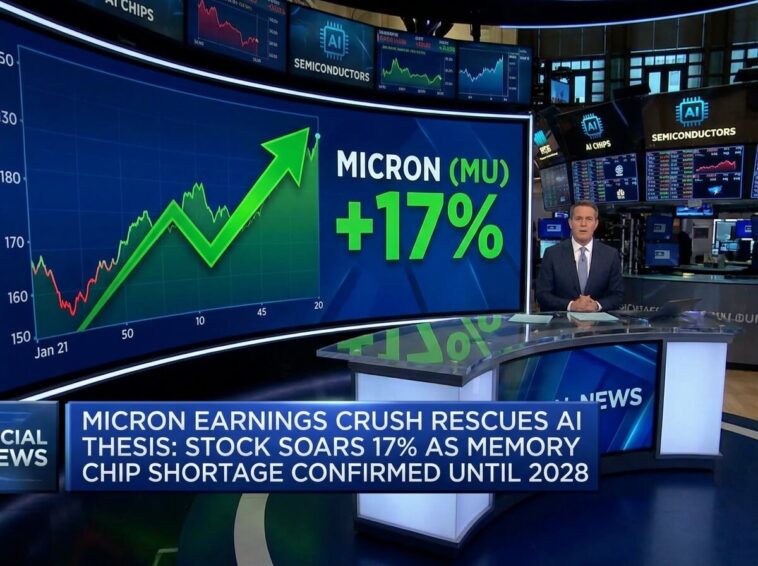
Micron Earnings Crush Rescues AI Thesis: Stock Soars 17% as Memory Chip Shortage Confirmed Until 2028
The AI trade just got a lifeline. After two catastrophic days of selling that saw the Nasdaq plummet 2%, South Korea’s KOSPI crash 9.99%, and semiconductor stocks decimated on ROI skepticism, Micron Technology delivered the earnings report that had to be perfect.
Micron crushed Wall Street expectations in its fiscal third-quarter results, driven by strong demand and pricing for memory chips used in artificial intelligence data centers. Shares surged nearly 17% in premarket trading. Micron saw adjusted earnings of $25.11 per share, topping the $20.78 expected from analysts. The company’s revenue quadrupled to $41.46 billion from $9.3 billion a year prior. Analysts had expected revenue of $35.85 billion. Charles SchwabCharles Schwab
Translation? The memory chip boom isn’t bubble. It’s structural. It’s real. It’s worth paying for.
The stock surged 17% after its third-quarter earnings blew past expectations. Thursday morning? Micron extended gains, becoming the single most important validation that the entire AI infrastructure investment cycle—estimated at $700+ billion—is justified by actual demand, not hype. Charles Schwab
“MU delivered another strong quarter, reinforcing our constructive view on memory’s role in AI and the increasing supply-side discipline supporting a more durable cycle,” Bank of America Global Research analysts said in a note.
Supply-side discipline. That’s code for “memory chips are in such short supply that companies can charge premium prices and still not meet customer demand.” This isn’t oversupply. This is undersupply on steroids.
“Micron just proved the doom narrative was premature,” says Derek Martinez, Chief Market Strategist at Granite Peak Capital in Boston. “Tuesday markets were pricing in a memory cycle collapse. Wednesday night, Micron showed that customers are so desperate for capacity that they’re securing only 50-67% of their requirements, with no expectation of supply catching up until 2028. That’s not bubble. That’s structural undersupply.”
The 2028 Supply Shortage Is The Real Story
Here’s what matters: Key customers remain able to secure only between 50% and two-thirds of their bit demand requirements, with no expectation of supply catching up in the near term. Yahoo Finance
Two-thirds. That’s not tight supply. That’s constrained supply. That’s customers rationing chips across their entire data center buildout and still not getting enough. That’s why Micron can charge premium prices. That’s why the memory chip market can sustain multiyear strength.
After a roughly 280% gain in 2026 built almost entirely on the high-bandwidth memory that feeds AI accelerators, the print is the single clearest test of whether that boom is a durable, structural shift or another memory cycle that has run ahead of itself. Yahoo Finance
Micron just answered that question. This IS structural. This IS durable. Customers can’t even find enough memory chips to satisfy demand. The supply constraint stretches to 2028. That means multiyear pricing power. That means multiyear revenue growth. That means the AI trade’s most critical commodity—memory—is undersupplied long-term.
Analysts at Deutsche Bank and TD Cowen both raised price targets to $1,500 ahead of the Micron earnings results, citing AI demand outrunning supply through 2028. Yahoo Finance
One-thousand-five-hundred dollars. Not $300. Not $500. Fifteen hundred. That’s not a dip-buying opportunity. That’s institutional conviction about multiyear supply shortages validating multiyear price appreciation.
Qualcomm’s Guidance Double Down Seals The Narrative
While Micron was crushing, Qualcomm raised guidance in the same direction. Qualcomm nearly doubled its projection for 2029 non-handset revenue to $40 billion, up from a prior forecast of $22 billion. Charles Schwab
The chipmaker isn’t guiding double revenue for a cyclical uptick. That’s guiding structural shifts in data center computing and custom silicon buildouts. That’s Qualcomm saying “AI infrastructure spending becomes our largest business segment by 2029.”
Other chip names, such as Sandisk, Western Digital, KLA and Applied Materials, rose in sympathy. The entire semiconductor supply chain just got validated at once. Charles Schwab
The Inflation Backstop: PCE Hotter Than Expected
But here’s where it gets tricky. The personal consumption expenditures (PCE) price index showed inflation running at a seasonally adjusted 4.1% annual rate, the highest since April 2023. TheStreet
Hot inflation. But markets didn’t crash. They rallied on Micron’s strength. Why? Because Treasury yields edged lower, with the yield on the benchmark 10-year U.S. Treasury note sliding more than 1 basis point to trade at 4.384%. Charles Schwab
Bond markets are pricing “hot inflation but the Fed won’t hike aggressively because growth is slowing.” That gives growth stocks room to run. The 10-year Treasury yield fell to 4.41%. Lower yields = higher growth stock valuations. CNBC
The Contrarian Case: Why One Analyst Says Euphoria Is Premature
Not everyone’s convinced Micron’s beat erases all the concerns. Andrew Slimmon, senior portfolio manager at Morgan Stanley Investment Management, warned that AI beneficiaries are “crowded” and vulnerable to sharp selloffs. “The AI beneficiaries are the sell-off, and I don’t think they’re expensive, but they’re crowded,” Slimmon said on CNBC’s “Squawk Box.”
Crowded positioning means another catalyst—disappointing guidance from Alphabet, another executive departure, or a macro shock—could trigger renewed selling even with Micron’s beat in the books.
What Retail Investors Must Do Right Now
First, understand that Micron earnings validated the memory chip supply shortage through 2028. That’s structural, not cyclical. Position accordingly for multiyear tailwinds. Charles Schwab
Second, buy the dip in semiconductor names that crashed Tuesday/Wednesday. Qualcomm raising guidance 100% is confirmation that the data center spending cycle is real. Memory supply shortages are real. Pricing power is real.
Third, watch Apple’s margin pressure. Apple shares fell more than 4% after the company announced price increases on MacBook and iPad. Apple cited the surge in prices for components like chips. If premium chipmakers charge Apple $500+ for their chips, that flows through to consumer pricing and margin pressure across the industry. Charles Schwab
Fourth, lock in some gains in Micron if you bought the dip. The stock quadrupled YoY. It’s extended. Micron just proved the thesis correct. Take some chips off the table before another earnings report becomes the next catalyst.
Micron’s earnings just rescued the AI bull case after a near-death experience. The memory supply shortage is real. Customers can’t find enough chips until 2028. That’s structural undersupply meeting structural demand.
The AI trade lives another day.