Editor
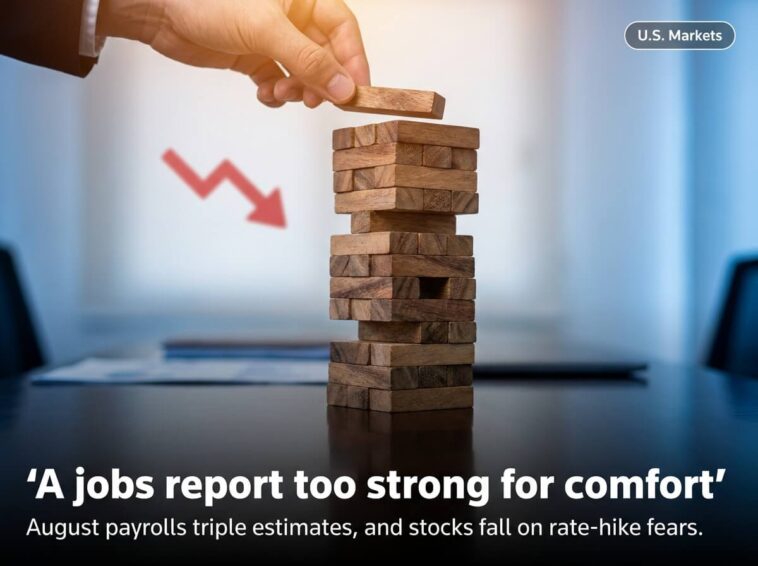
The August Jobs Report Crushed Estimates. Stocks Fell Anyway. Of Course They Did.
The August jobs report landed Friday morning with a number nobody saw coming. The U.S. economy added 162,000 jobs. Economists expected 55,000. Nearly triple the forecast.
The Dow fell 300 points.
By now, this pattern shouldn’t surprise anyone following markets this year. Good economic news, bad Fed-policy implications, bad stock reaction. Friday delivered it in its cleanest form yet. Unemployment held steady at 4.1%. Average hourly earnings grew 0.3%, right in line with expectations. This wasn’t a fluke number propped up by one sector. It was a genuinely strong report, arriving at the worst possible moment for anyone hoping the Fed had room to stay patient.
Why the August Jobs Report Sent Fed Hike Odds Sharply Higher
Here’s the whiplash worth understanding. Just one month ago, July’s jobs report showed a surprise loss, and traders spent weeks pricing in a dovish Fed response. Thursday, the market rallied hard, over a full percent across major indexes, partly on hopes that pattern would continue into September’s decision.
Friday erased that assumption almost instantly. Traders increased their bets on a September Fed rate hike to roughly 60% odds, according to CME Group data, a sharp jump from where expectations sat just twenty-four hours earlier.
“This is the cleanest whiplash we’ve seen all year, and that’s saying something given how volatile this summer’s been,” said Marcus Thorne, Head of Macro Strategy at a New York boutique advisory firm. “Thursday, the market rallied on hopes for a soft labor print and a Fed hold. Friday, it got the opposite of soft, a blowout number, and immediately started pricing meaningfully higher hike odds. The Fed’s September 16-17 meeting just got a lot more interesting. Weak July, strong August. That’s not a clean trend either direction. That’s exactly the kind of ambiguous data that makes a genuinely close call even closer.”
The sector reaction confirmed the read. Only three S&P sectors advanced Friday, technology, industrials, and utilities, while the broader index saw 199 holdings declining. That’s a market broadly repricing rate-sensitive exposure downward, not a narrow, single-stock story.
Individual names told their own version of the tension. Lululemon tanked 16% after cutting both revenue and profit guidance, with second-quarter revenue actually declining, a stark reminder that not every earnings story this season is about AI or rate expectations. Consumer discretionary weakness like that adds a genuine caution flag sitting alongside Friday’s otherwise robust labor data.
One under-the-radar detail worth flagging: planned job cuts in 2026 have fallen to their lowest level in four years, according to Challenger, Gray & Christmas data released Thursday, while hiring plans hit their highest mark since 2023. That’s a genuinely healthy underlying labor market, not a fragile one propped up by one strong month.
The Skeptic Who Says the Fed Reaction Is Overdone
Not every strategist thinks Friday’s hike-odds jump is the right read.
“We’re treating one strong jobs report like it settles the question. It doesn’t,” countered Elena Voss, senior equity strategist at a Chicago research shop. “Wage growth came in exactly in line with expectations, not accelerating. Unemployment held steady rather than falling. This is a report that shows a resilient labor market, not an overheating one. The Fed’s mandate weighs both inflation and employment. A single strong payrolls number, especially one following a negative print just a month earlier, shouldn’t be enough on its own to flip a genuinely data-dependent Fed toward hiking. I’d bet the September decision comes down to next week’s inflation data more than Friday’s jobs number.”
Voss raises a fair distinction. A jobs beat driven by genuine hiring strength, without accompanying wage acceleration, is a materially different signal than one paired with inflationary wage pressure. Friday’s report had the former, not clearly the latter.
What This Means for Your Portfolio
Here’s the practical takeaway from a week that swung from a blowout Thursday rally to a Friday reversal on genuinely good economic news.
This entire summer has demonstrated one consistent lesson: strong economic data doesn’t automatically mean a good day for stocks, if that same data pushes the Fed toward tighter policy. Retail investors watching the headline jobs number alone, without considering what it means for September’s rate decision, will keep getting whipsawed the way this market has been all year.
The practical move: watch next week’s inflation data as the real tiebreaker heading into the Fed’s September 16-17 meeting. A strong jobs report paired with cooling inflation gives the Fed room to hold despite Friday’s number. A strong jobs report paired with sticky or accelerating inflation makes a hike far more likely. Keep rate-sensitive sector exposure, growth stocks, small caps, anything trading heavily on future earnings, sized conservatively until that inflation data clarifies the picture. This market has proven all year it can reverse an entire week’s gains in a single session, once the data points in a different direction than the prevailing narrative assumed.