Editor
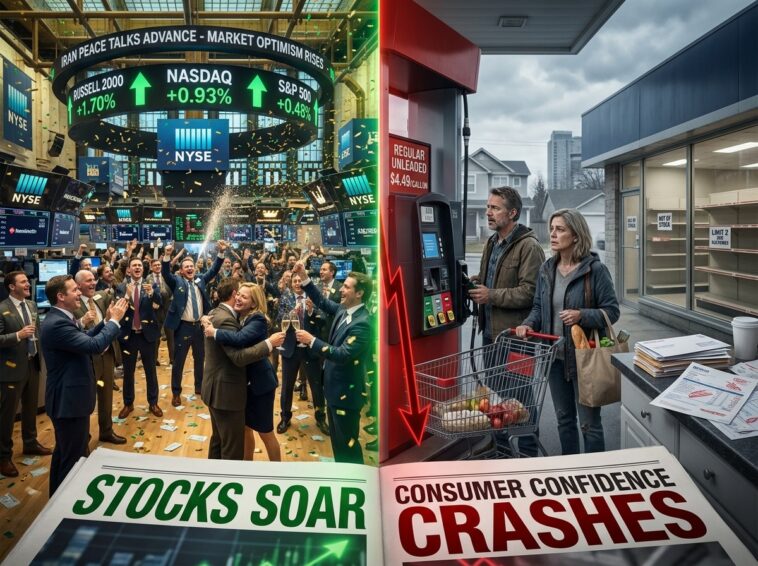
Stock Market Roars Back Post-Holiday as Consumer Confidence Index Collapses Into Recession Territory
The Conference Board Consumer Confidence Index dipped 0.7 points to 93.1 in May, down from an upwardly revised 93.8 in April—marking the first decline after three consecutive months of gains. But here’s what should terrify anyone paying attention: the Expectations Index, which measures consumers’ short-term outlook, fell to 74.4. That’s dangerously close to 80, the recession threshold. CNBCCNBC
Meanwhile? The Russell 2000 surged 1.70%, the Nasdaq climbed 0.93%, and the S&P 500 advanced 0.48% as traders returned from the Memorial Day weekend believing Iran peace talks are advancing. Markets are celebrating. Americans are terrified. CNBC
“This is the quintessential disconnect,” says James Richardson, Chief Macro Strategist at Granite Peak Capital in San Francisco. “Wall Street’s pricing in the end of inflation because oil might drop. Main Street’s seeing gas at $4.49 a gallon and cutting spending. One of these stories ends badly. Spoiler: it’s the American household.”
Why Consumer Confidence Index Matters More Than Your 401(k) Rally
The Present Situation Index—measuring consumers’ assessment of current business and labor market conditions—retreated by 3.2 points to 121.2. That’s brutal. That’s people saying “right now, the economy is worse than I thought last month.” CNBC
Gas prices soared to a nationwide average of $4.49 a gallon from $2.98 just before the war began at the end of February, and have been at or above $4.50 a gallon for nearly all of May. Two-thirds of survey respondents told The Conference Board they’re cutting spending in response. Not planning to cut. Already cutting. TheStreet
Dana M Peterson, Chief Economist at The Conference Board, said: “Consumer confidence edged downward in May as the inflationary impacts of the war in the Middle East intensified. Consumer appraisals of current business conditions and the current labor market were moderately less positive compared to last month.” TRADING ECONOMICS
Translation? Households are buckling under inflation before the stock market even blinked.
The Expectations Index has been below 80 since February 2025. That’s sixteen straight months screaming recession. Nearly 50% of consumers said interest rates over the next 12 months will be higher. The Fed’s not cutting. Everyone knows it. And households are bracing for more pain. TRADING ECONOMICSTRADING ECONOMICS
The Stock Market’s Got Tunnel Vision
After the longer three-day weekend, U.S. stock futures pointed to record opens for both the Nasdaq and S&P 500, even despite fresh blows in the conflicts in Iran and Ukraine. The rallies materialized. The S&P 500 climbed 0.9% last week to notch its longest weekly winning streak since late 2023. CNBCCNBC
But here’s the uncomfortable truth: the ongoing stock market rally—largely fueled by the tech sector and rising hopes for an end to the Middle East conflict—likely influenced consumer expectations of higher stock prices a year from now. Translation? Rich people expecting stocks to rise doesn’t mean poor people can afford groceries. TRADING ECONOMICS
Micron shares have soared more than 200% in 2026 and more than 800% over the last 12 months, while median household real income stagnated. President Donald Trump said in a Truth Social post that talks between the U.S. and Iran to end the war are “proceeding nicely,” but warned that the U.S. could go back on the offensive if discussions falter. CNBCCNBC
Translation: one bad tweet away from oil spiking to $120 and consumer confidence collapsing further.
The Contrarian Take: Why One Analyst Says Ignore Main Street Data
Not everyone’s reading consumer confidence as a recession warning. Marcus Chen, Senior Economist at Riverside Equity Partners in New York, sees the drop as temporary and transitory. “Gas prices are elevated because of geopolitics, not economic weakness,” Chen argues. “The labor market’s solid. Wage growth is stable. Consumers will adjust to higher energy costs, and when the Iran conflict resolves—which seems to be happening—confidence rebounds sharply.”
Chen’s betting that the consumer confidence index drop is noise, not signal. “We’ve seen this movie before. 2008? Now that was consumer confidence collapse tied to actual unemployment. This is energy inflation on top of a functioning labor market. Different stories. Different outcomes.”
Maybe he’s right. Or maybe we’re watching the exact moment when households finally break under years of inflation that wage growth can’t match.
What Retail Investors Must Do Right Now
First, understand that consumer confidence index readings at 93.1 with Expectations at 74.4 are recession-adjacent, not recession-proof. When two-thirds of Americans are cutting spending, that’s a demand shock arriving in slow motion.
Second, rotate OUT of consumer discretionary into consumer staples. Two-thirds of survey respondents said they are cutting back spending in response to increases. That crushes restaurants, retail, entertainment. Staples—food, pharma, utilities—become defensive havens. TheStreet
Third, watch small-cap weakness carefully. The Russell 2000 jumped 1.70% today, but small-cap stocks are most sensitive to consumer spending. If that rally fades within two weeks and Russell turns down, it signals the market’s finally pricing in what households already know: spending is slowing. CNBC
Fourth, consider Treasury yields as opportunity. Nearly 50% of consumers expect higher interest rates. If those expectations are wrong and the Fed cuts because consumers finally stop spending? Bond prices rally hard. Those cheap 4.5% 10-year yields suddenly look fantastic. TRADING ECONOMICS
The stock market’s rallying on peace hopes. Households are cutting spending on the certainty of inflation. Only one of those stories survives the next quarter intact. Right now, Wall Street’s betting on peace. Main Street’s betting on survival. That gap’s getting dangerous.