Editor
Dow Jones Record High Masks Deeper Cracks as Iran Peace Hopes Collide With Manufacturing Collapse
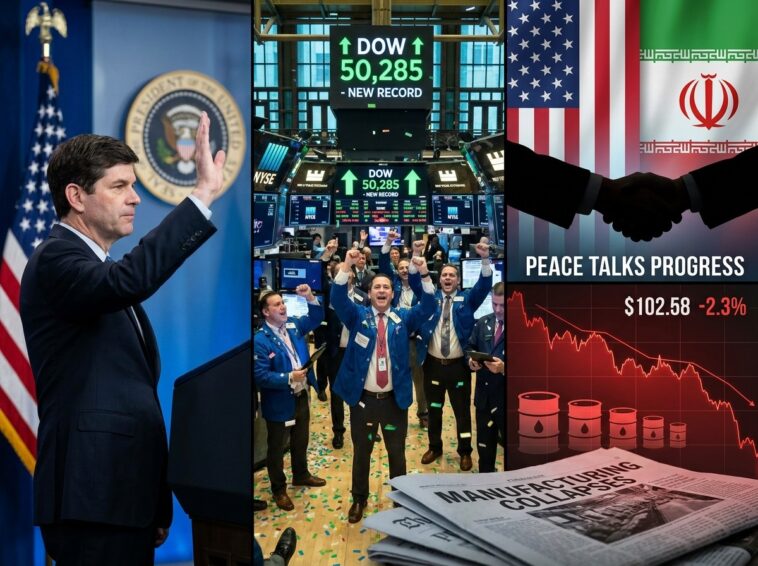
The Dow Jones record close hit 50,285.66 today, surging 276 points or 0.6%, as diplomatic signals from Washington and Tehran sparked hopes that the four-month Middle East conflict might finally end. At midday, the Dow was up over 400 points after setting a new intraday record, with Merck leading gains at 5.34%. CNBCTheStreet
Markets celebrated. Oil crashed. Brent crude futures settled at $102.58 per barrel, down $2.44 or 2.3%, while WTI crude closed at $96.35, falling $1.90 or 1.9%—the lowest levels in nearly two weeks. U.S. Secretary of State Marco Rubio said Thursday there were “good signs” emerging from negotiations, though Tehran’s enriched uranium stockpile and Strait of Hormuz tolls remain unresolved. CNBCTheStreet
But here’s what nobody’s talking about amid the Dow Jones record rally: the Philadelphia Fed manufacturing index crashed from 26.7 in April to -0.4 in May after rising four consecutive months. That’s not a slowdown. That’s contraction territory. That’s a recession signal screaming while everyone watches oil prices. CNBC
“The market’s pricing in peace dividends while ignoring the fact that domestic manufacturing just fell off a cliff,” warns Derek Harrison, Chief Economic Strategist at Riverside Capital in Boston. “You don’t go from 26.7 to negative without something fundamental breaking. The Iran optimism is masking serious economic weakness.”
Why Today’s Dow Jones Record Might Not Last
President Donald Trump led a ceremony swearing in Kevin Warsh as chair of the Federal Reserve this morning, handing the former investment banker control of a central bank navigating inflation above 3.5%, Treasury yields at 19-year highs, and now—apparently—contracting manufacturing activity. NYSE
Trump said he wanted Warsh to “just do your own thing and do a great job,” adding “I want Kevin to be totally independent”. Independent. Right. The same president who spent months pressuring Jerome Powell now expects markets to believe he’ll let Warsh operate autonomously while inflation rages and election season approaches. NYSE
For the week ended May 16, initial jobless claims came in at 209,000, a decrease of 3,000 from the previous week’s revised level. The labor market’s holding up—for now. But manufacturing doesn’t lead employment data, it follows. If factories are contracting in May, layoffs hit in June and July. CNBC
The S&P 500 is on pace for its eighth straight weekly advance, its strongest streak since 2023, powered largely by AI euphoria and geopolitical hope. About 52% of U.S. stocks were advancing midday—which means 48% weren’t. That’s not broad-based strength. That’s concentration risk dressed up as a Dow Jones record. 24/7 Wall St.TheStreet
Oil’s Collapse Changes Everything—If Peace Actually Holds
Here’s the math that matters for retail investors: U.S. drivers will pay gasoline prices near four-year highs when they fuel up for travel over the long Memorial Day weekend, with averages still near $4.50 nationally. But if Brent crude sustains a move below $100 and the Strait of Hormuz fully reopens, gas could drop to $3.80 within weeks. NYSE
That’s $700 annually back in the average household’s budget. That’s consumer spending power returning. That’s the Fed’s inflation problem potentially solving itself without rate hikes—precisely what Warsh needs on his first day running monetary policy.
“Peace in the Middle East doesn’t just lower oil—it resets the entire macro playbook,” says Patricia Nguyen, Senior Portfolio Manager at Summit Peak Advisors in Denver. “Inflation moderates. The Fed can hold steady instead of hiking. Growth stocks get re-rated higher because real rates decline. This isn’t just a one-day Dow Jones record—it’s potentially the inflection point for the entire second half of 2026.”
Maybe. Or maybe this is the fifth “Iran deal imminent” headline that evaporates within 72 hours, oil spikes back to $110, and the manufacturing contraction accelerates into full recession.
The Contrarian Case: Why One Analyst Says Sell the Rally
Marcus Chen, Head of Macro Strategy at Apex Capital Partners in New York, sees today’s Dow Jones record as a classic bull trap. “Everyone’s assuming peace is done because Rubio used the words ‘good signs,'” Chen argues. “Meanwhile, actual economic data—the Philly Fed number—just turned negative for the first time in five months. That’s not ‘soft landing.’ That’s hard stop.”
Chen’s prescription? Use today’s strength to reduce equity exposure and rotate into Treasuries. “The 10-year yield at 4.6% suddenly looks attractive if we’re headed into contraction. When manufacturing crashes and unemployment starts rising, the Fed cuts aggressively. Bond prices rally. Stocks don’t.”
The contrarian view hinges on one uncomfortable question: what if Iran talks collapse again, oil spikes to $120, and the manufacturing weakness accelerates? Then today’s Dow Jones record becomes the top, and Kevin Warsh’s first week as Fed Chair becomes a nightmare of stagflation—rising unemployment with persistent inflation.
What Retail Investors Should Do Right Now
First, understand that geopolitical optimism is not the same as geopolitical resolution. The two nations remain at odds over Tehran’s enriched uranium stockpile and tolls on the strategically vital Strait of Hormuz. Until those issues resolve, oil volatility persists. TheStreet
Second, watch manufacturing data obsessively over the next two months. The Philly Fed doesn’t crash from 26.7 to -0.4 without consequences. If ISM manufacturing follows into contraction territory next month, recession odds spike regardless of what happens in Iran.
Third, consider rebalancing into defensive positions. If oil collapses sustainably below $95, energy stocks get crushed—rotate out before the stampede. If manufacturing continues contracting, cyclicals and industrials face margin compression—financials and consumer staples offer safer harbors.
The Dow Jones record is real. The oil collapse is real. But so is that -0.4 manufacturing print. One of these signals is lying. By June, we’ll know which one.