Editor
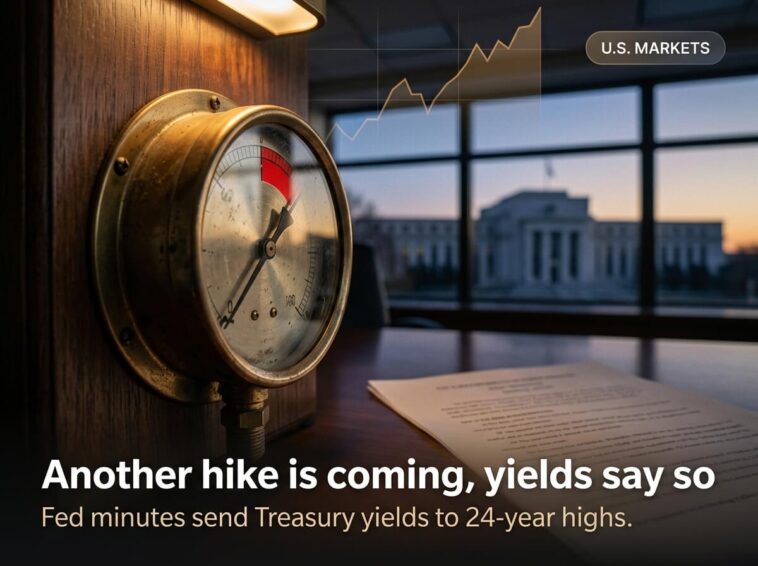
Fed Minutes Point to Another Rate Hike, and Bond Yields Just Hit a 24-Year High
The Fed minutes landed at 2 p.m. Eastern Wednesday, and they carried a message bond traders didn’t want to hear. Another rate hike is coming. Probably.
Stocks flinched. Not a rout, just a step back. The S&P 500 slipped 0.22% to 7,801.77, retreating from Tuesday’s record. The Nasdaq Composite lost the same 0.22%. The Dow fell 0.66%, and the small-cap Russell 2000 took the worst of it, down 1.31%. Bitcoin dropped below $83,000 as leveraged bets unwound.
But the real action was in Treasuries. Earlier in the day, before the minutes even printed, the 10-year yield touched 5.36%, its highest level since April 2002. The 30-year reached 5.73%, a peak not seen since May 2002. Both pulled back by the close, with the 30-year settling at 5.66% and the 10-year near 5.28%. Still brutal. Still two-decade territory.
What the Fed Minutes Really Told Wall Street
The document covers the September 15-16 meeting, where the Fed lifted rates by a quarter point, to a range of 3.75% to 4%. It was the central bank’s first hike in more than three years, and every participant backed it.
The key line came next. Most participants judged that another increase would likely be appropriate by year-end. No timeline. No promise. The minutes also stressed that officials approach each meeting with an open mind, and that future decisions depend on incoming data.
So, hawkish, but hedged.
Traders read it that way too. Futures put roughly 17% odds on a hike at the Fed’s October meeting next week, far below where they sat a couple of weeks ago, after softer jobs and inflation readings cooled the rhetoric from several policymakers. The Fed’s move? Likely patient in October. The direction? Still up.
“Everybody wanted to know how loud the hawks were, and the answer is: loud enough,” said Marcus Thorne, head of macro strategy at a New York boutique firm. “The committee isn’t in a hurry, but it isn’t finished either. That’s the worst combination for long bonds, because investors have to price a Fed that might hike again and a Treasury that keeps borrowing.”
Why Long-Term Yields Keep Climbing
Here’s the part the headlines miss. The Fed doesn’t control the long end of the curve, and the long end is where the pain sits.
The minutes themselves listed several pressures behind higher long-term yields. A stronger economy. Expectations for heavy AI-related borrowing. Geopolitical shocks. Even the Treasury’s buyback program and competition for capital from a flood of private debt issued to build AI infrastructure got a mention, since all of it pushes up the extra compensation investors demand for locking money away for a decade or more.
Fresh evidence arrived the same day. A Bloomberg report said SpaceX is looking to raise $40 billion in new debt to buy Nvidia chips. That’s one company asking bond buyers for more than the annual budget of some small countries. Add oil near $100 a barrel, with Brent bouncing on attacks around the Strait of Hormuz, and inflation worries don’t fade quietly.
Think of it as a crowded checkout line. Washington, corporations and AI builders all want cash at once. Lenders get to name their price.
And that price shows up everywhere. Mortgage rates. Business loans. The math behind every growth stock’s valuation, which shrinks when the discount rate rises.
The Skeptic: Stocks Aren’t Broken
Not everyone sees danger.
“The market is behaving like a market, not like a casualty,” said Priya Natarajan, senior equity strategist at a Boston research firm. “A 0.2% dip from a record isn’t a verdict. Third-quarter earnings season starts next week, profit forecasts keep rising, and bond yields have overshot Fed expectations before. If earnings land, equities can live with a 10-year near 5.3%.”
She has a point. Strong earnings estimates, mostly from AI giants, have powered the recent run. Yet that strength is narrow. Nvidia, Apple and Microsoft together make up roughly a fifth of the S&P 500, so a record index can hide a lot of ordinary stocks that aren’t keeping pace. Wednesday’s small-cap drop offered a hint.
Her view works only if earnings cooperate. Nobody can promise that.
What Retail Investors Should Do Now
Practical moves beat predictions here. Three come to mind.
First, check your bond duration. Long-term bond funds swing hard when yields jump, and they’ve been jumping for six weeks. Short-term Treasuries and T-bills now pay yields close to the Fed’s policy rate with far less price risk. For money you may need within a few years, that trade-off deserves a look.
Second, check what’s actually in your stock funds. If one index fund leaves a fifth of your money riding on three companies, you own a concentrated bet whether you meant to or not. Spreading across sectors and company sizes isn’t exciting. It’s protection.
Third, don’t treat the yield as a stock tip. A 5% or better Treasury is a real alternative to taking equity risk. That’s new for many investors who spent years with nowhere else to earn income. Decide how much safety you want before the market decides for you.
Rate-sensitive areas like small caps, real estate and unprofitable growth names tend to feel pressure first when long yields climb. That doesn’t mean sell them. It means know how much of your portfolio leans on cheap borrowing.
The Week Ahead
The Fed meets again next week, and a hike looks unlikely. What matters more is the tone. If officials sound ready to move in December, long-term yields could keep pushing higher whatever stocks do.
Earnings arrive soon after. Strong profits could keep the rally alive. Weak guidance would expose how much the market leans on a handful of names.
For now, the Fed minutes gave bond investors the last word on Wednesday. Stocks can ignore that for a while. They can’t ignore it forever.