Editor
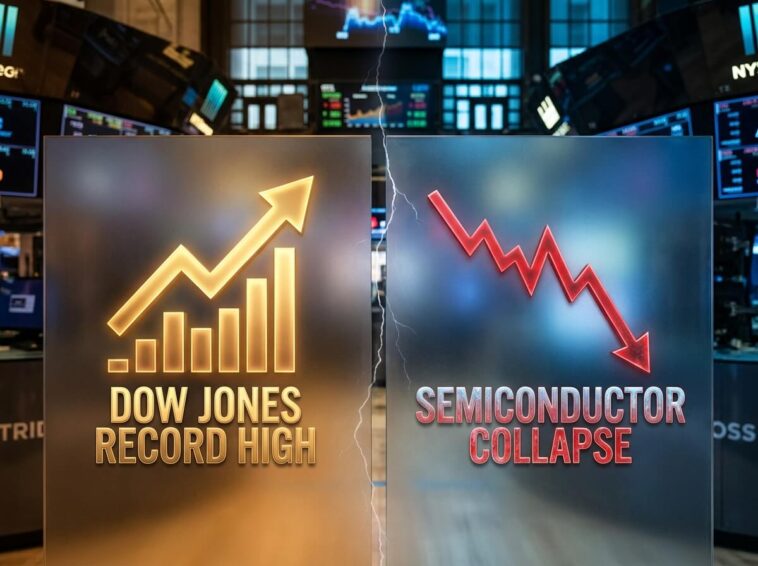
The June Jobs Report Just Broke the Market in Two
The June jobs report landed with a thud Thursday. Way below forecast. And Wall Street didn’t know whether to celebrate or panic.
The U.S. economy added just 57,000 jobs last month. Economists wanted 115,000. Half the number, basically. Yet the unemployment rate actually dipped, to 4.2% from 4.3%. Contradictory. Messy. Exactly the kind of data that makes traders reach for the antacids.
The Dow didn’t blink. It surged to a fresh record, north of 52,800, up more than 300 points. The S&P 500 sat near flat. The Nasdaq? Down over a percent, dragged lower by a chip sector that’s now bleeding for a second straight session.
Same data. Two completely different reactions. That’s the story.
Why the June Jobs Report Split the Market
Weak hiring usually means one thing to traders: the Fed cuts sooner. Cheaper money. Lower borrowing costs. Good for stocks, in theory.
“A print like this tells the Fed exactly what it needed to hear,” said Marcus Thorne, Head of Macro Strategy at a New York boutique advisory firm. “Fifty-seven thousand jobs isn’t a crisis. But it’s soft enough to open the door for a cut later this summer. The Dow’s reading that door as good news.”
Fed Chair Kevin Warsh, for his part, has been unusually blunt lately. He’s told markets, repeatedly, to stop waiting on him for signals. Watch the data instead. Well. The data just spoke. Loudly, and a little confusingly.
Old-economy names — industrials, financials, consumer staples — caught a bid. Chips did not. Micron and SanDisk are each down more than 20% over two trading days. Applied Materials shed 10% in a single session. The memory and semiconductor trade that powered the first half of 2026 is now unwinding, fast, and a soft jobs number didn’t stop the bleeding one bit.
The Counter-Narrative Nobody Wants to Hear
Not everyone thinks a weak labor market is bullish. Far from it.
“Everyone’s celebrating this as a rate-cut trigger. I’d be more careful,” said Elena Voss, senior equity strategist at a Chicago research shop. “Fifty-seven thousand jobs is a real slowdown, not a rounding error. If hiring keeps decelerating into fall, we’re not talking about a Fed cut anymore. We’re talking about earnings guidance getting cut. That’s a different market entirely.”
Voss has history on her side. Soft labor prints don’t always resolve into gentle rate cuts. Sometimes they’re the first crack before something worse.
What This Means for Your Portfolio
So what do you actually do with a jobs report this messy?
Don’t chase the Dow’s record high blindly. And don’t assume the chip selloff is over just because it’s been ugly for two days.
The practical takeaway ties straight back to sector rotation. When labor data softens and rate-cut odds rise, capital tends to flow out of the most expensive, most crowded trades — semiconductors have been exactly that in 2026 — and into steadier, cash-generating businesses. Industrials. Staples. Dividend payers. The stuff that doesn’t need a perfect economy to keep printing profit.
A simple gut-check for retail investors: if your portfolio is heavily concentrated in AI infrastructure names, ask whether you’re comfortable holding through more two-digit-percentage swings. Diversification isn’t exciting. It rarely is. But weeks like this one are exactly why it exists.
Markets close early Thursday, then shut Friday for the holiday. Traders get a three-day breather to think this through.
They’ll need it. The June jobs report didn’t just miss a number. It reopened the entire debate over where this economy — and this market — is actually headed.