Editor
Behind the Dow Jones Record High, a Market Coming Apart at the Seams
The Dow Jones hit a record high Thursday. Again. Up nearly 600 points, closing above 52,800 for the first time ever. Confetti-worthy, on paper.
Except nobody in the AI trade was celebrating.
Micron sank 7%. Applied Materials dropped over 7%. AMD fell more than 4%. And Tesla — despite reporting stronger-than-expected delivery numbers — got hammered for 7.5%. Strong news. Ugly stock reaction. That combination alone should tell you something’s off.
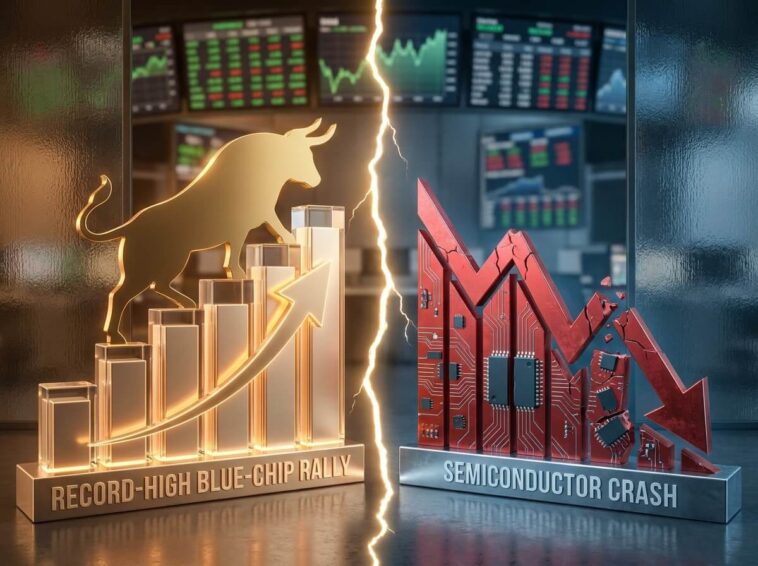
This wasn’t one market Thursday. It was two.
The Dow Jones Record High Nobody Trusts Yet
Old-economy names carried the load. Apple jumped nearly 5%. Walmart and Visa both climbed. McDonald’s, Disney — the boring, cash-flush stuff — did the heavy lifting while chipmakers got taken to the woodshed for a second straight session.
“You’re watching capital physically relocate,” said Marcus Thorne, Head of Macro Strategy at a New York boutique advisory firm. “It’s leaving anything priced on 2030 earnings and moving into companies making money right now. That’s not a crash. That’s a rotation. But it’s a violent one.”
The trigger? A softer-than-expected June jobs report pulled back rate-hike fears and pushed Treasury yields lower. Cheaper money helps steady, dividend-paying blue chips. It does less for speculative growth names already trading at nosebleed valuations.
Then came the headlines that really spooked chip investors. Reports surfaced that OpenAI is in early talks to sell a 5% stake to the U.S. government. Meta, separately, said it may start renting out its excess AI computing capacity — a tacit admission that it built more than it currently needs. Neither headline screams “insatiable AI demand.” Both raised an uncomfortable question: has the buildout gotten ahead of itself?
Micron, Marvell, Applied Materials, SanDisk. All of them have posted double-digit losses across two trading days. That’s not a dip. That’s a repricing.
The Skeptic Who Says Don’t Buy the Panic
Not everyone’s ready to call the AI trade broken.
“People are reading two rough sessions as the end of the story. It isn’t,” said Elena Voss, senior equity strategist at a Chicago research shop. “Capex guidance from the hyperscalers hasn’t budged. Microsoft’s still spending. Amazon’s still spending. A stock down 7% on no change in fundamentals is a valuation reset, not a verdict on the technology.”
Voss has a fair point, buried under the noise. Nasdaq futures actually rebounded more than 1% Friday, even with U.S. markets closed for the holiday. Korean memory giants SK Hynix and Samsung bounced too. The panic, if that’s what Thursday was, didn’t have much follow-through overseas.
What This Means for Your Portfolio
Here’s the practical lesson, and it’s not complicated.
When a market splits like this — record highs in one corner, double-digit chip carnage in the other — it’s usually a signal about valuation, not doom. The stocks getting hit hardest are the ones priced most aggressively for a perfect future. When yields wobble, or a single headline introduces doubt, those are the names that move first and move hardest.
For a retail investor, that argues for balance, not abandonment. Don’t dump your entire AI allocation because of two rough sessions. But don’t let it balloon into half your portfolio either, just because it’s been the hot hand all year.
A decent rule: if a single sector swing of 5-10% would meaningfully wreck your week, you’re overexposed. Trim it back. Park the difference somewhere boring — the Apples and Walmarts of the world — that just posted gains while the AI trade caught its breath.
The Dow’s record high is real. So is the chip selloff underneath it. Markets reopen Monday. Neither story is finished.