Editor
When Relief Trades Meet Reality: How a Geopolitical Thaw Just Rewrote the Market’s Script
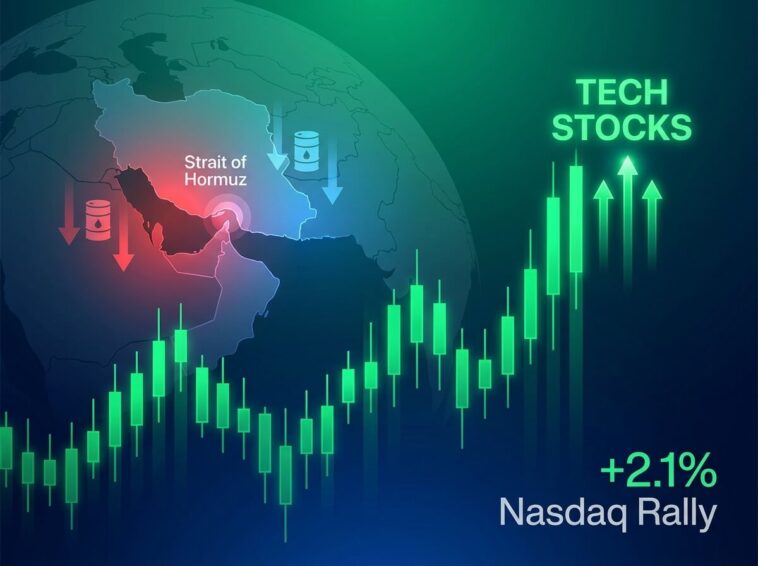
The Nasdaq rocketed 2.1% higher Monday as crude oil prices tumbled and U.S.-Iran hostilities finally—finally—appeared to genuinely pause. It was the kind of market day that reminds you why volatility exists: one week of death-defying strikes over the Strait of Hormuz had pinned tech stocks to the mat, and now they’re back. A tech rally and hopes for lasting peace in the Middle East helped lift sentiment across the board. Yahoo FinanceTheStreet
But here’s what keeps a veteran trader up at night: relief rallies are easy. Lasting ones are not.
The numbers tell the tale. The Dow Jones hit a new all-time high, jumping 0.6% to 52,182.74 points, while the S&P 500 gained 1.2% to close at 7,440.43 points. More tellingly, Communication Services climbed 3.1%, Consumer Discretionary jumped 2.7%, and the Information Technology sector gained 1.7%—meaning this wasn’t just a Magnificent Seven bounce. It was broad-based. Yahoo FinanceYahoo Finance
The Oil-Inflation-Fed Trifecta Breaking in Real Time
For months, the market has been strangled by a simple calculus: oil up, inflation sticky, Fed stays hawkish, growth stocks get crushed. Global oil prices have tumbled by around 20% from 2026 highs as investors have grown increasingly optimistic on prospects for a long-lasting ceasefire deal between the U.S. and Iran, which would unlock shipping through the Strait of Hormuz. CNBC
That’s not chump change. As of June 22, 2026, WTI stood at $73.61 per barrel, and Brent at $77.68 per barrel—down steeply from April’s panic peaks when Brent briefly pierced $118. The Strait of Hormuz, which carries 20% of global oil, went from being a geopolitical minefield to a potential transit corridor again. Plastics TodayZiro Market
And that changes everything for the inflation-sensitive playbook.
“This is a classic risk-off-to-risk-on transition,” says Marcus Thorne, Head of Macro Strategy at Veridian Capital Advisors, a New York-based boutique macro shop. “When oil falls 30-plus percent from its highs, the entire inflation narrative shifts. Suddenly, the Fed doesn’t need to stay as restrictive. Tech multiples aren’t facing the same yield headwind. You get a rebalancing moment.”
He’s right. But not everyone’s buying the permanence story.
The Skeptic’s Case: Fragile Isn’t Forever
Enter Dr. Rebecca Cho, Senior Geopolitical Economist at Stratford Research Group. She’s not convinced the ceasefire holds through Q4. “We’ve had three previous ‘final’ agreements since February,” she told me via email. “Each time, within two weeks, strikes resumed. The June 29 ceasefire? It’s real. But it’s also unstable. Treasury sanctions remain on Iran’s military oil apparatus, and there’s zero enforcement mechanism in the MOU. I’d be cautious betting the ranch on a structural oil repricing.”
She’s not alone in that view. Markets have already run ahead on optimism. Brent’s partial rebound reflects a market that had perhaps run too quickly on ceasefire optimism, as one IG analyst noted after fresh strikes. Al Jazeera
What This Means for Your Portfolio (The Real Investment Tip)
Here’s the practical play: The rotation happening right now isn’t just a tech bounce. It’s a repricing of sector dominance. 64% of S&P 500 stocks traded above their 50-day moving average, up from just 50% a month ago. That breadth tells you something crucial—the mega-cap tech concentration game is starting to crack. Charles Schwab
Alphabet (GOOG) surged 4.96% and Tesla (+8.45%) rebounded sharply, while Amazon (+3.18%) and Meta (+2.2%) also appreciated from the relief rally. But here’s where the sophistication comes in: Don’t overcommit to mega-cap tech just because they’re back in favor. TheStreet
The smarter move? Rebalance toward cyclicals and industrials if the geopolitical truce holds. Oil prices moving from $118 to $73 is disinflationary—that’s a green light for sectors that were crushed by high energy costs. But Cho’s caution matters: keep positions modular. A ceasefire is fragile. Hedge your bets until there’s enforcement teeth to this deal.
The best quarter in six years doesn’t have to be spoiled by a geopolitical flare-up in Q3. Read the headlines, watch the Strait, and don’t fall in love with any single narrative.
The market giveth, and the Strait of Hormuz taketh away.